

184
14 On the Plasticity Conditions of an Isotropic Body
τ max =
1
2
max [(σ 1 − σ 2 ), (σ 2 − σ 3 ), (σ 3 − σ 1 )] = K.
(14.10)
The parameter K in condition (14.10) is a constant value of the material. It does not
depend on the type of stressed state and is found experimentally. In particular, in the
case of uniaxial elongation, we have
σ 1 = σ s ; σ 2 = σ 3 = 0; τ max =
σ 1 − σ 3
2
=
σ s
2
= K.
(14.11)
In the second partial case, pure shear, we obtain as follows:
σ 1 = −σ 3 = τ max = τ s .
(14.12)
In this manner, for the plasticity condition of Tresca 1 , formulas (14.11) and (14.12)
result in
σ s = 2τ s .
(14.13)
Later, we will talk of compliance between dependency (14.13) and experimental
data (p. 186).
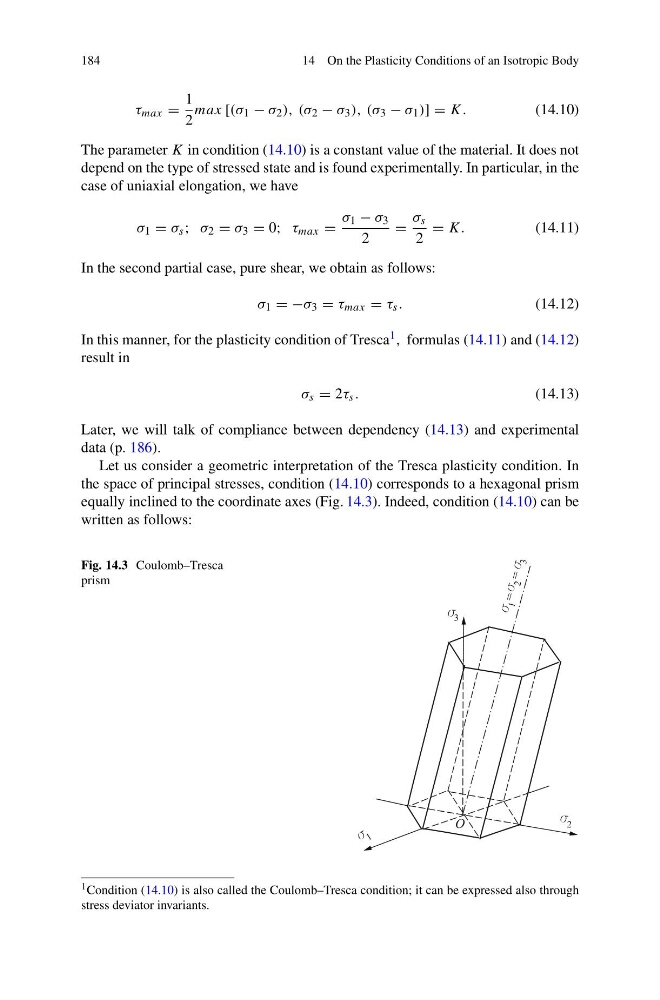
Let us consider a geometric interpretation of the Tresca plasticity condition. In
the space of principal stresses, condition (14.10) corresponds to a hexagonal prism
equally inclined to the coordinate axes (Fig. 14.3). Indeed, condition (14.10) can be
written as follows:
Fig. 14.3 Coulomb–Tresca
prism
1 Condition (14.10) is also called the Coulomb–Tresca condition; it can be expressed also through
stress deviator invariants.
14 On the Plasticity Conditions of an Isotropic Body
τ max =
1
2
max [(σ 1 − σ 2 ), (σ 2 − σ 3 ), (σ 3 − σ 1 )] = K.
(14.10)
The parameter K in condition (14.10) is a constant value of the material. It does not
depend on the type of stressed state and is found experimentally. In particular, in the
case of uniaxial elongation, we have
σ 1 = σ s ; σ 2 = σ 3 = 0; τ max =
σ 1 − σ 3
2
=
σ s
2
= K.
(14.11)
In the second partial case, pure shear, we obtain as follows:
σ 1 = −σ 3 = τ max = τ s .
(14.12)
In this manner, for the plasticity condition of Tresca 1 , formulas (14.11) and (14.12)
result in
σ s = 2τ s .
(14.13)
Later, we will talk of compliance between dependency (14.13) and experimental
data (p. 186).
Let us consider a geometric interpretation of the Tresca plasticity condition. In
the space of principal stresses, condition (14.10) corresponds to a hexagonal prism
equally inclined to the coordinate axes (Fig. 14.3). Indeed, condition (14.10) can be
written as follows:
Fig. 14.3 Coulomb–Tresca
prism
1 Condition (14.10) is also called the Coulomb–Tresca condition; it can be expressed also through
stress deviator invariants.