

186
14 On the Plasticity Conditions of an Isotropic Body
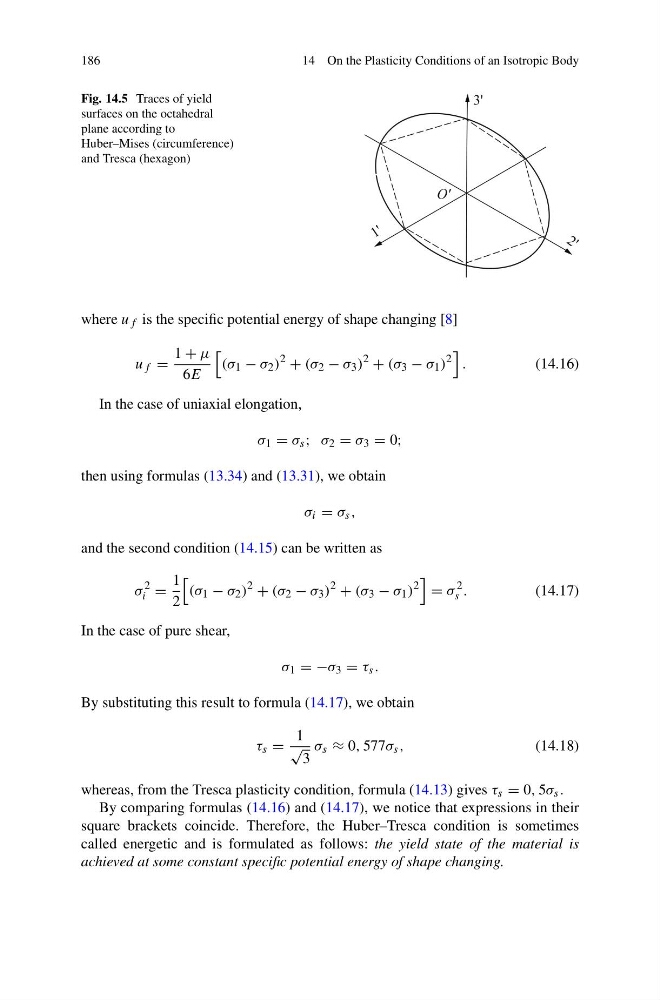
Fig. 14.5 Traces of yield
surfaces on the octahedral
plane according to
Huber–Mises (circumference)
and Tresca (hexagon)
where u f is the specific potential energy of shape changing [8]
u f =
1 + μ
6E
(σ 1 − σ 2 )
2
+ (σ 2 − σ 3 )
2
+ (σ 3 − σ 1 )
2
.
(14.16)
In the case of uniaxial elongation,
σ 1 = σ s ; σ 2 = σ 3 = 0;
then using formulas (13.34) and (13.31), we obtain
σ i = σ s ,
and the second condition (14.15) can be written as
σ
2
i =
1
2
(σ 1 − σ 2 )
2
+ (σ 2 − σ 3 )
2
+ (σ 3 − σ 1 )
2
= σ
2
s .
(14.17)
In the case of pure shear,
σ 1 = −σ 3 = τ s .
By substituting this result to formula (14.17), we obtain
τ s =
1
√
3
σ s ≈ 0, 577σ s ,
(14.18)
whereas, from the Tresca plasticity condition, formula (14.13) gives τ s = 0, 5σ s .
By comparing formulas (14.16) and (14.17), we notice that expressions in their
square brackets coincide. Therefore, the Huber–Tresca condition is sometimes
called energetic and is formulated as follows: the yield state of the material is
achieved at some constant specific potential energy of shape changing.
14 On the Plasticity Conditions of an Isotropic Body
Fig. 14.5 Traces of yield
surfaces on the octahedral
plane according to
Huber–Mises (circumference)
and Tresca (hexagon)
where u f is the specific potential energy of shape changing [8]
u f =
1 + μ
6E
(σ 1 − σ 2 )
2
+ (σ 2 − σ 3 )
2
+ (σ 3 − σ 1 )
2
.
(14.16)
In the case of uniaxial elongation,
σ 1 = σ s ; σ 2 = σ 3 = 0;
then using formulas (13.34) and (13.31), we obtain
σ i = σ s ,
and the second condition (14.15) can be written as
σ
2
i =
1
2
(σ 1 − σ 2 )
2
+ (σ 2 − σ 3 )
2
+ (σ 3 − σ 1 )
2
= σ
2
s .
(14.17)
In the case of pure shear,
σ 1 = −σ 3 = τ s .
By substituting this result to formula (14.17), we obtain
τ s =
1
√
3
σ s ≈ 0, 577σ s ,
(14.18)
whereas, from the Tresca plasticity condition, formula (14.13) gives τ s = 0, 5σ s .
By comparing formulas (14.16) and (14.17), we notice that expressions in their
square brackets coincide. Therefore, the Huber–Tresca condition is sometimes
called energetic and is formulated as follows: the yield state of the material is
achieved at some constant specific potential energy of shape changing.