

10.6 Somigliana Dislocation in Half-Plane
111
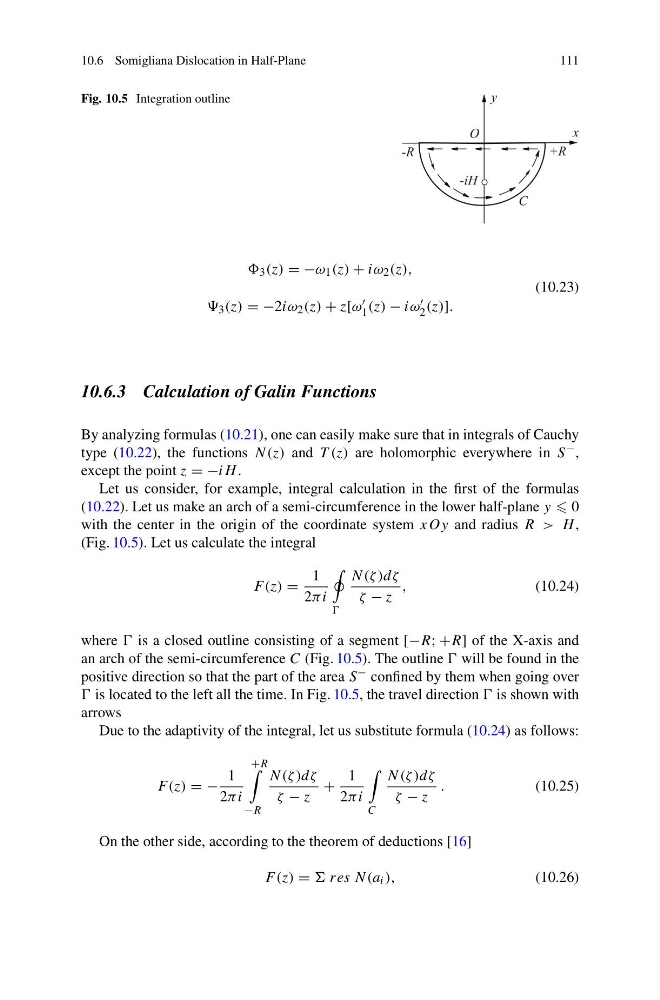
Fig. 10.5 Integration outline
3 (z) = −ω 1 (z) + iω 2 (z),
3 (z) = −2iω 2 (z) + z[ω
1 (z) − iω
2 (z)].
(10.23)
10.6.3 Calculation of Galin Functions
By analyzing formulas (10.21), one can easily make sure that in integrals of Cauchy
type (10.22), the functions N(z) and T (z) are holomorphic everywhere in S − ,
except the point z = −iH .
Let us consider, for example, integral calculation in the first of the formulas
(10.22). Let us make an arch of a semi-circumference in the lower half-plane y 0
with the center in the origin of the coordinate system xOy and radius R > H,
(Fig. 10.5). Let us calculate the integral
F (z) =
1
2πi
N(ζ )dζ
ζ − z
,
(10.24)
where is a closed outline consisting of a segment [−R; +R] of the X-axis and
an arch of the semi-circumference C (Fig. 10.5). The outline will be found in the
positive direction so that the part of the area S − confined by them when going over
is located to the left all the time. In Fig. 10.5, the travel direction is shown with
arrows
Due to the adaptivity of the integral, let us substitute formula (10.24) as follows:
F (z) = −
1
2πi
+R
−R
N(ζ )dζ
ζ − z
+
1
2πi
C
N(ζ )dζ
ζ − z
.
(10.25)
On the other side, according to the theorem of deductions [16]
F (z) = res N(a i ),
(10.26)
111
Fig. 10.5 Integration outline
3 (z) = −ω 1 (z) + iω 2 (z),
3 (z) = −2iω 2 (z) + z[ω
1 (z) − iω
2 (z)].
(10.23)
10.6.3 Calculation of Galin Functions
By analyzing formulas (10.21), one can easily make sure that in integrals of Cauchy
type (10.22), the functions N(z) and T (z) are holomorphic everywhere in S − ,
except the point z = −iH .
Let us consider, for example, integral calculation in the first of the formulas
(10.22). Let us make an arch of a semi-circumference in the lower half-plane y 0
with the center in the origin of the coordinate system xOy and radius R > H,
(Fig. 10.5). Let us calculate the integral
F (z) =
1
2πi
N(ζ )dζ
ζ − z
,
(10.24)
where is a closed outline consisting of a segment [−R; +R] of the X-axis and
an arch of the semi-circumference C (Fig. 10.5). The outline will be found in the
positive direction so that the part of the area S − confined by them when going over
is located to the left all the time. In Fig. 10.5, the travel direction is shown with
arrows
Due to the adaptivity of the integral, let us substitute formula (10.24) as follows:
F (z) = −
1
2πi
+R
−R
N(ζ )dζ
ζ − z
+
1
2πi
C
N(ζ )dζ
ζ − z
.
(10.25)
On the other side, according to the theorem of deductions [16]
F (z) = res N(a i ),
(10.26)