

110
10 Mathematical Structural Imperfections
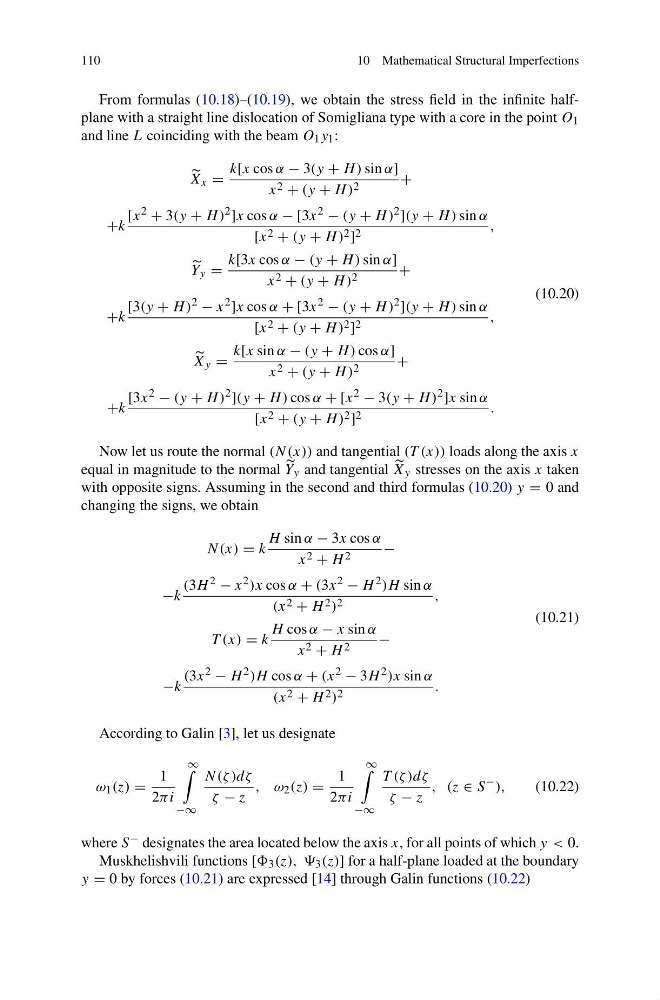
From formulas (10.18)–(10.19), we obtain the stress field in the infinite halfplane with a straight line dislocation of Somigliana type with a core in the point O 1
and line L coinciding with the beam O 1 y 1 :
X x =
k[x cos α − 3(y + H ) sin α]
x 2 + (y + H ) 2
+
+k
[x 2 + 3(y + H ) 2 ]x cos α − [3x 2 − (y + H ) 2 ](y + H ) sin α
[x 2 + (y + H ) 2 ] 2
,
Y y =
k[3x cos α − (y + H ) sin α]
x 2 + (y + H ) 2
+
+k
[3(y + H ) 2 − x 2 ]x cos α + [3x 2 − (y + H ) 2 ](y + H ) sin α
[x 2 + (y + H ) 2 ] 2
,
X y =
k[x sin α − (y + H ) cos α]
x 2 + (y + H ) 2
+
+k
[3x 2 − (y + H ) 2 ](y + H ) cos α + [x 2 − 3(y + H ) 2 ]x sin α
[x 2 + (y + H ) 2 ] 2
.
(10.20)
Now let us route the normal (N(x)) and tangential (T (x)) loads along the axis x
equal in magnitude to the normal
Y y and tangential
X y stresses on the axis x taken
with opposite signs. Assuming in the second and third formulas (10.20) y = 0 and
changing the signs, we obtain
N(x) = k
H sin α − 3x cos α
x 2 + H 2
−
−k
(3H 2 − x 2 )x cos α + (3x 2 − H 2 )H sin α
(x 2 + H 2 ) 2
,
T (x) = k
H cos α − x sin α
x 2 + H 2
−
−k
(3x 2 − H 2 )H cos α + (x 2 − 3H 2 )x sin α
(x 2 + H 2 ) 2
.
(10.21)
According to Galin [3], let us designate
ω 1 (z) =
1
2πi
∞
−∞
N(ζ )dζ
ζ − z
, ω 2 (z) =
1
2πi
∞
−∞
T (ζ )dζ
ζ − z
, (z ∈ S
− ),
(10.22)
where S − designates the area located below the axis x, for all points of which y < 0.
Muskhelishvili functions [ 3 (z), , 3 (z)] for a half-plane loaded at the boundary
y = 0 by forces (10.21) are expressed [14] through Galin functions (10.22)
10 Mathematical Structural Imperfections
From formulas (10.18)–(10.19), we obtain the stress field in the infinite halfplane with a straight line dislocation of Somigliana type with a core in the point O 1
and line L coinciding with the beam O 1 y 1 :
X x =
k[x cos α − 3(y + H ) sin α]
x 2 + (y + H ) 2
+
+k
[x 2 + 3(y + H ) 2 ]x cos α − [3x 2 − (y + H ) 2 ](y + H ) sin α
[x 2 + (y + H ) 2 ] 2
,
Y y =
k[3x cos α − (y + H ) sin α]
x 2 + (y + H ) 2
+
+k
[3(y + H ) 2 − x 2 ]x cos α + [3x 2 − (y + H ) 2 ](y + H ) sin α
[x 2 + (y + H ) 2 ] 2
,
X y =
k[x sin α − (y + H ) cos α]
x 2 + (y + H ) 2
+
+k
[3x 2 − (y + H ) 2 ](y + H ) cos α + [x 2 − 3(y + H ) 2 ]x sin α
[x 2 + (y + H ) 2 ] 2
.
(10.20)
Now let us route the normal (N(x)) and tangential (T (x)) loads along the axis x
equal in magnitude to the normal
Y y and tangential
X y stresses on the axis x taken
with opposite signs. Assuming in the second and third formulas (10.20) y = 0 and
changing the signs, we obtain
N(x) = k
H sin α − 3x cos α
x 2 + H 2
−
−k
(3H 2 − x 2 )x cos α + (3x 2 − H 2 )H sin α
(x 2 + H 2 ) 2
,
T (x) = k
H cos α − x sin α
x 2 + H 2
−
−k
(3x 2 − H 2 )H cos α + (x 2 − 3H 2 )x sin α
(x 2 + H 2 ) 2
.
(10.21)
According to Galin [3], let us designate
ω 1 (z) =
1
2πi
∞
−∞
N(ζ )dζ
ζ − z
, ω 2 (z) =
1
2πi
∞
−∞
T (ζ )dζ
ζ − z
, (z ∈ S
− ),
(10.22)
where S − designates the area located below the axis x, for all points of which y < 0.
Muskhelishvili functions [ 3 (z), , 3 (z)] for a half-plane loaded at the boundary
y = 0 by forces (10.21) are expressed [14] through Galin functions (10.22)