

92
9 Plane Problem of Elasticity Theory
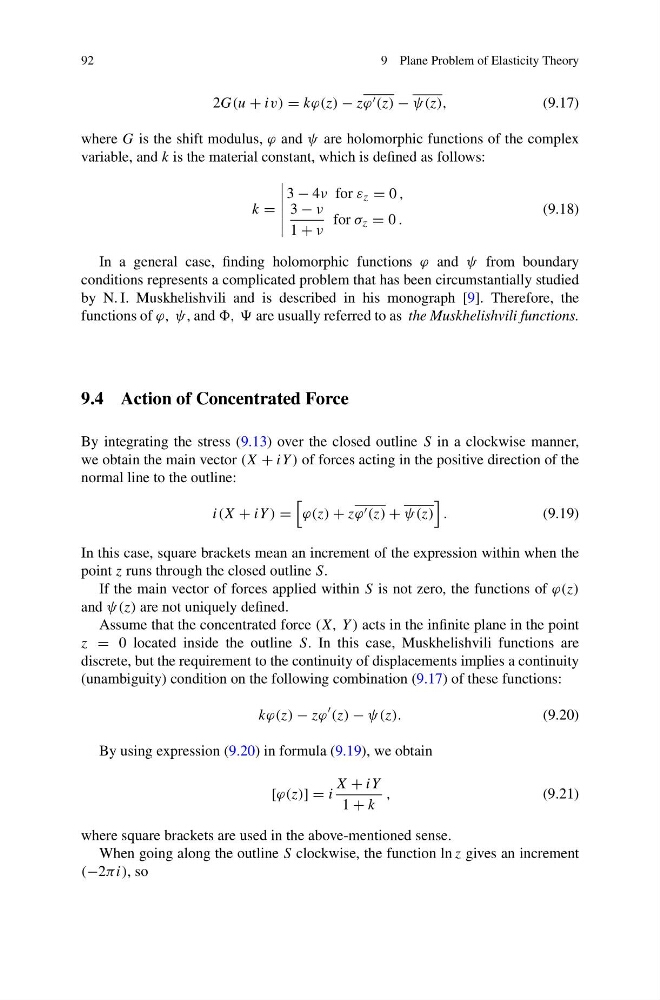
2G(u + iv) = kϕ(z) − zϕ (z) − ψ(z),
(9.17)
where G is the shift modulus, ϕ and ψ are holomorphic functions of the complex
variable, and k is the material constant, which is defined as follows:
k =
3 − 4ν for ε z = 0 ,
3 − ν
1 + ν
for σ z = 0 .
(9.18)
In a general case, finding holomorphic functions ϕ and ψ from boundary
conditions represents a complicated problem that has been circumstantially studied
by N. I. Muskhelishvili and is described in his monograph [9]. Therefore, the
functions of ϕ, ψ, and , , are usually referred to as the Muskhelishvili functions.
9.4 Action of Concentrated Force
By integrating the stress (9.13) over the closed outline S in a clockwise manner,
we obtain the main vector (X + iY ) of forces acting in the positive direction of the
normal line to the outline:
i(X + iY ) =
ϕ(z) + zϕ (z) + ψ(z)
.
(9.19)
In this case, square brackets mean an increment of the expression within when the
point z runs through the closed outline S.
If the main vector of forces applied within S is not zero, the functions of ϕ(z)
and ψ(z) are not uniquely defined.
Assume that the concentrated force (X, Y ) acts in the infinite plane in the point
z = 0 located inside the outline S. In this case, Muskhelishvili functions are
discrete, but the requirement to the continuity of displacements implies a continuity
(unambiguity) condition on the following combination (9.17) of these functions:
kϕ(z) − zϕ
(z) − ψ(z).
(9.20)
By using expression (9.20) in formula (9.19), we obtain
[ϕ(z)] = i
X + iY
1 + k
,
(9.21)
where square brackets are used in the above-mentioned sense.
When going along the outline S clockwise, the function ln z gives an increment
(−2πi), so
9 Plane Problem of Elasticity Theory
2G(u + iv) = kϕ(z) − zϕ (z) − ψ(z),
(9.17)
where G is the shift modulus, ϕ and ψ are holomorphic functions of the complex
variable, and k is the material constant, which is defined as follows:
k =
3 − 4ν for ε z = 0 ,
3 − ν
1 + ν
for σ z = 0 .
(9.18)
In a general case, finding holomorphic functions ϕ and ψ from boundary
conditions represents a complicated problem that has been circumstantially studied
by N. I. Muskhelishvili and is described in his monograph [9]. Therefore, the
functions of ϕ, ψ, and , , are usually referred to as the Muskhelishvili functions.
9.4 Action of Concentrated Force
By integrating the stress (9.13) over the closed outline S in a clockwise manner,
we obtain the main vector (X + iY ) of forces acting in the positive direction of the
normal line to the outline:
i(X + iY ) =
ϕ(z) + zϕ (z) + ψ(z)
.
(9.19)
In this case, square brackets mean an increment of the expression within when the
point z runs through the closed outline S.
If the main vector of forces applied within S is not zero, the functions of ϕ(z)
and ψ(z) are not uniquely defined.
Assume that the concentrated force (X, Y ) acts in the infinite plane in the point
z = 0 located inside the outline S. In this case, Muskhelishvili functions are
discrete, but the requirement to the continuity of displacements implies a continuity
(unambiguity) condition on the following combination (9.17) of these functions:
kϕ(z) − zϕ
(z) − ψ(z).
(9.20)
By using expression (9.20) in formula (9.19), we obtain
[ϕ(z)] = i
X + iY
1 + k
,
(9.21)
where square brackets are used in the above-mentioned sense.
When going along the outline S clockwise, the function ln z gives an increment
(−2πi), so