

9.5 Solution of the First Principal Problem for a Circle
93
ϕ(z) = A ln z ,
(9.22)
where
A = −
X + iY
2π(1 + k)
.
Taking into account the continuity of expression (9.20), we also find
ψ(z) = B ln z ,
(9.23)
where
B = k
X − iY
2π(1 + k)
.
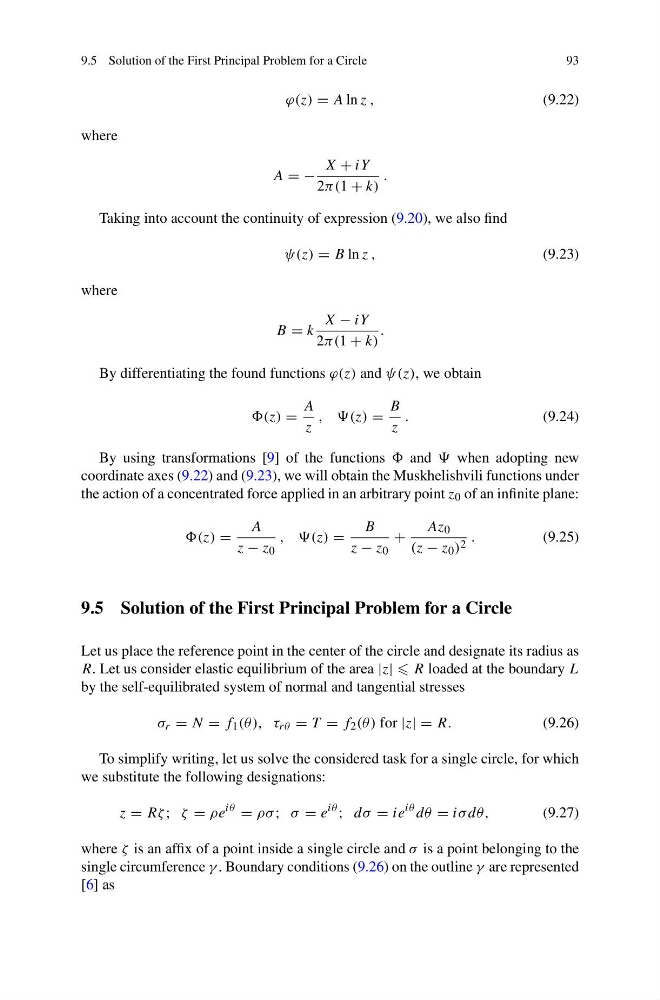
By differentiating the found functions ϕ(z) and ψ(z), we obtain
=
A
z
, ,(z) =
B
z
.
(9.24)
By using transformations [9] of the functions and when adopting new
coordinate axes (9.22) and (9.23), we will obtain the Muskhelishvili functions under
the action of a concentrated force applied in an arbitrary point z 0 of an infinite plane:
=
A
z − z 0
, ,(z) =
B
z − z 0
+
Az 0
(z − z 0 ) 2 .
(9.25)
9.5 Solution of the First Principal Problem for a Circle
Let us place the reference point in the center of the circle and designate its radius as
R. Let us consider elastic equilibrium of the area |z| R loaded at the boundary L
by the self-equilibrated system of normal and tangential stresses
σ r = N = f 1 (θ ), τ rθ = T = f 2 (θ ) for |z| = R.
(9.26)
To simplify writing, let us solve the considered task for a single circle, for which
we substitute the following designations:
z = Rζ ; ζ = ρe
iθ
= ρσ ; σ = e
iθ
; dσ = ie
iθ dθ = iσ dθ,
(9.27)
where ζ is an affix of a point inside a single circle and σ is a point belonging to the
single circumference γ . Boundary conditions (9.26) on the outline γ are represented
[6] as
93
ϕ(z) = A ln z ,
(9.22)
where
A = −
X + iY
2π(1 + k)
.
Taking into account the continuity of expression (9.20), we also find
ψ(z) = B ln z ,
(9.23)
where
B = k
X − iY
2π(1 + k)
.
By differentiating the found functions ϕ(z) and ψ(z), we obtain
=
A
z
, ,(z) =
B
z
.
(9.24)
By using transformations [9] of the functions and when adopting new
coordinate axes (9.22) and (9.23), we will obtain the Muskhelishvili functions under
the action of a concentrated force applied in an arbitrary point z 0 of an infinite plane:
=
A
z − z 0
, ,(z) =
B
z − z 0
+
Az 0
(z − z 0 ) 2 .
(9.25)
9.5 Solution of the First Principal Problem for a Circle
Let us place the reference point in the center of the circle and designate its radius as
R. Let us consider elastic equilibrium of the area |z| R loaded at the boundary L
by the self-equilibrated system of normal and tangential stresses
σ r = N = f 1 (θ ), τ rθ = T = f 2 (θ ) for |z| = R.
(9.26)
To simplify writing, let us solve the considered task for a single circle, for which
we substitute the following designations:
z = Rζ ; ζ = ρe
iθ
= ρσ ; σ = e
iθ
; dσ = ie
iθ dθ = iσ dθ,
(9.27)
where ζ is an affix of a point inside a single circle and σ is a point belonging to the
single circumference γ . Boundary conditions (9.26) on the outline γ are represented
[6] as