

9.3 Kolosov Displacement Integral
91
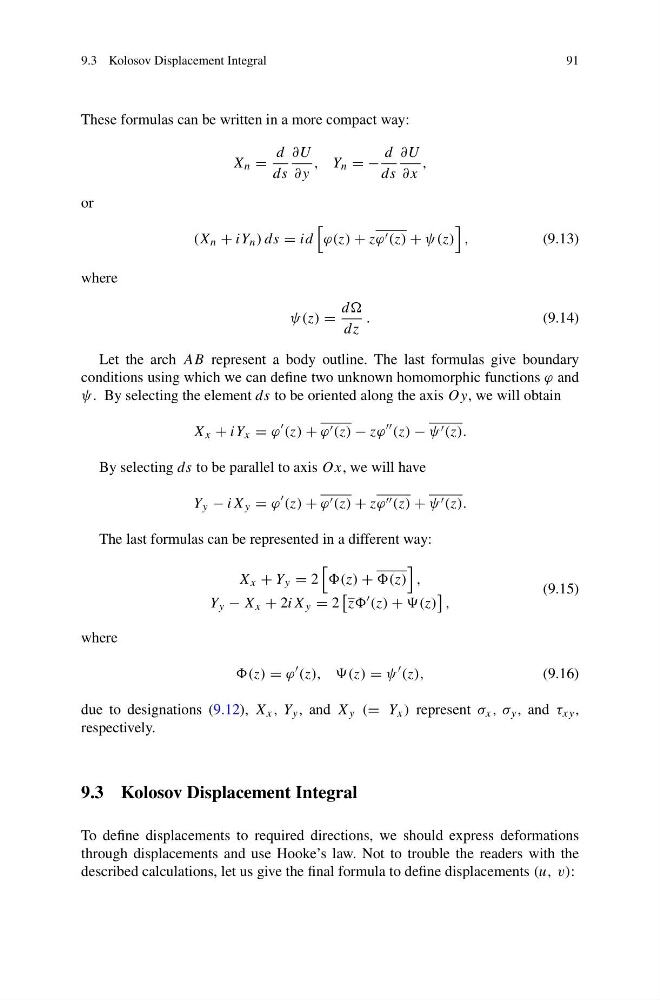
These formulas can be written in a more compact way:
X n =
d
ds
∂U
∂y
, Y n = −
d
ds
∂U
∂x
,
or
(X n + iY n ) ds = id
ϕ(z) + zϕ (z) + ψ(z)
,
(9.13)
where
ψ(z) =
dd
dz
.
(9.14)
Let the arch AB represent a body outline. The last formulas give boundary
conditions using which we can define two unknown homomorphic functions ϕ and
ψ. By selecting the element ds to be oriented along the axis Oy, we will obtain
X x + iY x = ϕ
(z) + ϕ (z) − zϕ
(z) − ψ (z).
By selecting ds to be parallel to axis Ox, we will have
Y y − iX y = ϕ
(z) + ϕ (z) + zϕ (z) + ψ (z).
The last formulas can be represented in a different way:
X x + Y y = 2
+
,
Y y − X x + 2iX y = 2
zz (z) + (z)
,
(9.15)
where
(z) = ϕ
(z), ,(z) = ψ
(z),
(9.16)
due to designations (9.12), X x , Y y , and X y (= Y x ) represent σ x , σ y , and τ xy ,
respectively.
9.3 Kolosov Displacement Integral
To define displacements to required directions, we should express deformations
through displacements and use Hooke’s law. Not to trouble the readers with the
described calculations, let us give the final formula to define displacements (u, v):
91
These formulas can be written in a more compact way:
X n =
d
ds
∂U
∂y
, Y n = −
d
ds
∂U
∂x
,
or
(X n + iY n ) ds = id
ϕ(z) + zϕ (z) + ψ(z)
,
(9.13)
where
ψ(z) =
dd
dz
.
(9.14)
Let the arch AB represent a body outline. The last formulas give boundary
conditions using which we can define two unknown homomorphic functions ϕ and
ψ. By selecting the element ds to be oriented along the axis Oy, we will obtain
X x + iY x = ϕ
(z) + ϕ (z) − zϕ
(z) − ψ (z).
By selecting ds to be parallel to axis Ox, we will have
Y y − iX y = ϕ
(z) + ϕ (z) + zϕ (z) + ψ (z).
The last formulas can be represented in a different way:
X x + Y y = 2
+
,
Y y − X x + 2iX y = 2
zz (z) + (z)
,
(9.15)
where
(z) = ϕ
(z), ,(z) = ψ
(z),
(9.16)
due to designations (9.12), X x , Y y , and X y (= Y x ) represent σ x , σ y , and τ xy ,
respectively.
9.3 Kolosov Displacement Integral
To define displacements to required directions, we should express deformations
through displacements and use Hooke’s law. Not to trouble the readers with the
described calculations, let us give the final formula to define displacements (u, v):