

8.6 Specific Potential Energy of Elastic Deformation
83
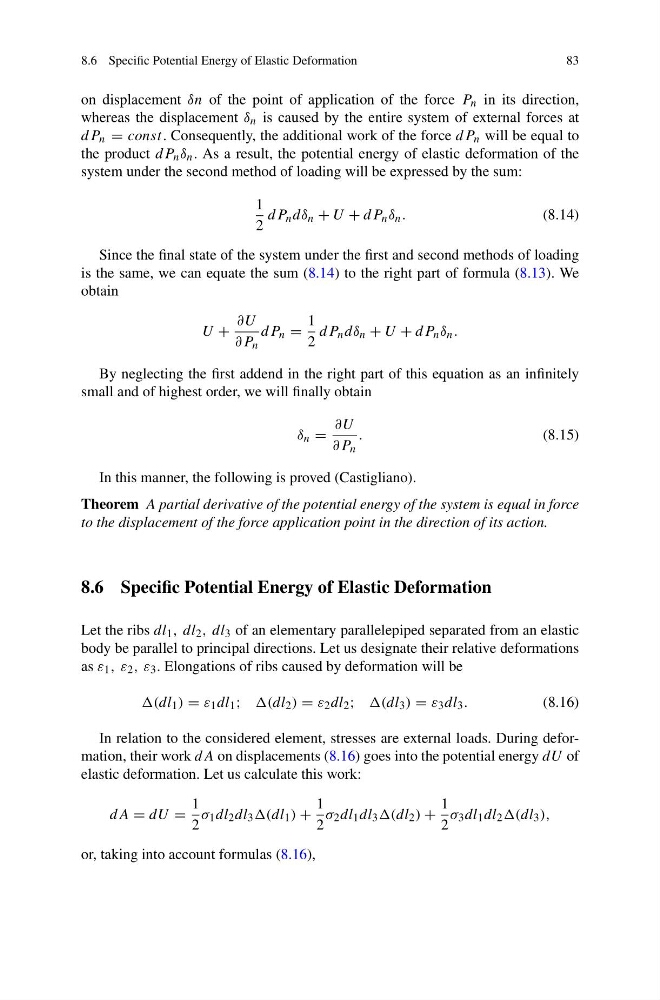
on displacement δn of the point of application of the force P n in its direction,
whereas the displacement δ n is caused by the entire system of external forces at
dP n = const. Consequently, the additional work of the force dP n will be equal to
the product dP n δ n . As a result, the potential energy of elastic deformation of the
system under the second method of loading will be expressed by the sum:
1
2
dP n dδ n + U + dP n δ n .
(8.14)
Since the final state of the system under the first and second methods of loading
is the same, we can equate the sum (8.14) to the right part of formula (8.13). We
obtain
U +
∂U
∂P n
dP n =
1
2
dP n dδ n + U + dP n δ n .
By neglecting the first addend in the right part of this equation as an infinitely
small and of highest order, we will finally obtain
δ n =
∂U
∂P n
.
(8.15)
In this manner, the following is proved (Castigliano).
Theorem A partial derivative of the potential energy of the system is equal in force
to the displacement of the force application point in the direction of its action.
8.6 Specific Potential Energy of Elastic Deformation
Let the ribs dl 1 , dl 2 , dl 3 of an elementary parallelepiped separated from an elastic
body be parallel to principal directions. Let us designate their relative deformations
as ε 1 , ε 2 , ε 3 . Elongations of ribs caused by deformation will be
(dl 1 ) = ε 1 dl 1 ; (dl 2 ) = ε 2 dl 2 ; (dl 3 ) = ε 3 dl 3 .
(8.16)
In relation to the considered element, stresses are external loads. During deformation, their work dA on displacements (8.16) goes into the potential energy dU of
elastic deformation. Let us calculate this work:
dA = dU =
1
2
σ 1 dl 2 dl 3 1 ) +
1
2
σ 2 dl 1 dl 3 (dl 2 ) +
1
2
σ 3 dl 1 dl 2 (dl 3 ),
or, taking into account formulas (8.16),
83
on displacement δn of the point of application of the force P n in its direction,
whereas the displacement δ n is caused by the entire system of external forces at
dP n = const. Consequently, the additional work of the force dP n will be equal to
the product dP n δ n . As a result, the potential energy of elastic deformation of the
system under the second method of loading will be expressed by the sum:
1
2
dP n dδ n + U + dP n δ n .
(8.14)
Since the final state of the system under the first and second methods of loading
is the same, we can equate the sum (8.14) to the right part of formula (8.13). We
obtain
U +
∂U
∂P n
dP n =
1
2
dP n dδ n + U + dP n δ n .
By neglecting the first addend in the right part of this equation as an infinitely
small and of highest order, we will finally obtain
δ n =
∂U
∂P n
.
(8.15)
In this manner, the following is proved (Castigliano).
Theorem A partial derivative of the potential energy of the system is equal in force
to the displacement of the force application point in the direction of its action.
8.6 Specific Potential Energy of Elastic Deformation
Let the ribs dl 1 , dl 2 , dl 3 of an elementary parallelepiped separated from an elastic
body be parallel to principal directions. Let us designate their relative deformations
as ε 1 , ε 2 , ε 3 . Elongations of ribs caused by deformation will be
(dl 1 ) = ε 1 dl 1 ; (dl 2 ) = ε 2 dl 2 ; (dl 3 ) = ε 3 dl 3 .
(8.16)
In relation to the considered element, stresses are external loads. During deformation, their work dA on displacements (8.16) goes into the potential energy dU of
elastic deformation. Let us calculate this work:
dA = dU =
1
2
σ 1 dl 2 dl 3 1 ) +
1
2
σ 2 dl 1 dl 3 (dl 2 ) +
1
2
σ 3 dl 1 dl 2 (dl 3 ),
or, taking into account formulas (8.16),