

82
8 Linear Elastic Systems
of the point of application of the second force in the direction of action of the first
single force.
8.5 Castigliano’s Theorem
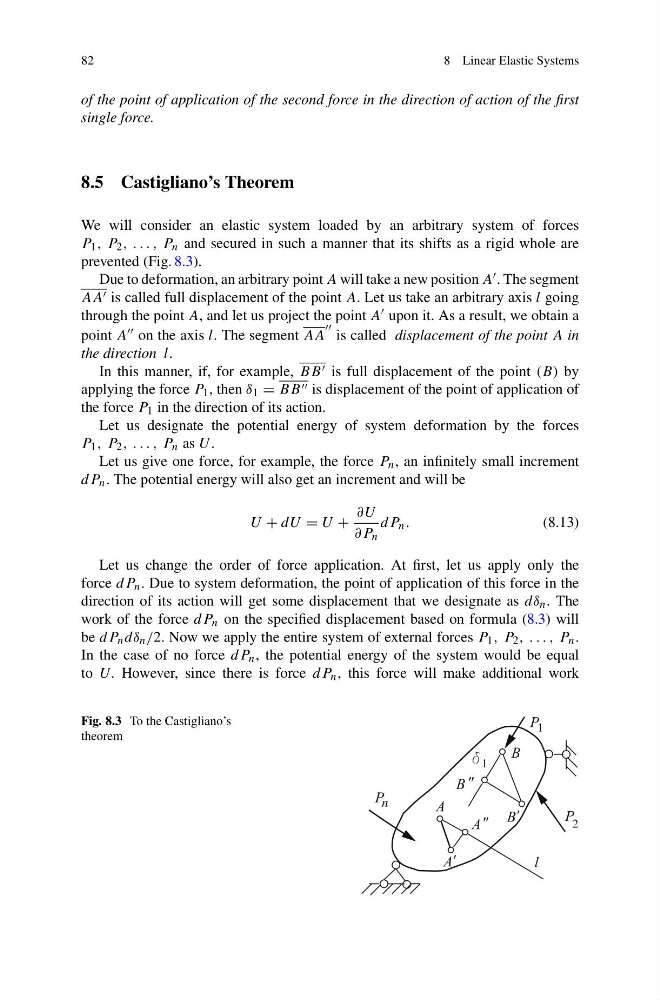
We will consider an elastic system loaded by an arbitrary system of forces
P 1 , P 2 , . . . , P n and secured in such a manner that its shifts as a rigid whole are
prevented (Fig. 8.3).
Due to deformation, an arbitrary point A will take a new position A . The segment
AA is called full displacement of the point A. Let us take an arbitrary axis l going
through the point A, and let us project the point A upon it. As a result, we obtain a
point A on the axis l. The segment AA
is called displacement of the point A in
the direction l.
In this manner, if, for example, BB is full displacement of the point (B) by
applying the force P 1 , then δ 1 = BB is displacement of the point of application of
the force P 1 in the direction of its action.
Let us designate the potential energy of system deformation by the forces
P 1 , P 2 , . . . , P n as U .
Let us give one force, for example, the force P n , an infinitely small increment
dP n . The potential energy will also get an increment and will be
U + dU = U +
∂U
∂P n
dP n .
(8.13)
Let us change the order of force application. At first, let us apply only the
force dP n . Due to system deformation, the point of application of this force in the
direction of its action will get some displacement that we designate as dδ n . The
work of the force dP n on the specified displacement based on formula (8.3) will
be dP n dδ n /2. Now we apply the entire system of external forces P 1 , P 2 , . . . , P n .
In the case of no force dP n , the potential energy of the system would be equal
to U. However, since there is force dP n , this force will make additional work
Fig. 8.3 To the Castigliano’s
theorem
8 Linear Elastic Systems
of the point of application of the second force in the direction of action of the first
single force.
8.5 Castigliano’s Theorem
We will consider an elastic system loaded by an arbitrary system of forces
P 1 , P 2 , . . . , P n and secured in such a manner that its shifts as a rigid whole are
prevented (Fig. 8.3).
Due to deformation, an arbitrary point A will take a new position A . The segment
AA is called full displacement of the point A. Let us take an arbitrary axis l going
through the point A, and let us project the point A upon it. As a result, we obtain a
point A on the axis l. The segment AA
is called displacement of the point A in
the direction l.
In this manner, if, for example, BB is full displacement of the point (B) by
applying the force P 1 , then δ 1 = BB is displacement of the point of application of
the force P 1 in the direction of its action.
Let us designate the potential energy of system deformation by the forces
P 1 , P 2 , . . . , P n as U .
Let us give one force, for example, the force P n , an infinitely small increment
dP n . The potential energy will also get an increment and will be
U + dU = U +
∂U
∂P n
dP n .
(8.13)
Let us change the order of force application. At first, let us apply only the
force dP n . Due to system deformation, the point of application of this force in the
direction of its action will get some displacement that we designate as dδ n . The
work of the force dP n on the specified displacement based on formula (8.3) will
be dP n dδ n /2. Now we apply the entire system of external forces P 1 , P 2 , . . . , P n .
In the case of no force dP n , the potential energy of the system would be equal
to U. However, since there is force dP n , this force will make additional work
Fig. 8.3 To the Castigliano’s
theorem