

84
8 Linear Elastic Systems
dU =
1
2
(σ 1 ε 1 + σ 2 ε 2 + σ 3 ε 3 ).
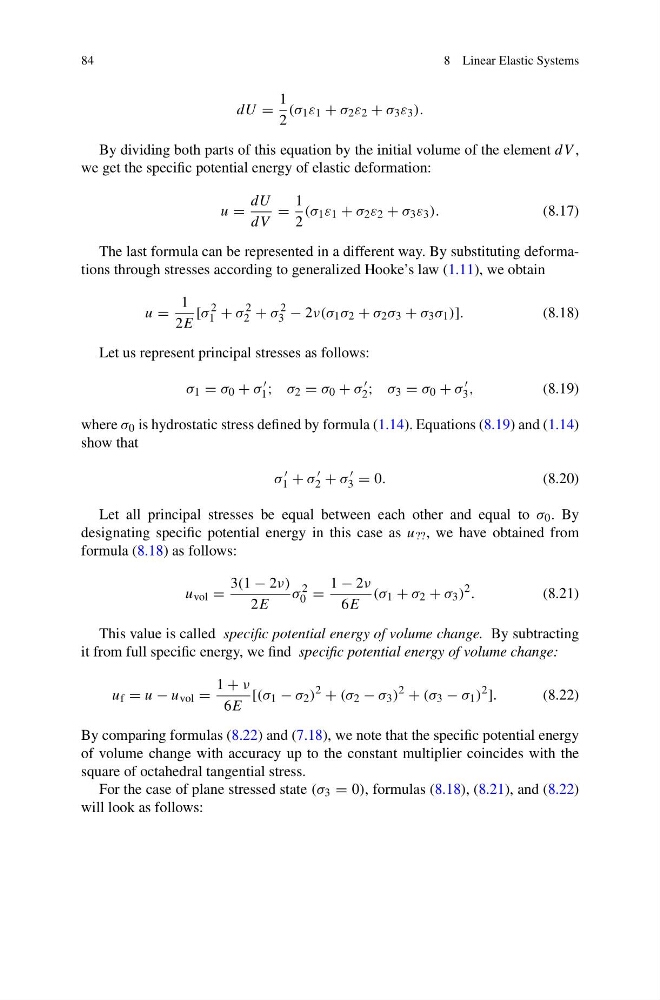
By dividing both parts of this equation by the initial volume of the element dV ,
we get the specific potential energy of elastic deformation:
u =
dU
dV
=
1
2
(σ 1 ε 1 + σ 2 ε 2 + σ 3 ε 3 ).
(8.17)
The last formula can be represented in a different way. By substituting deformations through stresses according to generalized Hooke’s law (1.11), we obtain
u =
1
2E
[σ
2
1 + σ
2
2 + σ
2
3 − 2ν(σ 1 σ 2 + σ 2 σ 3 + σ 3 σ 1 )].
(8.18)
Let us represent principal stresses as follows:
σ 1 = σ 0 + σ
1 ; σ 2 = σ 0 + σ
2 ; σ 3 = σ 0 + σ
3 ,
(8.19)
where σ 0 is hydrostatic stress defined by formula (1.14). Equations (8.19) and (1.14)
show that
σ
1 + σ
2 + σ
3 = 0.
(8.20)
Let all principal stresses be equal between each other and equal to σ 0 . By
designating specific potential energy in this case as u ?? , we have obtained from
formula (8.18) as follows:
u vol =
3(1 − 2ν)
2E
σ
2
0 =
1 − 2ν
6E
(σ 1 + σ 2 + σ 3 )
2 .
(8.21)
This value is called specific potential energy of volume change. By subtracting
it from full specific energy, we find specific potential energy of volume change:
u f = u − u vol =
1 + ν
6E
[(σ 1 − σ 2 )
2
+ (σ 2 − σ 3 )
2
+ (σ 3 − σ 1 )
2
].
(8.22)
By comparing formulas (8.22) and (7.18), we note that the specific potential energy
of volume change with accuracy up to the constant multiplier coincides with the
square of octahedral tangential stress.
For the case of plane stressed state (σ 3 = 0), formulas (8.18), (8.21), and (8.22)
will look as follows:
8 Linear Elastic Systems
dU =
1
2
(σ 1 ε 1 + σ 2 ε 2 + σ 3 ε 3 ).
By dividing both parts of this equation by the initial volume of the element dV ,
we get the specific potential energy of elastic deformation:
u =
dU
dV
=
1
2
(σ 1 ε 1 + σ 2 ε 2 + σ 3 ε 3 ).
(8.17)
The last formula can be represented in a different way. By substituting deformations through stresses according to generalized Hooke’s law (1.11), we obtain
u =
1
2E
[σ
2
1 + σ
2
2 + σ
2
3 − 2ν(σ 1 σ 2 + σ 2 σ 3 + σ 3 σ 1 )].
(8.18)
Let us represent principal stresses as follows:
σ 1 = σ 0 + σ
1 ; σ 2 = σ 0 + σ
2 ; σ 3 = σ 0 + σ
3 ,
(8.19)
where σ 0 is hydrostatic stress defined by formula (1.14). Equations (8.19) and (1.14)
show that
σ
1 + σ
2 + σ
3 = 0.
(8.20)
Let all principal stresses be equal between each other and equal to σ 0 . By
designating specific potential energy in this case as u ?? , we have obtained from
formula (8.18) as follows:
u vol =
3(1 − 2ν)
2E
σ
2
0 =
1 − 2ν
6E
(σ 1 + σ 2 + σ 3 )
2 .
(8.21)
This value is called specific potential energy of volume change. By subtracting
it from full specific energy, we find specific potential energy of volume change:
u f = u − u vol =
1 + ν
6E
[(σ 1 − σ 2 )
2
+ (σ 2 − σ 3 )
2
+ (σ 3 − σ 1 )
2
].
(8.22)
By comparing formulas (8.22) and (7.18), we note that the specific potential energy
of volume change with accuracy up to the constant multiplier coincides with the
square of octahedral tangential stress.
For the case of plane stressed state (σ 3 = 0), formulas (8.18), (8.21), and (8.22)
will look as follows: