

74
I. E. Ivanov et al.
∂(ρ Q 1 )
∂t
+
∂(ρu Q 1 )
∂ x
+
∂(ρvQ 1 )
∂ y
= r ∗ J + ˙
r ρ Q 0 −
ρ Q 1 v
y
(6.13)
∂(ρ Q 2 )
∂t
+
∂(ρu Q 2 )
∂ x
+
∂(ρvQ 2 )
∂ y
= r
2
∗ J + 2˙ r ρ Q 1 −
ρ Q 2 v
y
(6.14)
∂(ρα)
∂t
+
∂(ρuα)
∂ x
+
∂(ρvα)
∂ y
=
4
3
πρ l
r
3
∗ J + 3˙ r ρ Q 2
−
ρ Q 3 v
y
(6.15)
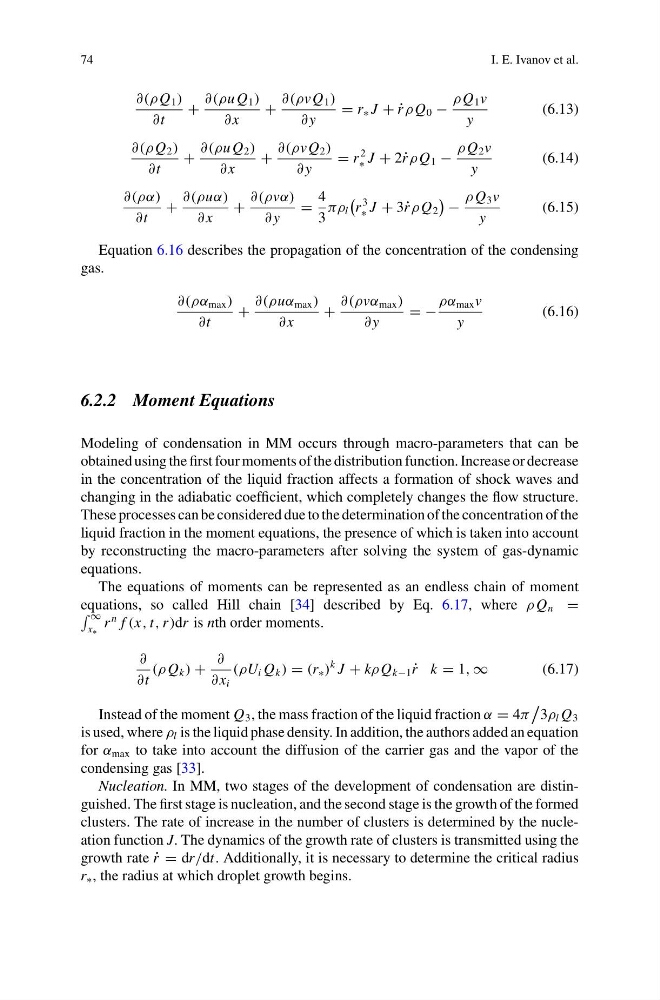
Equation 6.16 describes the propagation of the concentration of the condensing
gas.
∂(ρα max )
∂t
+
∂(ρuα max )
∂ x
+
∂(ρvα max )
∂ y
= −
ρα max v
y
(6.16)
6.2.2 Moment Equations
Modeling of condensation in MM occurs through macro-parameters that can be
obtained using the first four moments of the distribution function. Increase or decrease
in the concentration of the liquid fraction affects a formation of shock waves and
changing in the adiabatic coefficient, which completely changes the flow structure.
These processes can be considered due to the determination of the concentration of the
liquid fraction in the moment equations, the presence of which is taken into account
by reconstructing the macro-parameters after solving the system of gas-dynamic
equations.
The equations of moments can be represented as an endless chain of moment
equations, so called Hill chain [34] described by Eq. 6.17, where ρ Q n =
∞
x ∗
r
n f (x, t, r )dr is nth order moments.
∂
∂t
(ρ Q k ) +
∂
∂ x i
(ρU i Q k ) = (r ∗ )
k J + kρ Q k−1 ˙
r k = 1, ∞
(6.17)
Instead of the moment Q 3 , the mass fraction of the liquid fraction α = 4π
3ρ l Q 3
is used, where ρ l is the liquid phase density. In addition, the authors added an equation
for α max to take into account the diffusion of the carrier gas and the vapor of the
condensing gas [33].
Nucleation. In MM, two stages of the development of condensation are distinguished. The first stage is nucleation, and the second stage is the growth of the formed
clusters. The rate of increase in the number of clusters is determined by the nucleation function J. The dynamics of the growth rate of clusters is transmitted using the
growth rate ˙
r = dr/dt. Additionally, it is necessary to determine the critical radius
r ∗ , the radius at which droplet growth begins.
I. E. Ivanov et al.
∂(ρ Q 1 )
∂t
+
∂(ρu Q 1 )
∂ x
+
∂(ρvQ 1 )
∂ y
= r ∗ J + ˙
r ρ Q 0 −
ρ Q 1 v
y
(6.13)
∂(ρ Q 2 )
∂t
+
∂(ρu Q 2 )
∂ x
+
∂(ρvQ 2 )
∂ y
= r
2
∗ J + 2˙ r ρ Q 1 −
ρ Q 2 v
y
(6.14)
∂(ρα)
∂t
+
∂(ρuα)
∂ x
+
∂(ρvα)
∂ y
=
4
3
πρ l
r
3
∗ J + 3˙ r ρ Q 2
−
ρ Q 3 v
y
(6.15)
Equation 6.16 describes the propagation of the concentration of the condensing
gas.
∂(ρα max )
∂t
+
∂(ρuα max )
∂ x
+
∂(ρvα max )
∂ y
= −
ρα max v
y
(6.16)
6.2.2 Moment Equations
Modeling of condensation in MM occurs through macro-parameters that can be
obtained using the first four moments of the distribution function. Increase or decrease
in the concentration of the liquid fraction affects a formation of shock waves and
changing in the adiabatic coefficient, which completely changes the flow structure.
These processes can be considered due to the determination of the concentration of the
liquid fraction in the moment equations, the presence of which is taken into account
by reconstructing the macro-parameters after solving the system of gas-dynamic
equations.
The equations of moments can be represented as an endless chain of moment
equations, so called Hill chain [34] described by Eq. 6.17, where ρ Q n =
∞
x ∗
r
n f (x, t, r )dr is nth order moments.
∂
∂t
(ρ Q k ) +
∂
∂ x i
(ρU i Q k ) = (r ∗ )
k J + kρ Q k−1 ˙
r k = 1, ∞
(6.17)
Instead of the moment Q 3 , the mass fraction of the liquid fraction α = 4π
3ρ l Q 3
is used, where ρ l is the liquid phase density. In addition, the authors added an equation
for α max to take into account the diffusion of the carrier gas and the vapor of the
condensing gas [33].
Nucleation. In MM, two stages of the development of condensation are distinguished. The first stage is nucleation, and the second stage is the growth of the formed
clusters. The rate of increase in the number of clusters is determined by the nucleation function J. The dynamics of the growth rate of clusters is transmitted using the
growth rate ˙
r = dr/dt. Additionally, it is necessary to determine the critical radius
r ∗ , the radius at which droplet growth begins.