

6 The Investigation of the Evolution of Cluster Beam …
75
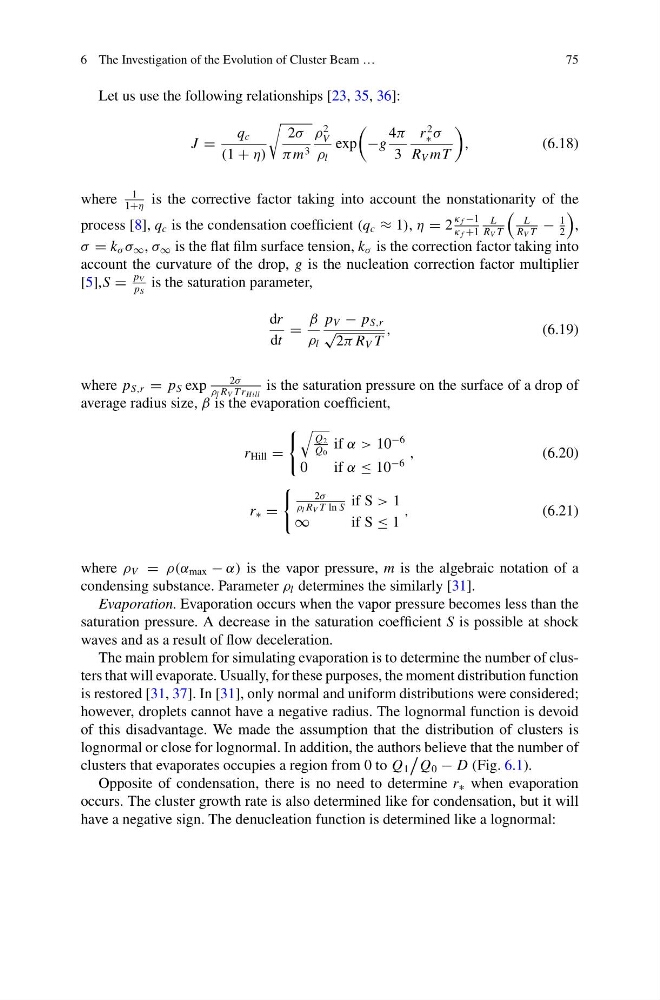
Let us use the following relationships [23, 35, 36]:
J =
q c
(1 + η)
2σ
π m 3
ρ
2
V
ρ l
exp
−g
4π
3
r
2
∗ σ
R V mT
,
(6.18)
where
1
1+η
is the corrective factor taking into account the nonstationarity of the
process [8], q c is the condensation coefficient (q c ≈ 1), η = 2
κ f −1
κ f +1
L
R V T
L
R V T
−
1
2
,
σ = k σ σ ∞ , σ ∞ is the flat film surface tension, k σ is the correction factor taking into
account the curvature of the drop, g is the nucleation correction factor multiplier
[5],S =
p V
p S
is the saturation parameter,
dr
dt
=
β
ρ l
p V − p S,r
√
2π R V T
,
(6.19)
where p S,r = p S exp
2σ
ρ l R V T r Hill
is the saturation pressure on the surface of a drop of
average radius size, β is the evaporation coefficient,
r Hill =
Q 2
Q 0
if α > 10
−6
0
ifα ≤ 10
−6
,
(6.20)
r ∗ =
2σ
ρ l R V T ln S
if S > 1
∞
if S ≤ 1
,
(6.21)
where ρ V = ρ(α max − α) is the vapor pressure, m is the algebraic notation of a
condensing substance. Parameter ρ l determines the similarly [31].
Evaporation. Evaporation occurs when the vapor pressure becomes less than the
saturation pressure. A decrease in the saturation coefficient S is possible at shock
waves and as a result of flow deceleration.
The main problem for simulating evaporation is to determine the number of clusters that will evaporate. Usually, for these purposes, the moment distribution function
is restored [31, 37]. In [31], only normal and uniform distributions were considered;
however, droplets cannot have a negative radius. The lognormal function is devoid
of this disadvantage. We made the assumption that the distribution of clusters is
lognormal or close for lognormal. In addition, the authors believe that the number of
clusters that evaporates occupies a region from 0 to Q 1
Q 0 − D (Fig. 6.1).
Opposite of condensation, there is no need to determine r ∗ when evaporation
occurs. The cluster growth rate is also determined like for condensation, but it will
have a negative sign. The denucleation function is determined like a lognormal:
75
Let us use the following relationships [23, 35, 36]:
J =
q c
(1 + η)
2σ
π m 3
ρ
2
V
ρ l
exp
−g
4π
3
r
2
∗ σ
R V mT
,
(6.18)
where
1
1+η
is the corrective factor taking into account the nonstationarity of the
process [8], q c is the condensation coefficient (q c ≈ 1), η = 2
κ f −1
κ f +1
L
R V T
L
R V T
−
1
2
,
σ = k σ σ ∞ , σ ∞ is the flat film surface tension, k σ is the correction factor taking into
account the curvature of the drop, g is the nucleation correction factor multiplier
[5],S =
p V
p S
is the saturation parameter,
dr
dt
=
β
ρ l
p V − p S,r
√
2π R V T
,
(6.19)
where p S,r = p S exp
2σ
ρ l R V T r Hill
is the saturation pressure on the surface of a drop of
average radius size, β is the evaporation coefficient,
r Hill =
Q 2
Q 0
if α > 10
−6
0
ifα ≤ 10
−6
,
(6.20)
r ∗ =
2σ
ρ l R V T ln S
if S > 1
∞
if S ≤ 1
,
(6.21)
where ρ V = ρ(α max − α) is the vapor pressure, m is the algebraic notation of a
condensing substance. Parameter ρ l determines the similarly [31].
Evaporation. Evaporation occurs when the vapor pressure becomes less than the
saturation pressure. A decrease in the saturation coefficient S is possible at shock
waves and as a result of flow deceleration.
The main problem for simulating evaporation is to determine the number of clusters that will evaporate. Usually, for these purposes, the moment distribution function
is restored [31, 37]. In [31], only normal and uniform distributions were considered;
however, droplets cannot have a negative radius. The lognormal function is devoid
of this disadvantage. We made the assumption that the distribution of clusters is
lognormal or close for lognormal. In addition, the authors believe that the number of
clusters that evaporates occupies a region from 0 to Q 1
Q 0 − D (Fig. 6.1).
Opposite of condensation, there is no need to determine r ∗ when evaporation
occurs. The cluster growth rate is also determined like for condensation, but it will
have a negative sign. The denucleation function is determined like a lognormal: