

268
N. M. Kuzmina and A. N. Ridley
⎧
⎪ ⎪ ⎪ ⎪ ⎪ ⎨
⎪ ⎪ ⎪ ⎪ ⎪ ⎩
¯
r
B
i j = g
B
i j ·
¯
r
T ∗
i j − h × y i j
¯
w
B
i = ¯
w
T
i + h × u i
min
i, j
¯
r
B
i j = 0
h → max
(18.7)
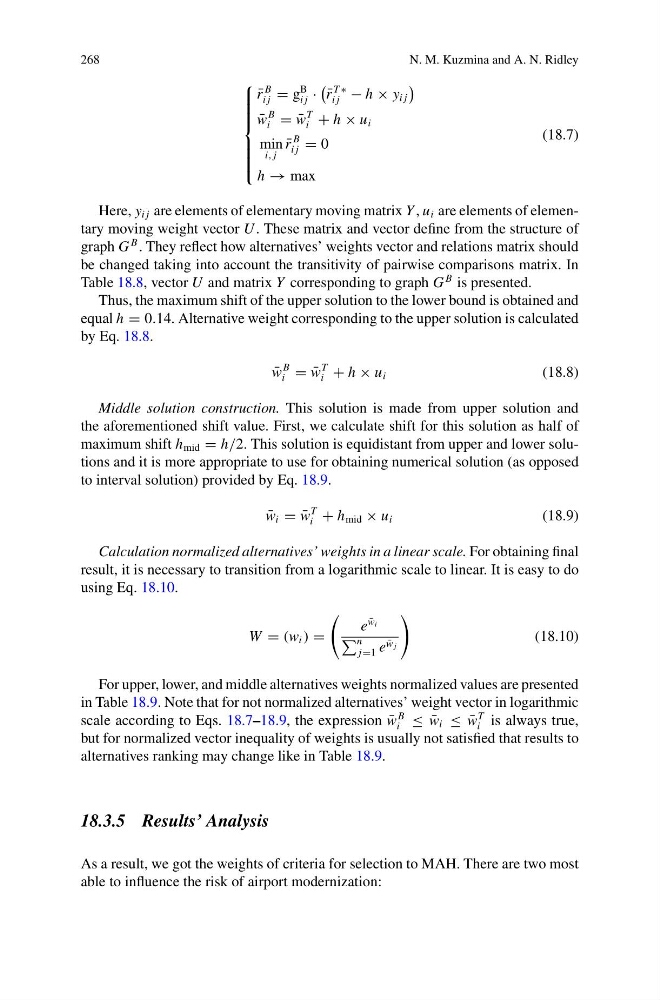
Here, y i j are elements of elementary moving matrix Y , u i are elements of elementary moving weight vector U . These matrix and vector define from the structure of
graph G
B . They reflect how alternatives’ weights vector and relations matrix should
be changed taking into account the transitivity of pairwise comparisons matrix. In
Table 18.8, vector U and matrix Y corresponding to graph G
B is presented.
Thus, the maximum shift of the upper solution to the lower bound is obtained and
equal h = 0.14. Alternative weight corresponding to the upper solution is calculated
by Eq. 18.8.
¯
w
B
i = ¯
w
T
i + h × u i
(18.8)
Middle solution construction. This solution is made from upper solution and
the aforementioned shift value. First, we calculate shift for this solution as half of
maximum shift h mid = h/2. This solution is equidistant from upper and lower solutions and it is more appropriate to use for obtaining numerical solution (as opposed
to interval solution) provided by Eq. 18.9.
¯
w i = ¯
w
T
i + h mid × u i
(18.9)
Calculation normalized alternatives’ weights in a linear scale. For obtaining final
result, it is necessary to transition from a logarithmic scale to linear. It is easy to do
using Eq. 18.10.
W = (w i ) =
e
¯
w i
n
j=1 e ¯
w j
(18.10)
For upper, lower, and middle alternatives weights normalized values are presented
in Table 18.9. Note that for not normalized alternatives’ weight vector in logarithmic
scale according to Eqs. 18.7–18.9, the expression ¯
w
B
i ≤ ¯
w i ≤ ¯
w
T
i is always true,
but for normalized vector inequality of weights is usually not satisfied that results to
alternatives ranking may change like in Table 18.9.
18.3.5 Results’ Analysis
As a result, we got the weights of criteria for selection to MAH. There are two most
able to influence the risk of airport modernization:
N. M. Kuzmina and A. N. Ridley
⎧
⎪ ⎪ ⎪ ⎪ ⎪ ⎨
⎪ ⎪ ⎪ ⎪ ⎪ ⎩
¯
r
B
i j = g
B
i j ·
¯
r
T ∗
i j − h × y i j
¯
w
B
i = ¯
w
T
i + h × u i
min
i, j
¯
r
B
i j = 0
h → max
(18.7)
Here, y i j are elements of elementary moving matrix Y , u i are elements of elementary moving weight vector U . These matrix and vector define from the structure of
graph G
B . They reflect how alternatives’ weights vector and relations matrix should
be changed taking into account the transitivity of pairwise comparisons matrix. In
Table 18.8, vector U and matrix Y corresponding to graph G
B is presented.
Thus, the maximum shift of the upper solution to the lower bound is obtained and
equal h = 0.14. Alternative weight corresponding to the upper solution is calculated
by Eq. 18.8.
¯
w
B
i = ¯
w
T
i + h × u i
(18.8)
Middle solution construction. This solution is made from upper solution and
the aforementioned shift value. First, we calculate shift for this solution as half of
maximum shift h mid = h/2. This solution is equidistant from upper and lower solutions and it is more appropriate to use for obtaining numerical solution (as opposed
to interval solution) provided by Eq. 18.9.
¯
w i = ¯
w
T
i + h mid × u i
(18.9)
Calculation normalized alternatives’ weights in a linear scale. For obtaining final
result, it is necessary to transition from a logarithmic scale to linear. It is easy to do
using Eq. 18.10.
W = (w i ) =
e
¯
w i
n
j=1 e ¯
w j
(18.10)
For upper, lower, and middle alternatives weights normalized values are presented
in Table 18.9. Note that for not normalized alternatives’ weight vector in logarithmic
scale according to Eqs. 18.7–18.9, the expression ¯
w
B
i ≤ ¯
w i ≤ ¯
w
T
i is always true,
but for normalized vector inequality of weights is usually not satisfied that results to
alternatives ranking may change like in Table 18.9.
18.3.5 Results’ Analysis
As a result, we got the weights of criteria for selection to MAH. There are two most
able to influence the risk of airport modernization: