

228
A. V. Panteleev and M. M. S. Karane
maximum value of the objective function x
best,k
, f (x
best,k
). During the next pass,
it does not change the position according to Eqs. 16.21, where the control of leader
u
best
= o or
dX
best
dt
= o with leader state vector X
best
= (x
best
, v
best
)
T .
dx
best
dt
= o x
best
(t k ) = x
best,k
dv
best
dt
= o v
best
(t k ) = o
t ∈ [t k , t k+1 ) k = 0, . . . , P max − 1
(16.21)
The remaining (N P − 1) agents are divided into four equal groups:
• Agents using the minimization criterion of agents’ movement to the current leader
in a finite time interval.
• Agents using the minimization criterion of agents’ movement to the current leader
in an infinite time interval.
• Agents using the minimization semi-defined criterion (so-called criterion of the
generalized work)—control agents for a finite time interval.
• Agents using functional increment minimization of agents’ movement to the
current leader at the current moment (locally optimal approach).
Dividing into four groups is optional, so all agents can be placed in one group or
divided into two or three groups, and during the calculation, a set of agents can be
divided in different ways. In this version of the algorithm, the division was carried
out into four groups.
For all agents of each group, the positions and velocity vectors are different, but the
same feedback control law could be found and applied determined by the relation for
a linear optimal controller, the gain matrix of which is found from the minimization
condition of the quadratic control quality criterion characterizing the nature of the
approximation agent to agent leader at the current iteration, as well as, the intensity
of the control signal applied.
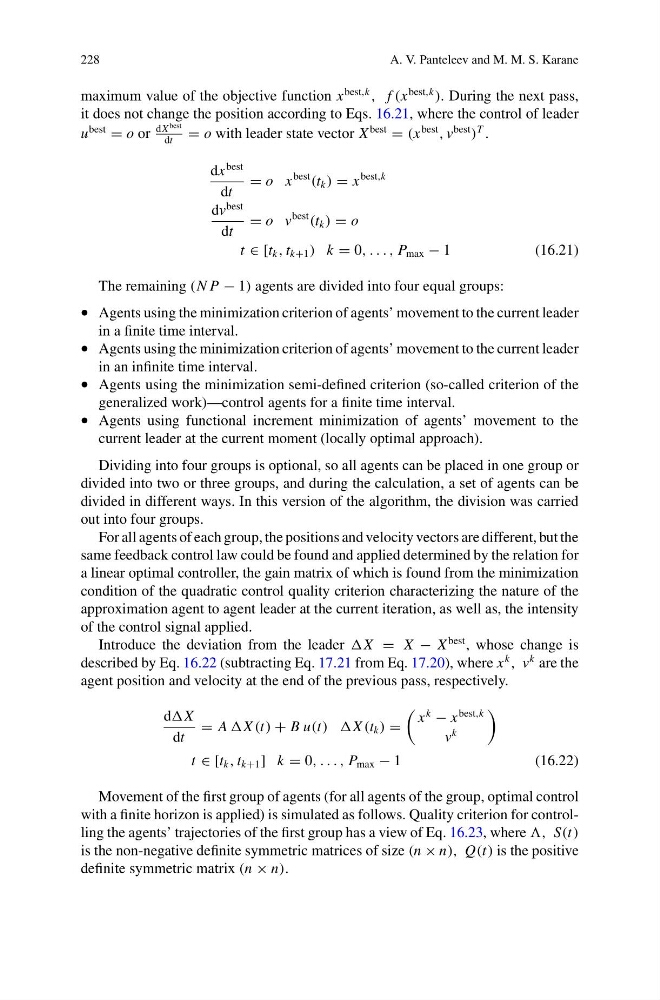
Introduce the deviation from the leader X = X − X
best , whose change is
described by Eq. 16.22 (subtracting Eq. 17.21 from Eq. 17.20), where x
k
, v
k are the
agent position and velocity at the end of the previous pass, respectively.
dX
dt
= A X (t) + B u(t) )X (t k ) =
x
k
− x
best,k
v
k
t ∈ [t k , t k+1 ] k = 0, . . . , P max − 1
(16.22)
Movement of the first group of agents (for all agents of the group, optimal control
with a finite horizon is applied) is simulated as follows. Quality criterion for controlling the agents’ trajectories of the first group has a view of Eq. 16.23, where , S(t)
is the non-negative definite symmetric matrices of size (n × n), Q(t) is the positive
definite symmetric matrix (n × n).
A. V. Panteleev and M. M. S. Karane
maximum value of the objective function x
best,k
, f (x
best,k
). During the next pass,
it does not change the position according to Eqs. 16.21, where the control of leader
u
best
= o or
dX
best
dt
= o with leader state vector X
best
= (x
best
, v
best
)
T .
dx
best
dt
= o x
best
(t k ) = x
best,k
dv
best
dt
= o v
best
(t k ) = o
t ∈ [t k , t k+1 ) k = 0, . . . , P max − 1
(16.21)
The remaining (N P − 1) agents are divided into four equal groups:
• Agents using the minimization criterion of agents’ movement to the current leader
in a finite time interval.
• Agents using the minimization criterion of agents’ movement to the current leader
in an infinite time interval.
• Agents using the minimization semi-defined criterion (so-called criterion of the
generalized work)—control agents for a finite time interval.
• Agents using functional increment minimization of agents’ movement to the
current leader at the current moment (locally optimal approach).
Dividing into four groups is optional, so all agents can be placed in one group or
divided into two or three groups, and during the calculation, a set of agents can be
divided in different ways. In this version of the algorithm, the division was carried
out into four groups.
For all agents of each group, the positions and velocity vectors are different, but the
same feedback control law could be found and applied determined by the relation for
a linear optimal controller, the gain matrix of which is found from the minimization
condition of the quadratic control quality criterion characterizing the nature of the
approximation agent to agent leader at the current iteration, as well as, the intensity
of the control signal applied.
Introduce the deviation from the leader X = X − X
best , whose change is
described by Eq. 16.22 (subtracting Eq. 17.21 from Eq. 17.20), where x
k
, v
k are the
agent position and velocity at the end of the previous pass, respectively.
dX
dt
= A X (t) + B u(t) )X (t k ) =
x
k
− x
best,k
v
k
t ∈ [t k , t k+1 ] k = 0, . . . , P max − 1
(16.22)
Movement of the first group of agents (for all agents of the group, optimal control
with a finite horizon is applied) is simulated as follows. Quality criterion for controlling the agents’ trajectories of the first group has a view of Eq. 16.23, where , S(t)
is the non-negative definite symmetric matrices of size (n × n), Q(t) is the positive
definite symmetric matrix (n × n).