

15 Astronomical and Geophysical Factors of the Perturbed Chandler Wobble …
205
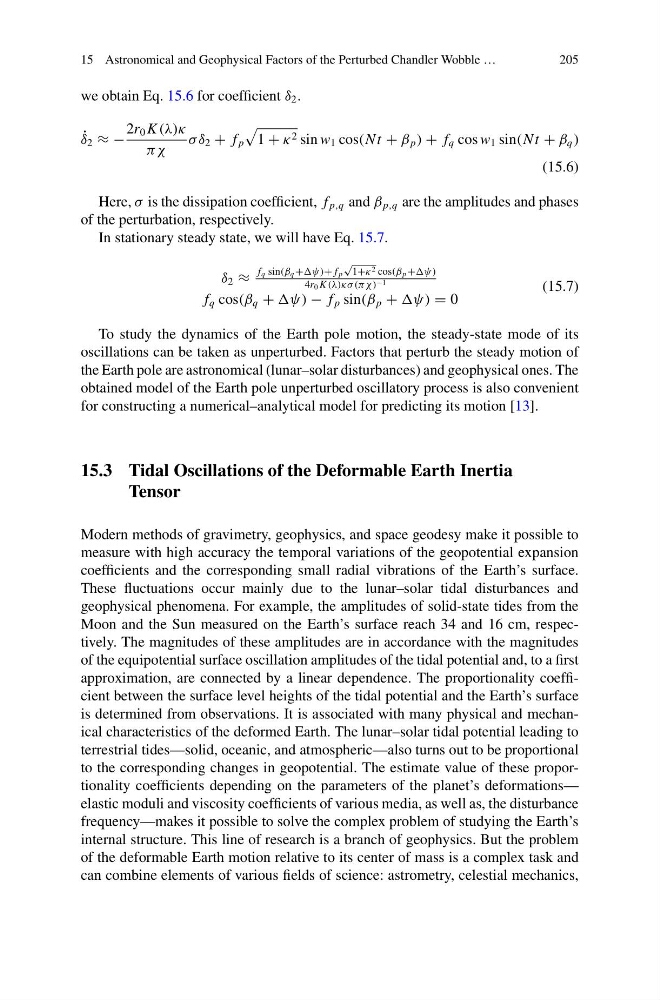
we obtain Eq. 15.6 for coefficient δ 2 .
˙
δ 2 ≈ −
2r 0 K (λ)κ
πχ
σ δ 2 + f p
1 + κ 2 sin w 1 cos(N t + β p ) + f q cos w 1 sin(N t + β q )
(15.6)
Here, σ is the dissipation coefficient, f p,q and β p,q are the amplitudes and phases
of the perturbation, respectively.
In stationary steady state, we will have Eq. 15.7.
δ 2 ≈
f q sin(β q +ψ)+ f p
√
1+κ 2 cos(β p +ψ)
4r 0 K (λ)κσ (πχ) −1
f q cos(β q + − f p sin(β p + ψ) = 0
(15.7)
To study the dynamics of the Earth pole motion, the steady-state mode of its
oscillations can be taken as unperturbed. Factors that perturb the steady motion of
the Earth pole are astronomical (lunar–solar disturbances) and geophysical ones. The
obtained model of the Earth pole unperturbed oscillatory process is also convenient
for constructing a numerical–analytical model for predicting its motion [13].
15.3 Tidal Oscillations of the Deformable Earth Inertia
Tensor
Modern methods of gravimetry, geophysics, and space geodesy make it possible to
measure with high accuracy the temporal variations of the geopotential expansion
coefficients and the corresponding small radial vibrations of the Earth’s surface.
These fluctuations occur mainly due to the lunar–solar tidal disturbances and
geophysical phenomena. For example, the amplitudes of solid-state tides from the
Moon and the Sun measured on the Earth’s surface reach 34 and 16 cm, respectively. The magnitudes of these amplitudes are in accordance with the magnitudes
of the equipotential surface oscillation amplitudes of the tidal potential and, to a first
approximation, are connected by a linear dependence. The proportionality coefficient between the surface level heights of the tidal potential and the Earth’s surface
is determined from observations. It is associated with many physical and mechanical characteristics of the deformed Earth. The lunar–solar tidal potential leading to
terrestrial tides—solid, oceanic, and atmospheric—also turns out to be proportional
to the corresponding changes in geopotential. The estimate value of these proportionality coefficients depending on the parameters of the planet’s deformations—
elastic moduli and viscosity coefficients of various media, as well as, the disturbance
frequency—makes it possible to solve the complex problem of studying the Earth’s
internal structure. This line of research is a branch of geophysics. But the problem
of the deformable Earth motion relative to its center of mass is a complex task and
can combine elements of various fields of science: astrometry, celestial mechanics,
205
we obtain Eq. 15.6 for coefficient δ 2 .
˙
δ 2 ≈ −
2r 0 K (λ)κ
πχ
σ δ 2 + f p
1 + κ 2 sin w 1 cos(N t + β p ) + f q cos w 1 sin(N t + β q )
(15.6)
Here, σ is the dissipation coefficient, f p,q and β p,q are the amplitudes and phases
of the perturbation, respectively.
In stationary steady state, we will have Eq. 15.7.
δ 2 ≈
f q sin(β q +ψ)+ f p
√
1+κ 2 cos(β p +ψ)
4r 0 K (λ)κσ (πχ) −1
f q cos(β q + − f p sin(β p + ψ) = 0
(15.7)
To study the dynamics of the Earth pole motion, the steady-state mode of its
oscillations can be taken as unperturbed. Factors that perturb the steady motion of
the Earth pole are astronomical (lunar–solar disturbances) and geophysical ones. The
obtained model of the Earth pole unperturbed oscillatory process is also convenient
for constructing a numerical–analytical model for predicting its motion [13].
15.3 Tidal Oscillations of the Deformable Earth Inertia
Tensor
Modern methods of gravimetry, geophysics, and space geodesy make it possible to
measure with high accuracy the temporal variations of the geopotential expansion
coefficients and the corresponding small radial vibrations of the Earth’s surface.
These fluctuations occur mainly due to the lunar–solar tidal disturbances and
geophysical phenomena. For example, the amplitudes of solid-state tides from the
Moon and the Sun measured on the Earth’s surface reach 34 and 16 cm, respectively. The magnitudes of these amplitudes are in accordance with the magnitudes
of the equipotential surface oscillation amplitudes of the tidal potential and, to a first
approximation, are connected by a linear dependence. The proportionality coefficient between the surface level heights of the tidal potential and the Earth’s surface
is determined from observations. It is associated with many physical and mechanical characteristics of the deformed Earth. The lunar–solar tidal potential leading to
terrestrial tides—solid, oceanic, and atmospheric—also turns out to be proportional
to the corresponding changes in geopotential. The estimate value of these proportionality coefficients depending on the parameters of the planet’s deformations—
elastic moduli and viscosity coefficients of various media, as well as, the disturbance
frequency—makes it possible to solve the complex problem of studying the Earth’s
internal structure. This line of research is a branch of geophysics. But the problem
of the deformable Earth motion relative to its center of mass is a complex task and
can combine elements of various fields of science: astrometry, celestial mechanics,