

204
S. S. Krylov et al.
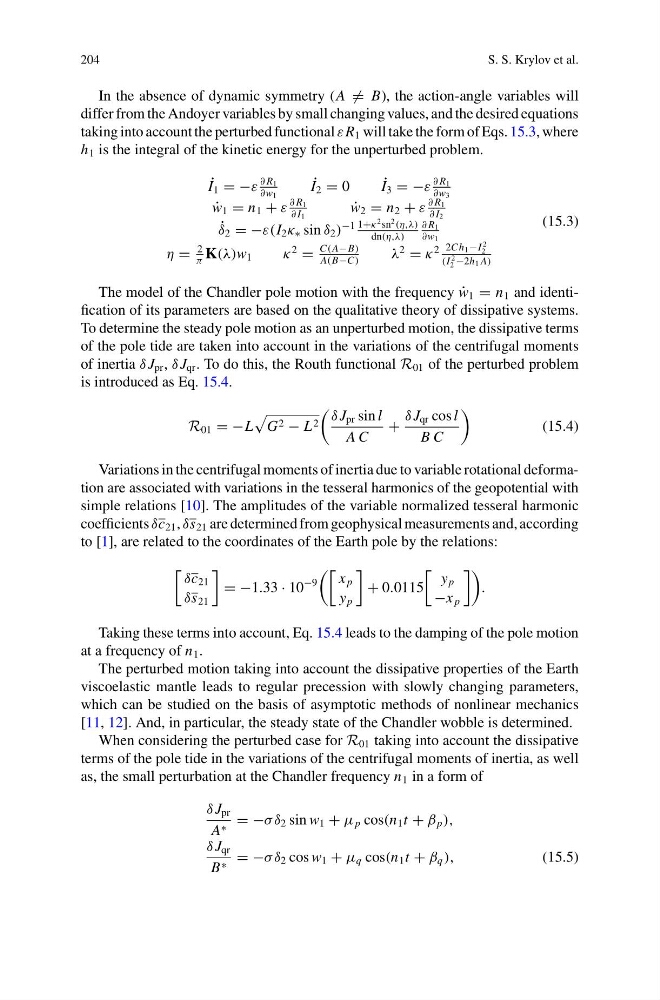
In the absence of dynamic symmetry (A = B), the action-angle variables will
differ from the Andoyer variables by small changing values, and the desired equations
taking into account the perturbed functional ε R 1 will take the form of Eqs. 15.3, where
h 1 is the integral of the kinetic energy for the unperturbed problem.
˙
I 1 = −ε
∂ R 1
∂w 1
˙
I 2 = 0
˙
I 3 = −ε
∂ R 1
∂w 3
˙
w 1 = n 1 + ε
∂ R 1
∂ I 1
˙
w 2 = n 2 + ε
∂ R 1
∂ I 2
˙
δ 2 = −ε(I 2 κ ∗ sin δ 2 )
−1 1+κ
2 sn
2 (η,λ)
dn(η,λ)
∂ R 1
∂w 1
η =
2
π
K(λ)w 1
κ
2
=
C(A−B)
A(B−C)
λ
2
= κ
2 2Ch 1 −I
2
2
(I
2
2 −2h 1 A)
(15.3)
The model of the Chandler pole motion with the frequency ˙
w 1 = n 1 and identification of its parameters are based on the qualitative theory of dissipative systems.
To determine the steady pole motion as an unperturbed motion, the dissipative terms
of the pole tide are taken into account in the variations of the centrifugal moments
of inertia δ J pr , δ J qr . To do this, the Routh functional R 01 of the perturbed problem
is introduced as Eq. 15.4.
R 01 = −L
G 2 − L 2
δ J pr sin l
A C
+
δ J qr cos l
B C
(15.4)
Variations in the centrifugal moments of inertia due to variable rotational deformation are associated with variations in the tesseral harmonics of the geopotential with
simple relations [10]. The amplitudes of the variable normalized tesseral harmonic
coefficients δc 21 , δs 21 are determined from geophysical measurements and, according
to [1], are related to the coordinates of the Earth pole by the relations:
δc 21
δs 21
= −1.33 · 10
−9
x p
y p
+ 0.0115
y p
−x p
.
Taking these terms into account, Eq. 15.4 leads to the damping of the pole motion
at a frequency of n 1 .
The perturbed motion taking into account the dissipative properties of the Earth
viscoelastic mantle leads to regular precession with slowly changing parameters,
which can be studied on the basis of asymptotic methods of nonlinear mechanics
[11, 12]. And, in particular, the steady state of the Chandler wobble is determined.
When considering the perturbed case for R 01 taking into account the dissipative
terms of the pole tide in the variations of the centrifugal moments of inertia, as well
as, the small perturbation at the Chandler frequency n 1 in a form of
δ J pr
A ∗ = −σ δ 2 sin w 1 + μ p cos(n 1 t + β p ),
δ J qr
B ∗ = −σ δ 2 cos w 1 + μ q cos(n 1 t + β q ),
(15.5)
S. S. Krylov et al.
In the absence of dynamic symmetry (A = B), the action-angle variables will
differ from the Andoyer variables by small changing values, and the desired equations
taking into account the perturbed functional ε R 1 will take the form of Eqs. 15.3, where
h 1 is the integral of the kinetic energy for the unperturbed problem.
˙
I 1 = −ε
∂ R 1
∂w 1
˙
I 2 = 0
˙
I 3 = −ε
∂ R 1
∂w 3
˙
w 1 = n 1 + ε
∂ R 1
∂ I 1
˙
w 2 = n 2 + ε
∂ R 1
∂ I 2
˙
δ 2 = −ε(I 2 κ ∗ sin δ 2 )
−1 1+κ
2 sn
2 (η,λ)
dn(η,λ)
∂ R 1
∂w 1
η =
2
π
K(λ)w 1
κ
2
=
C(A−B)
A(B−C)
λ
2
= κ
2 2Ch 1 −I
2
2
(I
2
2 −2h 1 A)
(15.3)
The model of the Chandler pole motion with the frequency ˙
w 1 = n 1 and identification of its parameters are based on the qualitative theory of dissipative systems.
To determine the steady pole motion as an unperturbed motion, the dissipative terms
of the pole tide are taken into account in the variations of the centrifugal moments
of inertia δ J pr , δ J qr . To do this, the Routh functional R 01 of the perturbed problem
is introduced as Eq. 15.4.
R 01 = −L
G 2 − L 2
δ J pr sin l
A C
+
δ J qr cos l
B C
(15.4)
Variations in the centrifugal moments of inertia due to variable rotational deformation are associated with variations in the tesseral harmonics of the geopotential with
simple relations [10]. The amplitudes of the variable normalized tesseral harmonic
coefficients δc 21 , δs 21 are determined from geophysical measurements and, according
to [1], are related to the coordinates of the Earth pole by the relations:
δc 21
δs 21
= −1.33 · 10
−9
x p
y p
+ 0.0115
y p
−x p
.
Taking these terms into account, Eq. 15.4 leads to the damping of the pole motion
at a frequency of n 1 .
The perturbed motion taking into account the dissipative properties of the Earth
viscoelastic mantle leads to regular precession with slowly changing parameters,
which can be studied on the basis of asymptotic methods of nonlinear mechanics
[11, 12]. And, in particular, the steady state of the Chandler wobble is determined.
When considering the perturbed case for R 01 taking into account the dissipative
terms of the pole tide in the variations of the centrifugal moments of inertia, as well
as, the small perturbation at the Chandler frequency n 1 in a form of
δ J pr
A ∗ = −σ δ 2 sin w 1 + μ p cos(n 1 t + β p ),
δ J qr
B ∗ = −σ δ 2 cos w 1 + μ q cos(n 1 t + β q ),
(15.5)