

15 Astronomical and Geophysical Factors of the Perturbed Chandler Wobble …
203
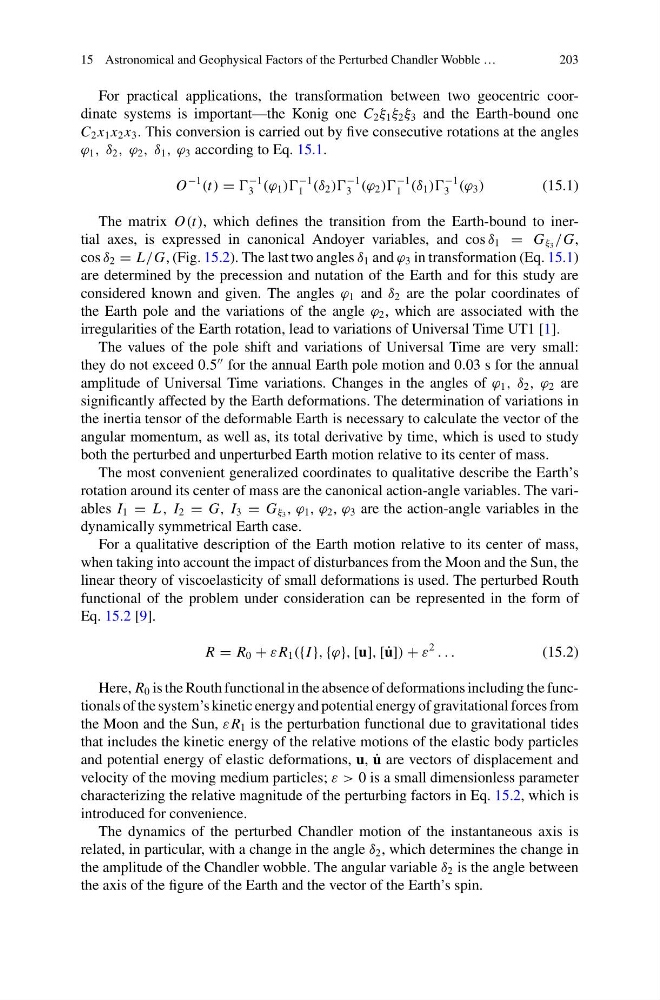
For practical applications, the transformation between two geocentric coordinate systems is important—the Konig one C 2 ξ 1 ξ 2 ξ 3 and the Earth-bound one
C 2 x 1 x 2 x 3 . This conversion is carried out by five consecutive rotations at the angles
ϕ 1 , δ 2 , ϕ 2 , δ 1 , ϕ 3 according to Eq. 15.1.
O
−1
(t) =
−1
3 (ϕ 1 ))
−1
1 (δ 2 ))
−1
3 (ϕ 2 ))
−1
1 (δ 1 ))
−1
3 (ϕ 3 )
(15.1)
The matrix O(t), which defines the transition from the Earth-bound to inertial axes, is expressed in canonical Andoyer variables, and cos δ 1 = G ξ 3 /G,
cos δ 2 = L/G, (Fig. 15.2). The last two angles δ 1 and ϕ 3 in transformation (Eq. 15.1)
are determined by the precession and nutation of the Earth and for this study are
considered known and given. The angles ϕ 1 and δ 2 are the polar coordinates of
the Earth pole and the variations of the angle ϕ 2 , which are associated with the
irregularities of the Earth rotation, lead to variations of Universal Time UT1 [1].
The values of the pole shift and variations of Universal Time are very small:
they do not exceed 0.5
for the annual Earth pole motion and 0.03 s for the annual
amplitude of Universal Time variations. Changes in the angles of ϕ 1 , δ 2 , ϕ 2 are
significantly affected by the Earth deformations. The determination of variations in
the inertia tensor of the deformable Earth is necessary to calculate the vector of the
angular momentum, as well as, its total derivative by time, which is used to study
both the perturbed and unperturbed Earth motion relative to its center of mass.
The most convenient generalized coordinates to qualitative describe the Earth’s
rotation around its center of mass are the canonical action-angle variables. The variables I 1 = L , I 2 = G, I 3 = G ξ 3 , ϕ 1 , ϕ 2 , ϕ 3 are the action-angle variables in the
dynamically symmetrical Earth case.
For a qualitative description of the Earth motion relative to its center of mass,
when taking into account the impact of disturbances from the Moon and the Sun, the
linear theory of viscoelasticity of small deformations is used. The perturbed Routh
functional of the problem under consideration can be represented in the form of
Eq. 15.2 [9].
R = R 0 + ε R 1 ({I }, {ϕ}, [u], [ ˙
u]) + ε
2
. . .
(15.2)
Here, R 0 is the Routh functional in the absence of deformations including the functionals of the system’s kinetic energy and potential energy of gravitational forces from
the Moon and the Sun, ε R 1 is the perturbation functional due to gravitational tides
that includes the kinetic energy of the relative motions of the elastic body particles
and potential energy of elastic deformations, u, ˙
u are vectors of displacement and
velocity of the moving medium particles; ε > 0 is a small dimensionless parameter
characterizing the relative magnitude of the perturbing factors in Eq. 15.2, which is
introduced for convenience.
The dynamics of the perturbed Chandler motion of the instantaneous axis is
related, in particular, with a change in the angle δ 2 , which determines the change in
the amplitude of the Chandler wobble. The angular variable δ 2 is the angle between
the axis of the figure of the Earth and the vector of the Earth’s spin.
203
For practical applications, the transformation between two geocentric coordinate systems is important—the Konig one C 2 ξ 1 ξ 2 ξ 3 and the Earth-bound one
C 2 x 1 x 2 x 3 . This conversion is carried out by five consecutive rotations at the angles
ϕ 1 , δ 2 , ϕ 2 , δ 1 , ϕ 3 according to Eq. 15.1.
O
−1
(t) =
−1
3 (ϕ 1 ))
−1
1 (δ 2 ))
−1
3 (ϕ 2 ))
−1
1 (δ 1 ))
−1
3 (ϕ 3 )
(15.1)
The matrix O(t), which defines the transition from the Earth-bound to inertial axes, is expressed in canonical Andoyer variables, and cos δ 1 = G ξ 3 /G,
cos δ 2 = L/G, (Fig. 15.2). The last two angles δ 1 and ϕ 3 in transformation (Eq. 15.1)
are determined by the precession and nutation of the Earth and for this study are
considered known and given. The angles ϕ 1 and δ 2 are the polar coordinates of
the Earth pole and the variations of the angle ϕ 2 , which are associated with the
irregularities of the Earth rotation, lead to variations of Universal Time UT1 [1].
The values of the pole shift and variations of Universal Time are very small:
they do not exceed 0.5
for the annual Earth pole motion and 0.03 s for the annual
amplitude of Universal Time variations. Changes in the angles of ϕ 1 , δ 2 , ϕ 2 are
significantly affected by the Earth deformations. The determination of variations in
the inertia tensor of the deformable Earth is necessary to calculate the vector of the
angular momentum, as well as, its total derivative by time, which is used to study
both the perturbed and unperturbed Earth motion relative to its center of mass.
The most convenient generalized coordinates to qualitative describe the Earth’s
rotation around its center of mass are the canonical action-angle variables. The variables I 1 = L , I 2 = G, I 3 = G ξ 3 , ϕ 1 , ϕ 2 , ϕ 3 are the action-angle variables in the
dynamically symmetrical Earth case.
For a qualitative description of the Earth motion relative to its center of mass,
when taking into account the impact of disturbances from the Moon and the Sun, the
linear theory of viscoelasticity of small deformations is used. The perturbed Routh
functional of the problem under consideration can be represented in the form of
Eq. 15.2 [9].
R = R 0 + ε R 1 ({I }, {ϕ}, [u], [ ˙
u]) + ε
2
. . .
(15.2)
Here, R 0 is the Routh functional in the absence of deformations including the functionals of the system’s kinetic energy and potential energy of gravitational forces from
the Moon and the Sun, ε R 1 is the perturbation functional due to gravitational tides
that includes the kinetic energy of the relative motions of the elastic body particles
and potential energy of elastic deformations, u, ˙
u are vectors of displacement and
velocity of the moving medium particles; ε > 0 is a small dimensionless parameter
characterizing the relative magnitude of the perturbing factors in Eq. 15.2, which is
introduced for convenience.
The dynamics of the perturbed Chandler motion of the instantaneous axis is
related, in particular, with a change in the angle δ 2 , which determines the change in
the amplitude of the Chandler wobble. The angular variable δ 2 is the angle between
the axis of the figure of the Earth and the vector of the Earth’s spin.