

202
S. S. Krylov et al.
barycenter C 12 , and the Koenig coordinate system C 12 ξ 1 ξ 2 ξ 3 . In an undeformed
state, the Earth is dynamically compressed, i.e., C > A, where C and A are the axial
and average equatorial moments of inertia, respectively. Let us bind the coordinate
system C
2 x 1 x 2 x 3 with the deformable Earth, in a way that the axes are directed along
the main central axes of the undeformed planet and the point C
2 is the center of mass
of the planet in the absence of deformations.
Let G be the spin of the planet, be the orbital angular momentum of the satellite’s
centers of mass C 1 and the planet’s C 2 . In the absence of disturbances, the angular
momentum of the system K = G + is stationary in inertial space and coincides
with the C 12 ξ 3 axis (Fig. 15.1).
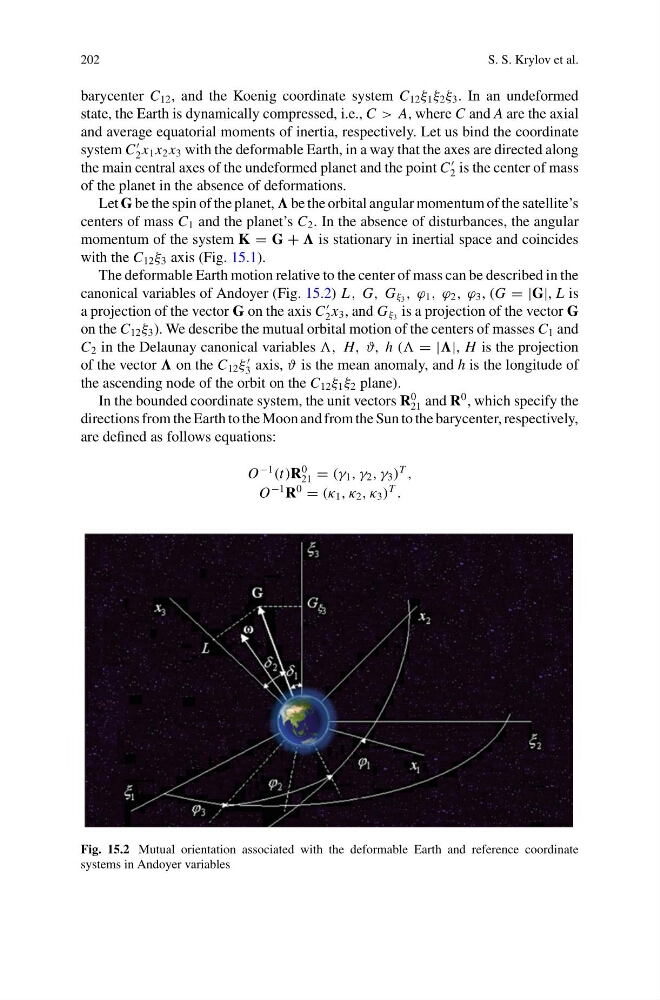
The deformable Earth motion relative to the center of mass can be described in the
canonical variables of Andoyer (Fig. 15.2) L , G, G ξ 3 , ϕ 1 , ϕ 2 , ϕ 3 , (G = |G|, L is
a projection of the vector G on the axis C
2 x 3 , and G ξ 3 is a projection of the vector G
on the C 12 ξ 3 ). We describe the mutual orbital motion of the centers of masses C 1 and
C 2 in the Delaunay canonical variables , H, ϑ, h ( = ||, H is the projection
of the vector on the C 12 ξ
3 axis, ϑ is the mean anomaly, and h is the longitude of
the ascending node of the orbit on the C 12 ξ 1 ξ 2 plane).
In the bounded coordinate system, the unit vectors R
0
21 and R
0 , which specify the
directions from the Earth to the Moon and from the Sun to the barycenter, respectively,
are defined as follows equations:
O
−1
(t)R
0
21 = (γ 1 , γ 2 , γ 3 )
T
,
O
−1 R
0
= (κ 1 , κ 2 , κ 3 )
T
.
Fig. 15.2 Mutual orientation associated with the deformable Earth and reference coordinate
systems in Andoyer variables
S. S. Krylov et al.
barycenter C 12 , and the Koenig coordinate system C 12 ξ 1 ξ 2 ξ 3 . In an undeformed
state, the Earth is dynamically compressed, i.e., C > A, where C and A are the axial
and average equatorial moments of inertia, respectively. Let us bind the coordinate
system C
2 x 1 x 2 x 3 with the deformable Earth, in a way that the axes are directed along
the main central axes of the undeformed planet and the point C
2 is the center of mass
of the planet in the absence of deformations.
Let G be the spin of the planet, be the orbital angular momentum of the satellite’s
centers of mass C 1 and the planet’s C 2 . In the absence of disturbances, the angular
momentum of the system K = G + is stationary in inertial space and coincides
with the C 12 ξ 3 axis (Fig. 15.1).
The deformable Earth motion relative to the center of mass can be described in the
canonical variables of Andoyer (Fig. 15.2) L , G, G ξ 3 , ϕ 1 , ϕ 2 , ϕ 3 , (G = |G|, L is
a projection of the vector G on the axis C
2 x 3 , and G ξ 3 is a projection of the vector G
on the C 12 ξ 3 ). We describe the mutual orbital motion of the centers of masses C 1 and
C 2 in the Delaunay canonical variables , H, ϑ, h ( = ||, H is the projection
of the vector on the C 12 ξ
3 axis, ϑ is the mean anomaly, and h is the longitude of
the ascending node of the orbit on the C 12 ξ 1 ξ 2 plane).
In the bounded coordinate system, the unit vectors R
0
21 and R
0 , which specify the
directions from the Earth to the Moon and from the Sun to the barycenter, respectively,
are defined as follows equations:
O
−1
(t)R
0
21 = (γ 1 , γ 2 , γ 3 )
T
,
O
−1 R
0
= (κ 1 , κ 2 , κ 3 )
T
.
Fig. 15.2 Mutual orientation associated with the deformable Earth and reference coordinate
systems in Andoyer variables