

15 Astronomical and Geophysical Factors of the Perturbed Chandler Wobble …
201
motion is introduced based on the celestial–mechanical model of the deformable
Earth rotation. Tidal oscillations in the inertia tensor of a deformable Earth, which
are taken into account in the framework of a simple celestial–mechanical model of
its motion, are considered in Sect. 15.3. In Sect. 15.4, a correspondence between
the intensity of perturbed oscillations in the Earth pole coordinates, the direction
of the coordinate axes and the longitude distribution of the ocean surface is established bassed on the processing of astrometric and geophysical observation data.
Section 15.5 is devoted to the study of the geophysical disturbances contribution to
the synchronization between the Earth pole motion and precession of the lunar orbit.
In Sect. 15.6, the main conclusions of the work are given.
15.2 Studying the Earth Rotation Within the Restricted
Three-Body Problem
The study of the Earth motion relative to its center of mass under the lunar–solar
gravitational–tidal and geophysical disturbances is based on the problem of a system
consisting of a deformable planet (the Earth) and a point satellite (the Moon) moving
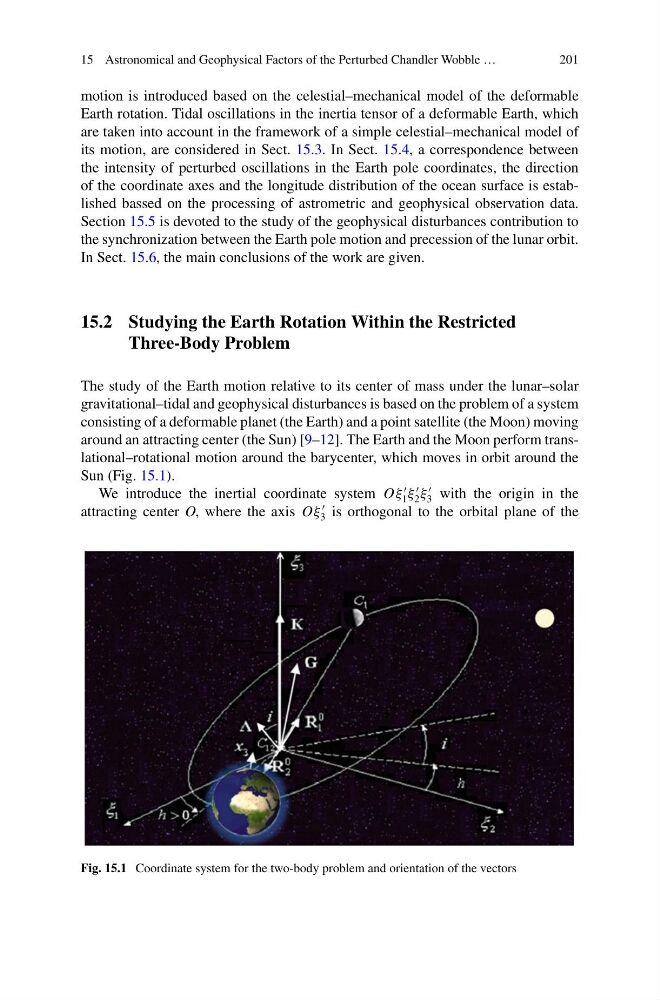
around an attracting center (the Sun) [9–12]. The Earth and the Moon perform translational–rotational motion around the barycenter, which moves in orbit around the
Sun (Fig. 15.1).
We introduce the inertial coordinate system Oξ
1 ξ
2 ξ
3 with the origin in the
attracting center O, where the axis Oξ
3 is orthogonal to the orbital plane of the
Fig. 15.1 Coordinate system for the two-body problem and orientation of the vectors
201
motion is introduced based on the celestial–mechanical model of the deformable
Earth rotation. Tidal oscillations in the inertia tensor of a deformable Earth, which
are taken into account in the framework of a simple celestial–mechanical model of
its motion, are considered in Sect. 15.3. In Sect. 15.4, a correspondence between
the intensity of perturbed oscillations in the Earth pole coordinates, the direction
of the coordinate axes and the longitude distribution of the ocean surface is established bassed on the processing of astrometric and geophysical observation data.
Section 15.5 is devoted to the study of the geophysical disturbances contribution to
the synchronization between the Earth pole motion and precession of the lunar orbit.
In Sect. 15.6, the main conclusions of the work are given.
15.2 Studying the Earth Rotation Within the Restricted
Three-Body Problem
The study of the Earth motion relative to its center of mass under the lunar–solar
gravitational–tidal and geophysical disturbances is based on the problem of a system
consisting of a deformable planet (the Earth) and a point satellite (the Moon) moving
around an attracting center (the Sun) [9–12]. The Earth and the Moon perform translational–rotational motion around the barycenter, which moves in orbit around the
Sun (Fig. 15.1).
We introduce the inertial coordinate system Oξ
1 ξ
2 ξ
3 with the origin in the
attracting center O, where the axis Oξ
3 is orthogonal to the orbital plane of the
Fig. 15.1 Coordinate system for the two-body problem and orientation of the vectors