

206
S. S. Krylov et al.
geophysics, the theory of stochastic systems, and many others. And first of all, the
methods and approaches used to construct the Earth motion model depend on the
goals of scientific research. In that case, if the goal of the problem is modeling in
a certain “average” sense that is a development of a model described the motion in
question with average observed parameters, then the celestial–mechanical approach
seems to be the most rational as the basis for constructing a complex model. Along
with this, it is justified from the point of view of practical application to construct
a few-parameter mathematical forecast model that allows us to reduce the computational complexity of the algorithmic implementation of the model of the Earth
orientation parameters oscillations.
Indeed, for qualitative conclusions about the Earth motion around its center of
mass, it will be logically justified to take into account coherent oscillations in various
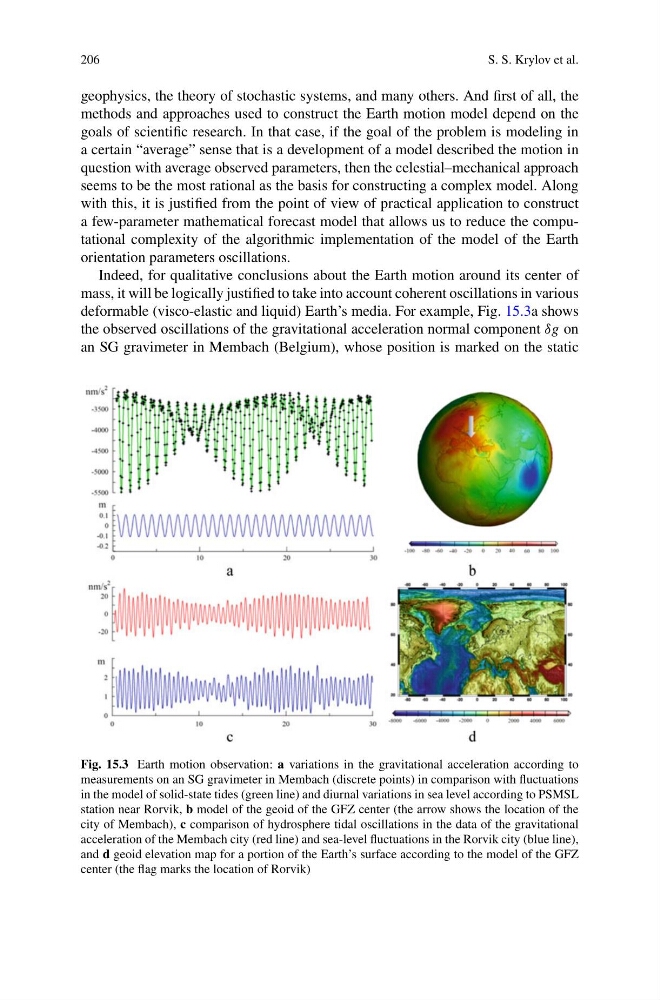
deformable (visco-elastic and liquid) Earth’s media. For example, Fig. 15.3a shows
the observed oscillations of the gravitational acceleration normal component δg on
an SG gravimeter in Membach (Belgium), whose position is marked on the static
Fig. 15.3 Earth motion observation: a variations in the gravitational acceleration according to
measurements on an SG gravimeter in Membach (discrete points) in comparison with fluctuations
in the model of solid-state tides (green line) and diurnal variations in sea level according to PSMSL
station near Rorvik, b model of the geoid of the GFZ center (the arrow shows the location of the
city of Membach), c comparison of hydrosphere tidal oscillations in the data of the gravitational
acceleration of the Membach city (red line) and sea-level fluctuations in the Rorvik city (blue line),
and d geoid elevation map for a portion of the Earth’s surface according to the model of the GFZ
center (the flag marks the location of Rorvik)
S. S. Krylov et al.
geophysics, the theory of stochastic systems, and many others. And first of all, the
methods and approaches used to construct the Earth motion model depend on the
goals of scientific research. In that case, if the goal of the problem is modeling in
a certain “average” sense that is a development of a model described the motion in
question with average observed parameters, then the celestial–mechanical approach
seems to be the most rational as the basis for constructing a complex model. Along
with this, it is justified from the point of view of practical application to construct
a few-parameter mathematical forecast model that allows us to reduce the computational complexity of the algorithmic implementation of the model of the Earth
orientation parameters oscillations.
Indeed, for qualitative conclusions about the Earth motion around its center of
mass, it will be logically justified to take into account coherent oscillations in various
deformable (visco-elastic and liquid) Earth’s media. For example, Fig. 15.3a shows
the observed oscillations of the gravitational acceleration normal component δg on
an SG gravimeter in Membach (Belgium), whose position is marked on the static
Fig. 15.3 Earth motion observation: a variations in the gravitational acceleration according to
measurements on an SG gravimeter in Membach (discrete points) in comparison with fluctuations
in the model of solid-state tides (green line) and diurnal variations in sea level according to PSMSL
station near Rorvik, b model of the geoid of the GFZ center (the arrow shows the location of the
city of Membach), c comparison of hydrosphere tidal oscillations in the data of the gravitational
acceleration of the Membach city (red line) and sea-level fluctuations in the Rorvik city (blue line),
and d geoid elevation map for a portion of the Earth’s surface according to the model of the GFZ
center (the flag marks the location of Rorvik)