

188
S. D. Arutyunov et al.
a
b
c
d
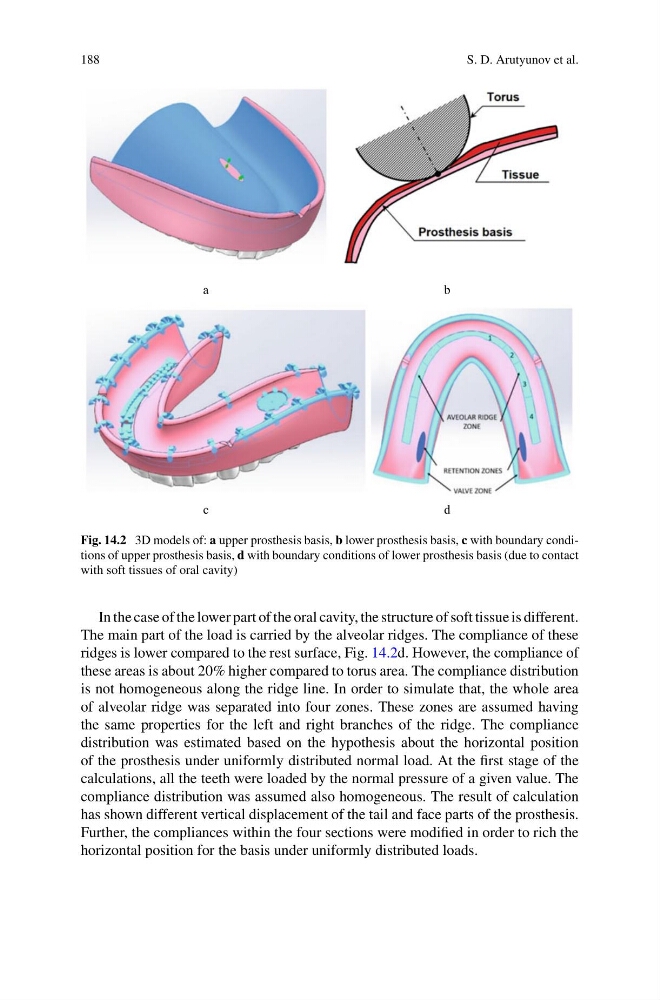
Fig. 14.2 3D models of: a upper prosthesis basis, b lower prosthesis basis, c with boundary conditions of upper prosthesis basis, d with boundary conditions of lower prosthesis basis (due to contact
with soft tissues of oral cavity)
In the case of the lower part of the oral cavity, the structure of soft tissue is different.
The main part of the load is carried by the alveolar ridges. The compliance of these
ridges is lower compared to the rest surface, Fig. 14.2d. However, the compliance of
these areas is about 20% higher compared to torus area. The compliance distribution
is not homogeneous along the ridge line. In order to simulate that, the whole area
of alveolar ridge was separated into four zones. These zones are assumed having
the same properties for the left and right branches of the ridge. The compliance
distribution was estimated based on the hypothesis about the horizontal position
of the prosthesis under uniformly distributed normal load. At the first stage of the
calculations, all the teeth were loaded by the normal pressure of a given value. The
compliance distribution was assumed also homogeneous. The result of calculation
has shown different vertical displacement of the tail and face parts of the prosthesis.
Further, the compliances within the four sections were modified in order to rich the
horizontal position for the basis under uniformly distributed loads.
S. D. Arutyunov et al.
a
b
c
d
Fig. 14.2 3D models of: a upper prosthesis basis, b lower prosthesis basis, c with boundary conditions of upper prosthesis basis, d with boundary conditions of lower prosthesis basis (due to contact
with soft tissues of oral cavity)
In the case of the lower part of the oral cavity, the structure of soft tissue is different.
The main part of the load is carried by the alveolar ridges. The compliance of these
ridges is lower compared to the rest surface, Fig. 14.2d. However, the compliance of
these areas is about 20% higher compared to torus area. The compliance distribution
is not homogeneous along the ridge line. In order to simulate that, the whole area
of alveolar ridge was separated into four zones. These zones are assumed having
the same properties for the left and right branches of the ridge. The compliance
distribution was estimated based on the hypothesis about the horizontal position
of the prosthesis under uniformly distributed normal load. At the first stage of the
calculations, all the teeth were loaded by the normal pressure of a given value. The
compliance distribution was assumed also homogeneous. The result of calculation
has shown different vertical displacement of the tail and face parts of the prosthesis.
Further, the compliances within the four sections were modified in order to rich the
horizontal position for the basis under uniformly distributed loads.