

12 Multi-mode Model and Calculation Method for Fatigue Damage …
161
ψ
1−γ
/(1 − γ ) − ψ
(1+α−γ )
/(1 + α − γ )
1
0
= B LH N |
N E
0
N LH = α/(1 + α − γ )/(1 − γ )/B LH
(12.3)
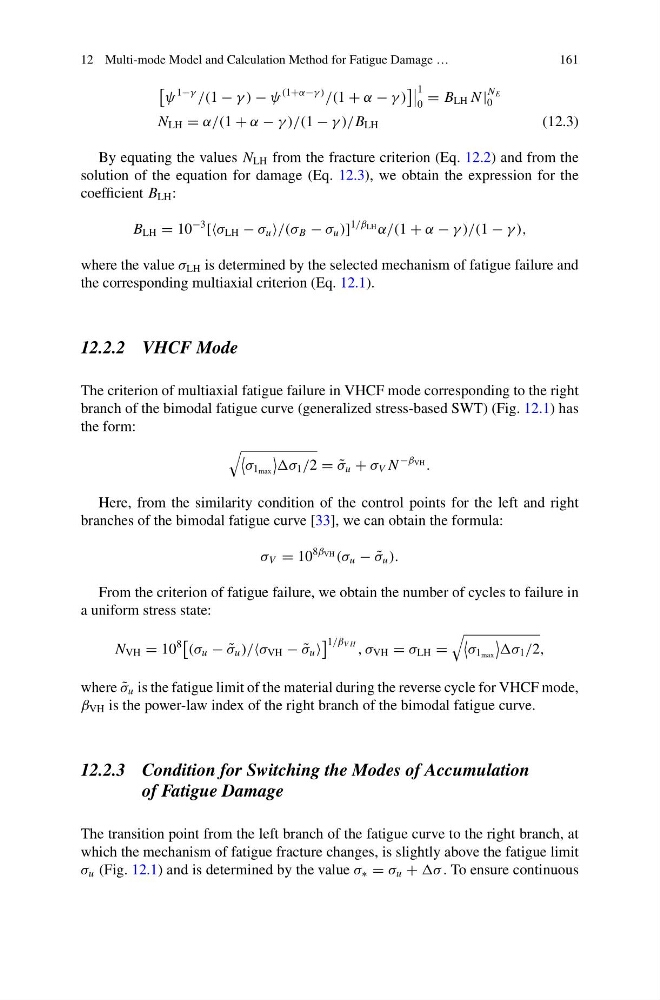
By equating the values N LH from the fracture criterion (Eq. 12.2) and from the
solution of the equation for damage (Eq. 12.3), we obtain the expression for the
coefficient B LH :
B LH = 10
−3 [σ LH − σ u /(σ B − σ u )]
1/β LH α/(1 + α − γ )/(1 − γ ),
where the value σ LH is determined by the selected mechanism of fatigue failure and
the corresponding multiaxial criterion (Eq. 12.1).
12.2.2 VHCF Mode
The criterion of multiaxial fatigue failure in VHCF mode corresponding to the right
branch of the bimodal fatigue curve (generalized stress-based SWT) (Fig. 12.1) has
the form:
σ 1 max
σ 1 /2 = ˜
σ u + σ V N
−β VH .
Here, from the similarity condition of the control points for the left and right
branches of the bimodal fatigue curve [33], we can obtain the formula:
σ V = 10
8β VH (σ u − ˜
σ u ).
From the criterion of fatigue failure, we obtain the number of cycles to failure in
a uniform stress state:
N VH = 10
8
(σ u − ˜
σ u )/σ VH − ˜
σ u
1/β V H , σ VH = σ LH =
σ 1 max
σ 1 /2,
where ˜
σ u is the fatigue limit of the material during the reverse cycle for VHCF mode,
β VH is the power-law index of the right branch of the bimodal fatigue curve.
12.2.3 Condition for Switching the Modes of Accumulation
of Fatigue Damage
The transition point from the left branch of the fatigue curve to the right branch, at
which the mechanism of fatigue fracture changes, is slightly above the fatigue limit
σ u (Fig. 12.1) and is determined by the value σ ∗ = σ u + σ . To ensure continuous
161
ψ
1−γ
/(1 − γ ) − ψ
(1+α−γ )
/(1 + α − γ )
1
0
= B LH N |
N E
0
N LH = α/(1 + α − γ )/(1 − γ )/B LH
(12.3)
By equating the values N LH from the fracture criterion (Eq. 12.2) and from the
solution of the equation for damage (Eq. 12.3), we obtain the expression for the
coefficient B LH :
B LH = 10
−3 [σ LH − σ u /(σ B − σ u )]
1/β LH α/(1 + α − γ )/(1 − γ ),
where the value σ LH is determined by the selected mechanism of fatigue failure and
the corresponding multiaxial criterion (Eq. 12.1).
12.2.2 VHCF Mode
The criterion of multiaxial fatigue failure in VHCF mode corresponding to the right
branch of the bimodal fatigue curve (generalized stress-based SWT) (Fig. 12.1) has
the form:
σ 1 max
σ 1 /2 = ˜
σ u + σ V N
−β VH .
Here, from the similarity condition of the control points for the left and right
branches of the bimodal fatigue curve [33], we can obtain the formula:
σ V = 10
8β VH (σ u − ˜
σ u ).
From the criterion of fatigue failure, we obtain the number of cycles to failure in
a uniform stress state:
N VH = 10
8
(σ u − ˜
σ u )/σ VH − ˜
σ u
1/β V H , σ VH = σ LH =
σ 1 max
σ 1 /2,
where ˜
σ u is the fatigue limit of the material during the reverse cycle for VHCF mode,
β VH is the power-law index of the right branch of the bimodal fatigue curve.
12.2.3 Condition for Switching the Modes of Accumulation
of Fatigue Damage
The transition point from the left branch of the fatigue curve to the right branch, at
which the mechanism of fatigue fracture changes, is slightly above the fatigue limit
σ u (Fig. 12.1) and is determined by the value σ ∗ = σ u + σ . To ensure continuous