

160
I. S. Nikitin et al.
12.2.1 LCF-HCF Mode
The criterion of multiaxial fatigue failure in LCF-HCF mode with the development of
normal crack microcracks [35] (stress-based SWT) corresponding to the left branch
of the bimodal fatigue curve (Fig. 12.1) is
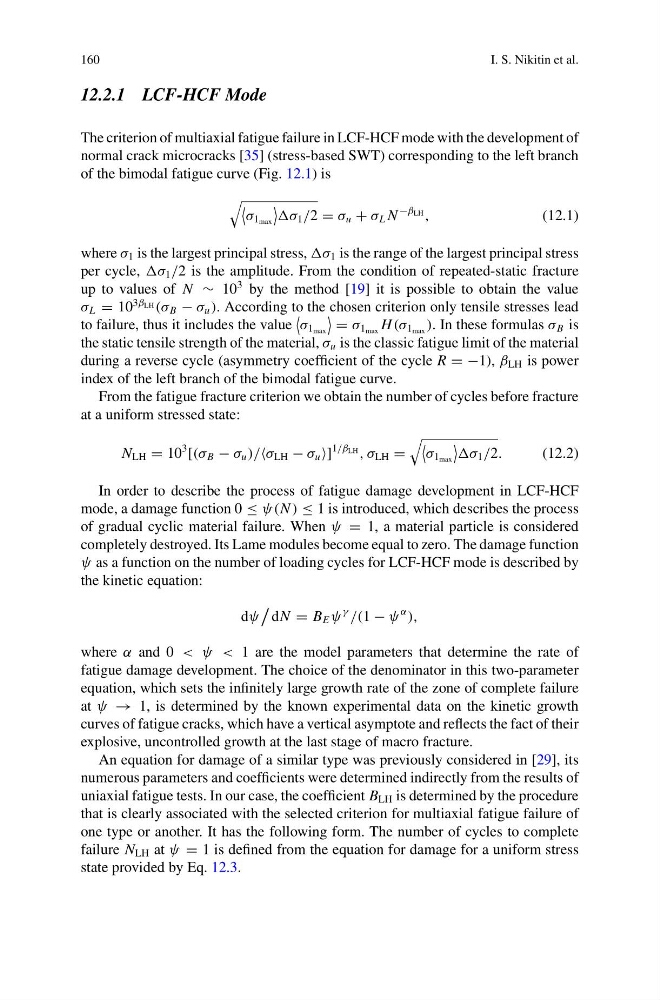
σ 1 max
σ 1 /2 = σ u + σ L N
−β LH ,
(12.1)
where σ 1 is the largest principal stress, σ 1 is the range of the largest principal stress
per cycle, σ 1 /2 is the amplitude. From the condition of repeated-static fracture
up to values of N ∼ 10
3 by the method [19] it is possible to obtain the value
σ L = 10
3β LH (σ B − σ u ). According to the chosen criterion only tensile stresses lead
to failure, thus it includes the value
σ 1 max
= σ 1 max H (σ 1 max ). In these formulas σ B is
the static tensile strength of the material, σ u is the classic fatigue limit of the material
during a reverse cycle (asymmetry coefficient of the cycle R = −1), β LH is power
index of the left branch of the bimodal fatigue curve.
From the fatigue fracture criterion we obtain the number of cycles before fracture
at a uniform stressed state:
N LH = 10
3 [(σ B − σ u )/σ LH − σ u ]
1/β LH , σ LH =
σ 1 max
σ 1 /2.
(12.2)
In order to describe the process of fatigue damage development in LCF-HCF
mode, a damage function 0 ≤ ψ(N ) ≤ 1 is introduced, which describes the process
of gradual cyclic material failure. When ψ = 1, a material particle is considered
completely destroyed. Its Lame modules become equal to zero. The damage function
ψ as a function on the number of loading cycles for LCF-HCF mode is described by
the kinetic equation:
dψ
dN = B E ψ
γ
/(1 − ψ
α
),
where α and 0 < ψ < 1 are the model parameters that determine the rate of
fatigue damage development. The choice of the denominator in this two-parameter
equation, which sets the infinitely large growth rate of the zone of complete failure
at ψ → 1, is determined by the known experimental data on the kinetic growth
curves of fatigue cracks, which have a vertical asymptote and reflects the fact of their
explosive, uncontrolled growth at the last stage of macro fracture.
An equation for damage of a similar type was previously considered in [29], its
numerous parameters and coefficients were determined indirectly from the results of
uniaxial fatigue tests. In our case, the coefficient B LH is determined by the procedure
that is clearly associated with the selected criterion for multiaxial fatigue failure of
one type or another. It has the following form. The number of cycles to complete
failure N LH at ψ = 1 is defined from the equation for damage for a uniform stress
state provided by Eq. 12.3.
I. S. Nikitin et al.
12.2.1 LCF-HCF Mode
The criterion of multiaxial fatigue failure in LCF-HCF mode with the development of
normal crack microcracks [35] (stress-based SWT) corresponding to the left branch
of the bimodal fatigue curve (Fig. 12.1) is
σ 1 max
σ 1 /2 = σ u + σ L N
−β LH ,
(12.1)
where σ 1 is the largest principal stress, σ 1 is the range of the largest principal stress
per cycle, σ 1 /2 is the amplitude. From the condition of repeated-static fracture
up to values of N ∼ 10
3 by the method [19] it is possible to obtain the value
σ L = 10
3β LH (σ B − σ u ). According to the chosen criterion only tensile stresses lead
to failure, thus it includes the value
σ 1 max
= σ 1 max H (σ 1 max ). In these formulas σ B is
the static tensile strength of the material, σ u is the classic fatigue limit of the material
during a reverse cycle (asymmetry coefficient of the cycle R = −1), β LH is power
index of the left branch of the bimodal fatigue curve.
From the fatigue fracture criterion we obtain the number of cycles before fracture
at a uniform stressed state:
N LH = 10
3 [(σ B − σ u )/σ LH − σ u ]
1/β LH , σ LH =
σ 1 max
σ 1 /2.
(12.2)
In order to describe the process of fatigue damage development in LCF-HCF
mode, a damage function 0 ≤ ψ(N ) ≤ 1 is introduced, which describes the process
of gradual cyclic material failure. When ψ = 1, a material particle is considered
completely destroyed. Its Lame modules become equal to zero. The damage function
ψ as a function on the number of loading cycles for LCF-HCF mode is described by
the kinetic equation:
dψ
dN = B E ψ
γ
/(1 − ψ
α
),
where α and 0 < ψ < 1 are the model parameters that determine the rate of
fatigue damage development. The choice of the denominator in this two-parameter
equation, which sets the infinitely large growth rate of the zone of complete failure
at ψ → 1, is determined by the known experimental data on the kinetic growth
curves of fatigue cracks, which have a vertical asymptote and reflects the fact of their
explosive, uncontrolled growth at the last stage of macro fracture.
An equation for damage of a similar type was previously considered in [29], its
numerous parameters and coefficients were determined indirectly from the results of
uniaxial fatigue tests. In our case, the coefficient B LH is determined by the procedure
that is clearly associated with the selected criterion for multiaxial fatigue failure of
one type or another. It has the following form. The number of cycles to complete
failure N LH at ψ = 1 is defined from the equation for damage for a uniform stress
state provided by Eq. 12.3.