

9 A Godunov-Type Method for a Multi-temperature Plasma …
119
electrons transfer heat by conduction. Also electrons exchange energy with the
protons. The temperatures of protons and electrons near SW are different. The kinetic
coefficients are specified as by Shafranov [16] as:
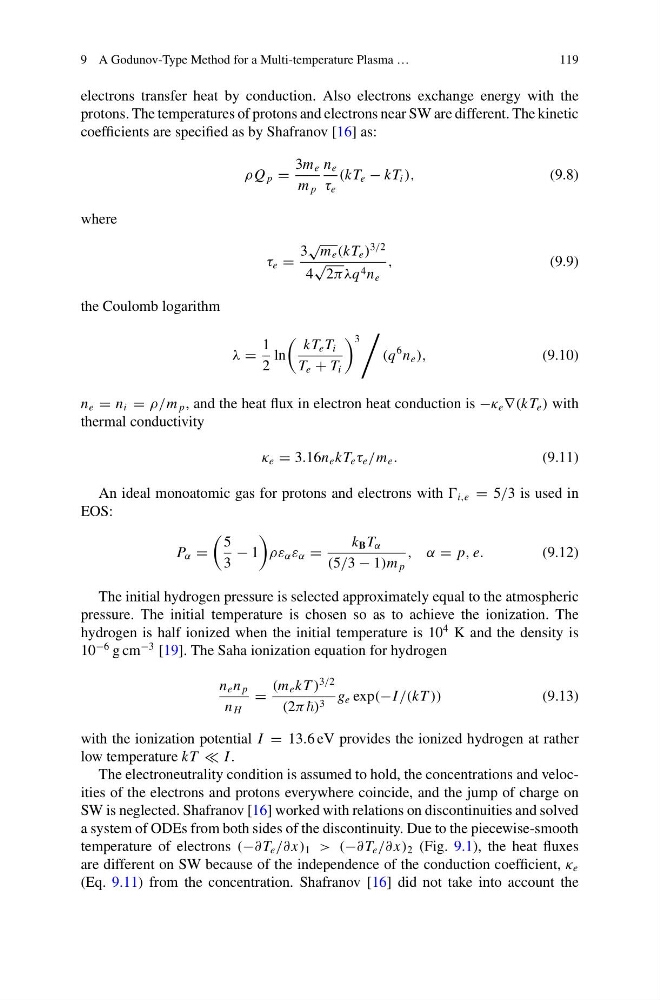
ρ Q p =
3m e
m p
n e
τ e
(kT e − kT i ),
(9.8)
where
τ e =
3
√ m e (kT e )
3/2
4
√
2πλq 4 n e
,
(9.9)
the Coulomb logarithm
λ =
1
2
ln
kT e T i
T e + T i
3
(q
6 n e ),
(9.10)
n e = n i = ρ/m p , and the heat flux in electron heat conduction is −κ e ∇(kT e ) with
thermal conductivity
κ e = 3.16n e kT e τ e /m e .
(9.11)
An ideal monoatomic gas for protons and electrons with i,e = 5/3 is used in
EOS:
P α =
5
3
− 1
ρε α ε α =
k B T α
(5/3 − 1)m p
, α = p, e.
(9.12)
The initial hydrogen pressure is selected approximately equal to the atmospheric
pressure. The initial temperature is chosen so as to achieve the ionization. The
hydrogen is half ionized when the initial temperature is 10
4 K and the density is
10
−6 g cm
−3 [19]. The Saha ionization equation for hydrogen
n e n p
n H
=
(m e kT )
3/2
(2π ) 3 g e exp(−I /(kT ))
(9.13)
with the ionization potential I = 13.6 eV provides the ionized hydrogen at rather
low temperature kT I .
The electroneutrality condition is assumed to hold, the concentrations and velocities of the electrons and protons everywhere coincide, and the jump of charge on
SW is neglected. Shafranov [16] worked with relations on discontinuities and solved
a system of ODEs from both sides of the discontinuity. Due to the piecewise-smooth
temperature of electrons (−∂ T e /∂ x) 1 > (−∂ T e /∂ x) 2 (Fig. 9.1), the heat fluxes
are different on SW because of the independence of the conduction coefficient, κ e
(Eq. 9.11) from the concentration. Shafranov [16] did not take into account the
119
electrons transfer heat by conduction. Also electrons exchange energy with the
protons. The temperatures of protons and electrons near SW are different. The kinetic
coefficients are specified as by Shafranov [16] as:
ρ Q p =
3m e
m p
n e
τ e
(kT e − kT i ),
(9.8)
where
τ e =
3
√ m e (kT e )
3/2
4
√
2πλq 4 n e
,
(9.9)
the Coulomb logarithm
λ =
1
2
ln
kT e T i
T e + T i
3
(q
6 n e ),
(9.10)
n e = n i = ρ/m p , and the heat flux in electron heat conduction is −κ e ∇(kT e ) with
thermal conductivity
κ e = 3.16n e kT e τ e /m e .
(9.11)
An ideal monoatomic gas for protons and electrons with i,e = 5/3 is used in
EOS:
P α =
5
3
− 1
ρε α ε α =
k B T α
(5/3 − 1)m p
, α = p, e.
(9.12)
The initial hydrogen pressure is selected approximately equal to the atmospheric
pressure. The initial temperature is chosen so as to achieve the ionization. The
hydrogen is half ionized when the initial temperature is 10
4 K and the density is
10
−6 g cm
−3 [19]. The Saha ionization equation for hydrogen
n e n p
n H
=
(m e kT )
3/2
(2π ) 3 g e exp(−I /(kT ))
(9.13)
with the ionization potential I = 13.6 eV provides the ionized hydrogen at rather
low temperature kT I .
The electroneutrality condition is assumed to hold, the concentrations and velocities of the electrons and protons everywhere coincide, and the jump of charge on
SW is neglected. Shafranov [16] worked with relations on discontinuities and solved
a system of ODEs from both sides of the discontinuity. Due to the piecewise-smooth
temperature of electrons (−∂ T e /∂ x) 1 > (−∂ T e /∂ x) 2 (Fig. 9.1), the heat fluxes
are different on SW because of the independence of the conduction coefficient, κ e
(Eq. 9.11) from the concentration. Shafranov [16] did not take into account the