

118
A. G. Aksenov
to solve the Riemann problem. On the left and right of the contact discontinuity,
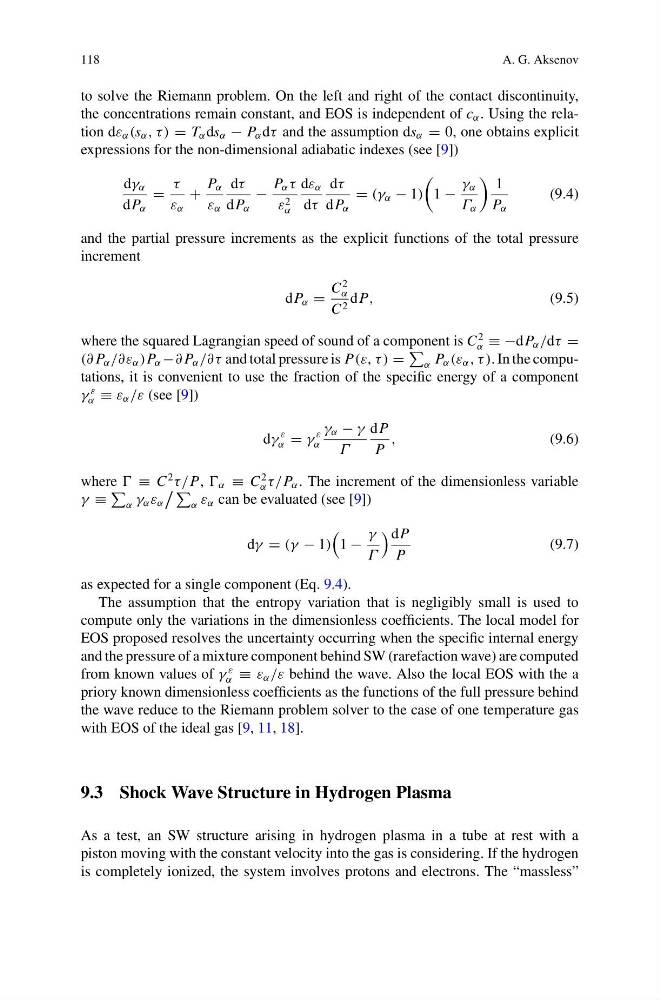
the concentrations remain constant, and EOS is independent of c α . Using the relation dε α (s α , τ ) = T α ds α − P α dτ and the assumption ds α = 0, one obtains explicit
expressions for the non-dimensional adiabatic indexes (see [9])
dγ α
dP α
=
τ
ε α
+
P α
ε α
dτ
dP α
−
P α τ
ε 2
α
dε α
dτ
dτ
dP α
= (γ α − 1)
1 −
γ α
Γ α
1
P α
(9.4)
and the partial pressure increments as the explicit functions of the total pressure
increment
dP α =
C
2
α
C 2 dP,
(9.5)
where the squared Lagrangian speed of sound of a component is C
2
α ≡ −dP α /dτ =
(∂ P α /∂ε α )P α −∂ P α /∂τ and total pressure is P(ε, τ ) =
α P α (ε α , τ ). In the computations, it is convenient to use the fraction of the specific energy of a component
γ
ε
α ≡ ε α /ε (see [9])
dγ
ε
α = γ
ε
α
γ α − γ
Γ
dP
P
,
(9.6)
where ≡ C
2
τ/P, α ≡ C
2
α τ/P α . The increment of the dimensionless variable
γ ≡
α γ α ε α
α ε α can be evaluated (see [9])
dγ = (γ − 1)
1 −
γ
Γ
dP
P
(9.7)
as expected for a single component (Eq. 9.4).
The assumption that the entropy variation that is negligibly small is used to
compute only the variations in the dimensionless coefficients. The local model for
EOS proposed resolves the uncertainty occurring when the specific internal energy
and the pressure of a mixture component behind SW (rarefaction wave) are computed
from known values of γ
ε
α ≡ ε α /ε behind the wave. Also the local EOS with the a
priory known dimensionless coefficients as the functions of the full pressure behind
the wave reduce to the Riemann problem solver to the case of one temperature gas
with EOS of the ideal gas [9, 11, 18].
9.3 Shock Wave Structure in Hydrogen Plasma
As a test, an SW structure arising in hydrogen plasma in a tube at rest with a
piston moving with the constant velocity into the gas is considering. If the hydrogen
is completely ionized, the system involves protons and electrons. The “massless”
A. G. Aksenov
to solve the Riemann problem. On the left and right of the contact discontinuity,
the concentrations remain constant, and EOS is independent of c α . Using the relation dε α (s α , τ ) = T α ds α − P α dτ and the assumption ds α = 0, one obtains explicit
expressions for the non-dimensional adiabatic indexes (see [9])
dγ α
dP α
=
τ
ε α
+
P α
ε α
dτ
dP α
−
P α τ
ε 2
α
dε α
dτ
dτ
dP α
= (γ α − 1)
1 −
γ α
Γ α
1
P α
(9.4)
and the partial pressure increments as the explicit functions of the total pressure
increment
dP α =
C
2
α
C 2 dP,
(9.5)
where the squared Lagrangian speed of sound of a component is C
2
α ≡ −dP α /dτ =
(∂ P α /∂ε α )P α −∂ P α /∂τ and total pressure is P(ε, τ ) =
α P α (ε α , τ ). In the computations, it is convenient to use the fraction of the specific energy of a component
γ
ε
α ≡ ε α /ε (see [9])
dγ
ε
α = γ
ε
α
γ α − γ
Γ
dP
P
,
(9.6)
where ≡ C
2
τ/P, α ≡ C
2
α τ/P α . The increment of the dimensionless variable
γ ≡
α γ α ε α
α ε α can be evaluated (see [9])
dγ = (γ − 1)
1 −
γ
Γ
dP
P
(9.7)
as expected for a single component (Eq. 9.4).
The assumption that the entropy variation that is negligibly small is used to
compute only the variations in the dimensionless coefficients. The local model for
EOS proposed resolves the uncertainty occurring when the specific internal energy
and the pressure of a mixture component behind SW (rarefaction wave) are computed
from known values of γ
ε
α ≡ ε α /ε behind the wave. Also the local EOS with the a
priory known dimensionless coefficients as the functions of the full pressure behind
the wave reduce to the Riemann problem solver to the case of one temperature gas
with EOS of the ideal gas [9, 11, 18].
9.3 Shock Wave Structure in Hydrogen Plasma
As a test, an SW structure arising in hydrogen plasma in a tube at rest with a
piston moving with the constant velocity into the gas is considering. If the hydrogen
is completely ionized, the system involves protons and electrons. The “massless”