

108
A. I. Lopato
Here, H = e + p is the enthalpy of a volume unit of the mixture. The upper index
“+” corresponds to the parameters on the right bound of the cell i, while the index
“−” corresponds to the left bound of the cell i + 1. The elements of Q
+
i , Q
−
i+1 are
determined using the ENO-reconstruction of the second approximation order of the
conservative variables [16]. The parameters M
+
i , M
−
i+1 , p
+
i , p
−
i+1 are calculated in
accordance with [15]. Note that the use of the AUSM scheme in the calculations is
not an obligatory requirement. Thus, in [17, 18], numerical modeling of combustion
and detonation waves was carried out using the Courant-Isaacson-Rees flux scheme.
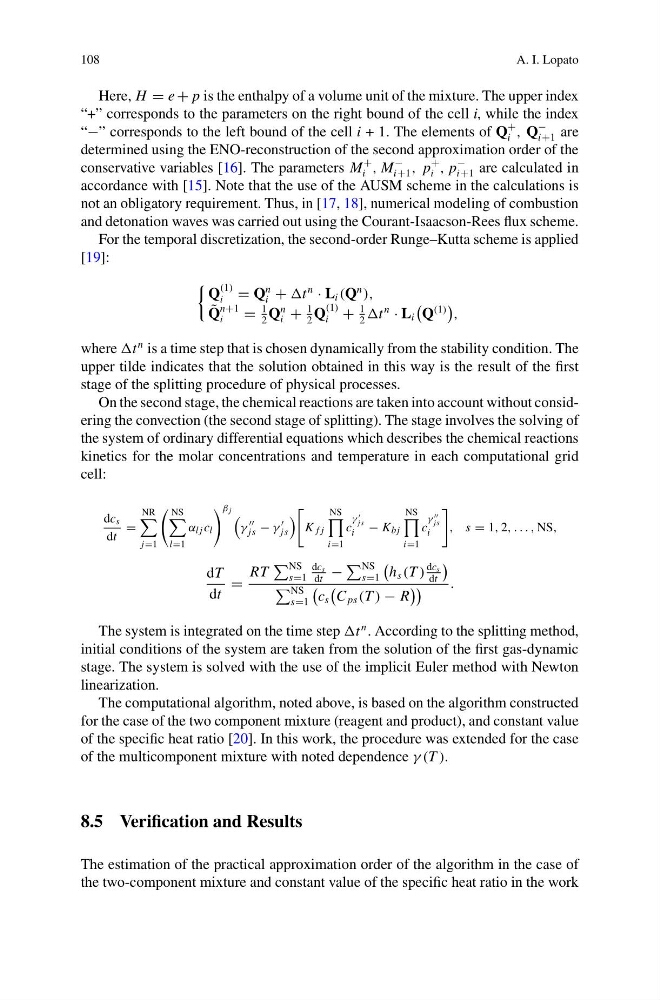
For the temporal discretization, the second-order Runge–Kutta scheme is applied
[19]:
Q
(1)
i = Q
n
i + t
n
· L i (Q
n
),
˜
Q
n+1
i
=
1
2
Q
n
i +
1
2
Q
(1)
i +
1
2
t
n
· L i
Q
(1)
,
where t
n is a time step that is chosen dynamically from the stability condition. The
upper tilde indicates that the solution obtained in this way is the result of the first
stage of the splitting procedure of physical processes.
On the second stage, the chemical reactions are taken into account without considering the convection (the second stage of splitting). The stage involves the solving of
the system of ordinary differential equations which describes the chemical reactions
kinetics for the molar concentrations and temperature in each computational grid
cell:
dc s
dt
=
NR
j=1
NS
l=1
α l j c l
β j
γ
js − γ
js
K f j
NS
i=1
c
γ
js
i − K bj
NS
i=1
c
γ
js
i
, s = 1, 2, . . . , NS,
dT
dt
=
RT
NS
s=1
dc s
dt
−
NS
s=1
h s (T )
dc s
dt
NS
s=1
c s
C ps (T ) − R
.
The system is integrated on the time step t
n . According to the splitting method,
initial conditions of the system are taken from the solution of the first gas-dynamic
stage. The system is solved with the use of the implicit Euler method with Newton
linearization.
The computational algorithm, noted above, is based on the algorithm constructed
for the case of the two component mixture (reagent and product), and constant value
of the specific heat ratio [20]. In this work, the procedure was extended for the case
of the multicomponent mixture with noted dependence γ (T ).
8.5 Verification and Results
The estimation of the practical approximation order of the algorithm in the case of
the two-component mixture and constant value of the specific heat ratio in the work
A. I. Lopato
Here, H = e + p is the enthalpy of a volume unit of the mixture. The upper index
“+” corresponds to the parameters on the right bound of the cell i, while the index
“−” corresponds to the left bound of the cell i + 1. The elements of Q
+
i , Q
−
i+1 are
determined using the ENO-reconstruction of the second approximation order of the
conservative variables [16]. The parameters M
+
i , M
−
i+1 , p
+
i , p
−
i+1 are calculated in
accordance with [15]. Note that the use of the AUSM scheme in the calculations is
not an obligatory requirement. Thus, in [17, 18], numerical modeling of combustion
and detonation waves was carried out using the Courant-Isaacson-Rees flux scheme.
For the temporal discretization, the second-order Runge–Kutta scheme is applied
[19]:
Q
(1)
i = Q
n
i + t
n
· L i (Q
n
),
˜
Q
n+1
i
=
1
2
Q
n
i +
1
2
Q
(1)
i +
1
2
t
n
· L i
Q
(1)
,
where t
n is a time step that is chosen dynamically from the stability condition. The
upper tilde indicates that the solution obtained in this way is the result of the first
stage of the splitting procedure of physical processes.
On the second stage, the chemical reactions are taken into account without considering the convection (the second stage of splitting). The stage involves the solving of
the system of ordinary differential equations which describes the chemical reactions
kinetics for the molar concentrations and temperature in each computational grid
cell:
dc s
dt
=
NR
j=1
NS
l=1
α l j c l
β j
γ
js − γ
js
K f j
NS
i=1
c
γ
js
i − K bj
NS
i=1
c
γ
js
i
, s = 1, 2, . . . , NS,
dT
dt
=
RT
NS
s=1
dc s
dt
−
NS
s=1
h s (T )
dc s
dt
NS
s=1
c s
C ps (T ) − R
.
The system is integrated on the time step t
n . According to the splitting method,
initial conditions of the system are taken from the solution of the first gas-dynamic
stage. The system is solved with the use of the implicit Euler method with Newton
linearization.
The computational algorithm, noted above, is based on the algorithm constructed
for the case of the two component mixture (reagent and product), and constant value
of the specific heat ratio [20]. In this work, the procedure was extended for the case
of the multicomponent mixture with noted dependence γ (T ).
8.5 Verification and Results
The estimation of the practical approximation order of the algorithm in the case of
the two-component mixture and constant value of the specific heat ratio in the work