

8 Some Aspects on Pulsating Detonation Wave Numerical Simulation …
107
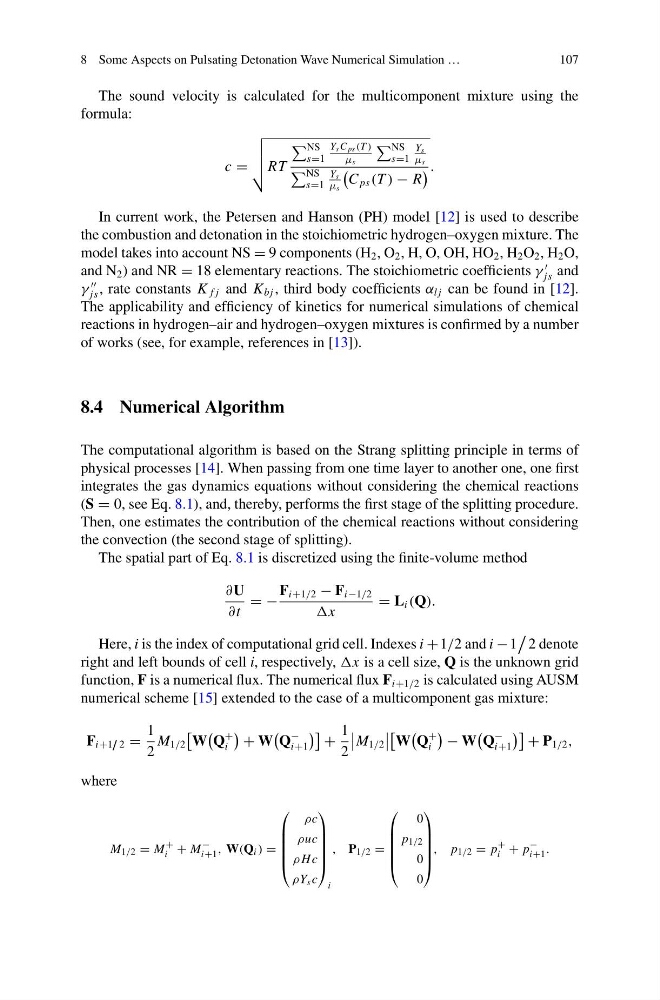
The sound velocity is calculated for the multicomponent mixture using the
formula:
c =
RT
NS
s=1
Y s C ps (T )
μ s
NS
s=1
Y s
μ s
NS
s=1
Y s
μ s
C ps (T ) − R
.
In current work, the Petersen and Hanson (PH) model [12] is used to describe
the combustion and detonation in the stoichiometric hydrogen–oxygen mixture. The
model takes into account NS = 9 components (H 2 , O 2 , H, O, OH, HO 2 , H 2 O 2 , H 2 O,
and N 2 ) and NR = 18 elementary reactions. The stoichiometric coefficients γ
js and
γ
js , rate constants K f j and K bj , third body coefficients α l j can be found in [12].
The applicability and efficiency of kinetics for numerical simulations of chemical
reactions in hydrogen–air and hydrogen–oxygen mixtures is confirmed by a number
of works (see, for example, references in [13]).
8.4 Numerical Algorithm
The computational algorithm is based on the Strang splitting principle in terms of
physical processes [14]. When passing from one time layer to another one, one first
integrates the gas dynamics equations without considering the chemical reactions
(S = 0, see Eq. 8.1), and, thereby, performs the first stage of the splitting procedure.
Then, one estimates the contribution of the chemical reactions without considering
the convection (the second stage of splitting).
The spatial part of Eq. 8.1 is discretized using the finite-volume method
∂U
∂t
= −
F i+1/2 − F i−1/2
x
= L i (Q).
Here, i is the index of computational grid cell. Indexes i + 1/2 and i − 1
2 denote
right and left bounds of cell i, respectively, x is a cell size, Q is the unknown grid
function, F is a numerical flux. The numerical flux F i+1/2 is calculated using AUSM
numerical scheme [15] extended to the case of a multicomponent gas mixture:
F i+1 / 2 =
1
2
M 1/2
W
Q
+
i
+ W
Q
−
i+1
+
1
2
M 1/2
W
Q
+
i
− W
Q
−
i+1
+ P 1/2 ,
where
M 1/2 = M
+
i + M
−
i+1 , W(Q i ) =
⎛
⎜
⎜
⎜
⎜
⎝
ρc
ρuc
ρ Hc
ρY s c
⎞
⎟
⎟
⎟
⎟
⎠
i
, P 1/2 =
⎛
⎜
⎜
⎜
⎜
⎝
0
p 1/2
0
0
⎞
⎟
⎟
⎟
⎟
⎠
, p 1/2 = p
+
i + p
−
i+1 .
107
The sound velocity is calculated for the multicomponent mixture using the
formula:
c =
RT
NS
s=1
Y s C ps (T )
μ s
NS
s=1
Y s
μ s
NS
s=1
Y s
μ s
C ps (T ) − R
.
In current work, the Petersen and Hanson (PH) model [12] is used to describe
the combustion and detonation in the stoichiometric hydrogen–oxygen mixture. The
model takes into account NS = 9 components (H 2 , O 2 , H, O, OH, HO 2 , H 2 O 2 , H 2 O,
and N 2 ) and NR = 18 elementary reactions. The stoichiometric coefficients γ
js and
γ
js , rate constants K f j and K bj , third body coefficients α l j can be found in [12].
The applicability and efficiency of kinetics for numerical simulations of chemical
reactions in hydrogen–air and hydrogen–oxygen mixtures is confirmed by a number
of works (see, for example, references in [13]).
8.4 Numerical Algorithm
The computational algorithm is based on the Strang splitting principle in terms of
physical processes [14]. When passing from one time layer to another one, one first
integrates the gas dynamics equations without considering the chemical reactions
(S = 0, see Eq. 8.1), and, thereby, performs the first stage of the splitting procedure.
Then, one estimates the contribution of the chemical reactions without considering
the convection (the second stage of splitting).
The spatial part of Eq. 8.1 is discretized using the finite-volume method
∂U
∂t
= −
F i+1/2 − F i−1/2
x
= L i (Q).
Here, i is the index of computational grid cell. Indexes i + 1/2 and i − 1
2 denote
right and left bounds of cell i, respectively, x is a cell size, Q is the unknown grid
function, F is a numerical flux. The numerical flux F i+1/2 is calculated using AUSM
numerical scheme [15] extended to the case of a multicomponent gas mixture:
F i+1 / 2 =
1
2
M 1/2
W
Q
+
i
+ W
Q
−
i+1
+
1
2
M 1/2
W
Q
+
i
− W
Q
−
i+1
+ P 1/2 ,
where
M 1/2 = M
+
i + M
−
i+1 , W(Q i ) =
⎛
⎜
⎜
⎜
⎜
⎝
ρc
ρuc
ρ Hc
ρY s c
⎞
⎟
⎟
⎟
⎟
⎠
i
, P 1/2 =
⎛
⎜
⎜
⎜
⎜
⎝
0
p 1/2
0
0
⎞
⎟
⎟
⎟
⎟
⎠
, p 1/2 = p
+
i + p
−
i+1 .