

106
A. I. Lopato
The aim of current work is the mathematical modeling of pulsating DW propagation in the hydrogen–air mixture using the numerical method of the second
approximation order and detailed chemical kinetics model.
8.3 Mathematical Model
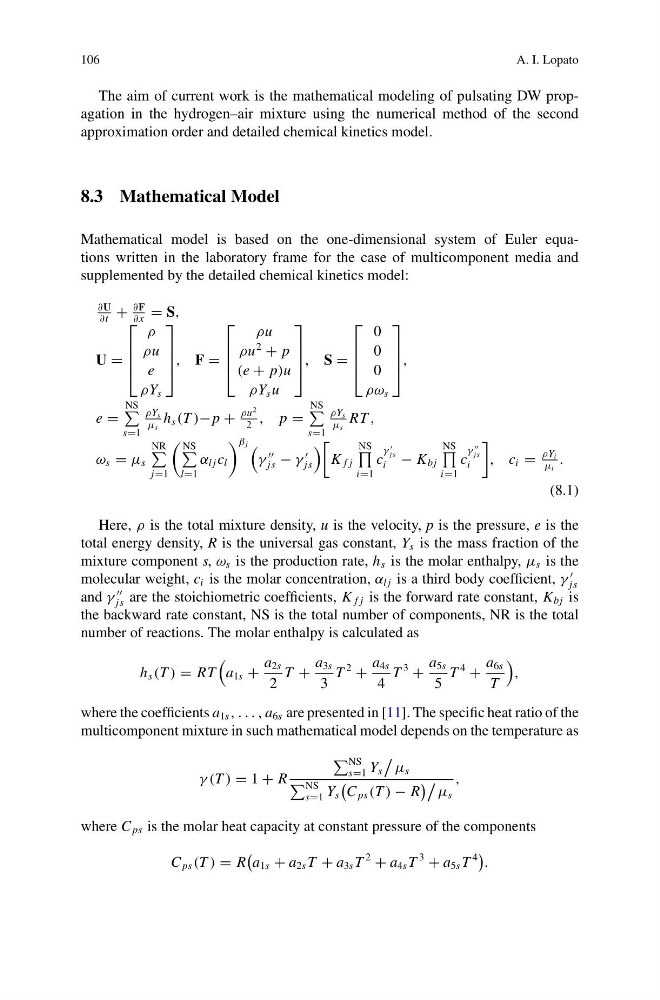
Mathematical model is based on the one-dimensional system of Euler equations written in the laboratory frame for the case of multicomponent media and
supplemented by the detailed chemical kinetics model:
∂U
∂t
+
∂F
∂ x
= S,
U =
⎡
⎢
⎢
⎣
ρ
ρu
e
ρY s
⎤
⎥
⎥
⎦ , F =
⎡
⎢
⎢
⎣
ρu
ρu
2
+ p
(e + p)u
ρY s u
⎤
⎥
⎥
⎦ , S =
⎡
⎢
⎢
⎣
0
0
0
ρω s
⎤
⎥
⎥
⎦ ,
e =
NS
s=1
ρY s
μ s
h s (T )− p +
ρu
2
2
, p =
NS
s=1
ρY s
μ s
RT ,
ω s = μ s
NR
j=1
NS
l=1
α l j c l
β j
γ
js − γ
js
K f j
NS
i=1
c
γ
js
i − K bj
NS
i=1
c
γ
js
i
, c i =
ρY i
μ i
.
(8.1)
Here, ρ is the total mixture density, u is the velocity, p is the pressure, e is the
total energy density, R is the universal gas constant, Y s is the mass fraction of the
mixture component s, ω s is the production rate, h s is the molar enthalpy, μ s is the
molecular weight, c i is the molar concentration, α l j is a third body coefficient, γ
js
and γ
js are the stoichiometric coefficients, K f j is the forward rate constant, K bj is
the backward rate constant, NS is the total number of components, NR is the total
number of reactions. The molar enthalpy is calculated as
h s (T ) = RT
a 1s +
a 2s
2
T +
a 3s
3
T
2
+
a 4s
4
T
3
+
a 5s
5
T
4
+
a 6s
T
,
where the coefficients a 1s , . . . , a 6s are presented in [11]. The specific heat ratio of the
multicomponent mixture in such mathematical model depends on the temperature as
γ (T ) = 1 + R
NS
s=1 Y s
μ s
NS
s=1 Y s
C ps (T ) − R
μ s
,
where C ps is the molar heat capacity at constant pressure of the components
C ps (T ) = R
a 1s + a 2s T + a 3s T
2
+ a 4s T
3
+ a 5s T
4
.
A. I. Lopato
The aim of current work is the mathematical modeling of pulsating DW propagation in the hydrogen–air mixture using the numerical method of the second
approximation order and detailed chemical kinetics model.
8.3 Mathematical Model
Mathematical model is based on the one-dimensional system of Euler equations written in the laboratory frame for the case of multicomponent media and
supplemented by the detailed chemical kinetics model:
∂U
∂t
+
∂F
∂ x
= S,
U =
⎡
⎢
⎢
⎣
ρ
ρu
e
ρY s
⎤
⎥
⎥
⎦ , F =
⎡
⎢
⎢
⎣
ρu
ρu
2
+ p
(e + p)u
ρY s u
⎤
⎥
⎥
⎦ , S =
⎡
⎢
⎢
⎣
0
0
0
ρω s
⎤
⎥
⎥
⎦ ,
e =
NS
s=1
ρY s
μ s
h s (T )− p +
ρu
2
2
, p =
NS
s=1
ρY s
μ s
RT ,
ω s = μ s
NR
j=1
NS
l=1
α l j c l
β j
γ
js − γ
js
K f j
NS
i=1
c
γ
js
i − K bj
NS
i=1
c
γ
js
i
, c i =
ρY i
μ i
.
(8.1)
Here, ρ is the total mixture density, u is the velocity, p is the pressure, e is the
total energy density, R is the universal gas constant, Y s is the mass fraction of the
mixture component s, ω s is the production rate, h s is the molar enthalpy, μ s is the
molecular weight, c i is the molar concentration, α l j is a third body coefficient, γ
js
and γ
js are the stoichiometric coefficients, K f j is the forward rate constant, K bj is
the backward rate constant, NS is the total number of components, NR is the total
number of reactions. The molar enthalpy is calculated as
h s (T ) = RT
a 1s +
a 2s
2
T +
a 3s
3
T
2
+
a 4s
4
T
3
+
a 5s
5
T
4
+
a 6s
T
,
where the coefficients a 1s , . . . , a 6s are presented in [11]. The specific heat ratio of the
multicomponent mixture in such mathematical model depends on the temperature as
γ (T ) = 1 + R
NS
s=1 Y s
μ s
NS
s=1 Y s
C ps (T ) − R
μ s
,
where C ps is the molar heat capacity at constant pressure of the components
C ps (T ) = R
a 1s + a 2s T + a 3s T
2
+ a 4s T
3
+ a 5s T
4
.