

7 Numerical Simulation of Generation, Distribution, and Impact …
97
Fig. 7.4 Contribution of
different processes to the
internal energy at the initial
stage of its dynamics for
different initial conditions
U a∞ are approximately larger (20%) than in the adiabatic case. The main decrease
in the current temperature occurs somewhat longer (∼ 3 × 10
−5 s).
However, the full formulation made it possible to clarify two important effects.
Since the particle density rapidly drops with time, the recombination rate decreases
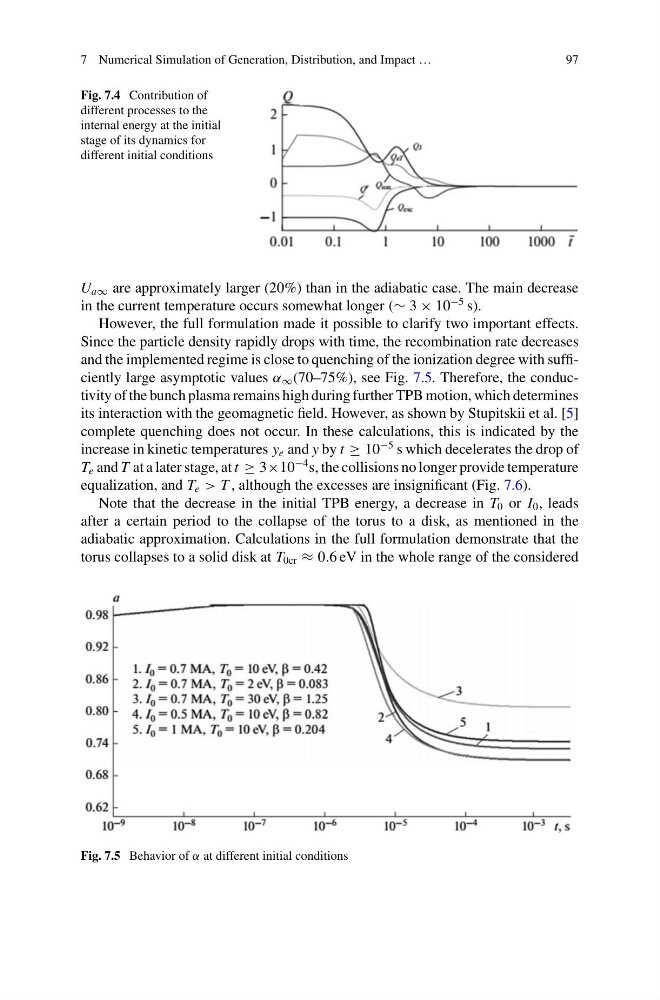
and the implemented regime is close to quenching of the ionization degree with sufficiently large asymptotic values α ∞ (70–75%), see Fig. 7.5. Therefore, the conductivity of the bunch plasma remains high during further TPB motion, which determines
its interaction with the geomagnetic field. However, as shown by Stupitskii et al. [5]
complete quenching does not occur. In these calculations, this is indicated by the
increase in kinetic temperatures y e and y by t ≥ 10
−5 s which decelerates the drop of
T e and T at a later stage, at t ≥ 3×10
−4 s, the collisions no longer provide temperature
equalization, and T e > T , although the excesses are insignificant (Fig. 7.6).
Note that the decrease in the initial TPB energy, a decrease in T 0 or I 0 , leads
after a certain period to the collapse of the torus to a disk, as mentioned in the
adiabatic approximation. Calculations in the full formulation demonstrate that the
torus collapses to a solid disk at T 0cr ≈ 0.6 eV in the whole range of the considered
Fig. 7.5 Behavior of α at different initial conditions
97
Fig. 7.4 Contribution of
different processes to the
internal energy at the initial
stage of its dynamics for
different initial conditions
U a∞ are approximately larger (20%) than in the adiabatic case. The main decrease
in the current temperature occurs somewhat longer (∼ 3 × 10
−5 s).
However, the full formulation made it possible to clarify two important effects.
Since the particle density rapidly drops with time, the recombination rate decreases
and the implemented regime is close to quenching of the ionization degree with sufficiently large asymptotic values α ∞ (70–75%), see Fig. 7.5. Therefore, the conductivity of the bunch plasma remains high during further TPB motion, which determines
its interaction with the geomagnetic field. However, as shown by Stupitskii et al. [5]
complete quenching does not occur. In these calculations, this is indicated by the
increase in kinetic temperatures y e and y by t ≥ 10
−5 s which decelerates the drop of
T e and T at a later stage, at t ≥ 3×10
−4 s, the collisions no longer provide temperature
equalization, and T e > T , although the excesses are insignificant (Fig. 7.6).
Note that the decrease in the initial TPB energy, a decrease in T 0 or I 0 , leads
after a certain period to the collapse of the torus to a disk, as mentioned in the
adiabatic approximation. Calculations in the full formulation demonstrate that the
torus collapses to a solid disk at T 0cr ≈ 0.6 eV in the whole range of the considered
Fig. 7.5 Behavior of α at different initial conditions