

98
E. L. Stupitsky et al.
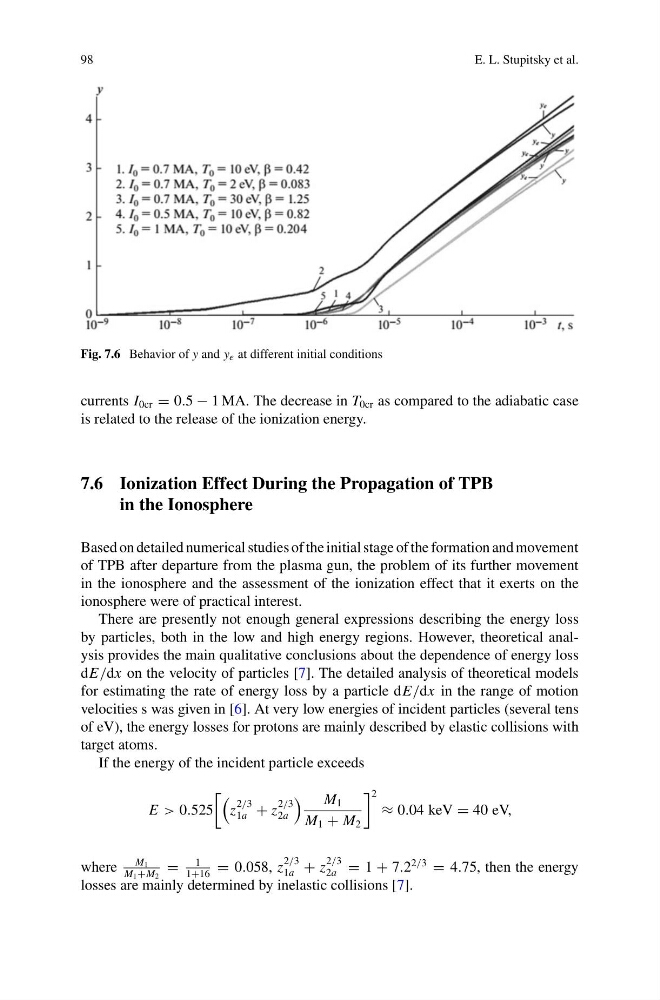
Fig. 7.6 Behavior of y and y e at different initial conditions
currents I 0cr = 0.5 − 1 MA. The decrease in T 0cr as compared to the adiabatic case
is related to the release of the ionization energy.
7.6 Ionization Effect During the Propagation of TPB
in the Ionosphere
Based on detailed numerical studies of the initial stage of the formation and movement
of TPB after departure from the plasma gun, the problem of its further movement
in the ionosphere and the assessment of the ionization effect that it exerts on the
ionosphere were of practical interest.
There are presently not enough general expressions describing the energy loss
by particles, both in the low and high energy regions. However, theoretical analysis provides the main qualitative conclusions about the dependence of energy loss
dE/dx on the velocity of particles [7]. The detailed analysis of theoretical models
for estimating the rate of energy loss by a particle dE/dx in the range of motion
velocities s was given in [6]. At very low energies of incident particles (several tens
of eV), the energy losses for protons are mainly described by elastic collisions with
target atoms.
If the energy of the incident particle exceeds
E > 0.525
z
2/3
1a + z
2/3
2a
M 1
M 1 + M 2
2
≈ 0.04 keV = 40 eV,
where
M 1
M 1 +M 2
=
1
1+16
= 0.058, z
2/3
1a + z
2/3
2a = 1 + 7.2
2/3
= 4.75, then the energy
losses are mainly determined by inelastic collisions [7].
E. L. Stupitsky et al.
Fig. 7.6 Behavior of y and y e at different initial conditions
currents I 0cr = 0.5 − 1 MA. The decrease in T 0cr as compared to the adiabatic case
is related to the release of the ionization energy.
7.6 Ionization Effect During the Propagation of TPB
in the Ionosphere
Based on detailed numerical studies of the initial stage of the formation and movement
of TPB after departure from the plasma gun, the problem of its further movement
in the ionosphere and the assessment of the ionization effect that it exerts on the
ionosphere were of practical interest.
There are presently not enough general expressions describing the energy loss
by particles, both in the low and high energy regions. However, theoretical analysis provides the main qualitative conclusions about the dependence of energy loss
dE/dx on the velocity of particles [7]. The detailed analysis of theoretical models
for estimating the rate of energy loss by a particle dE/dx in the range of motion
velocities s was given in [6]. At very low energies of incident particles (several tens
of eV), the energy losses for protons are mainly described by elastic collisions with
target atoms.
If the energy of the incident particle exceeds
E > 0.525
z
2/3
1a + z
2/3
2a
M 1
M 1 + M 2
2
≈ 0.04 keV = 40 eV,
where
M 1
M 1 +M 2
=
1
1+16
= 0.058, z
2/3
1a + z
2/3
2a = 1 + 7.2
2/3
= 4.75, then the energy
losses are mainly determined by inelastic collisions [7].