

96
E. L. Stupitsky et al.
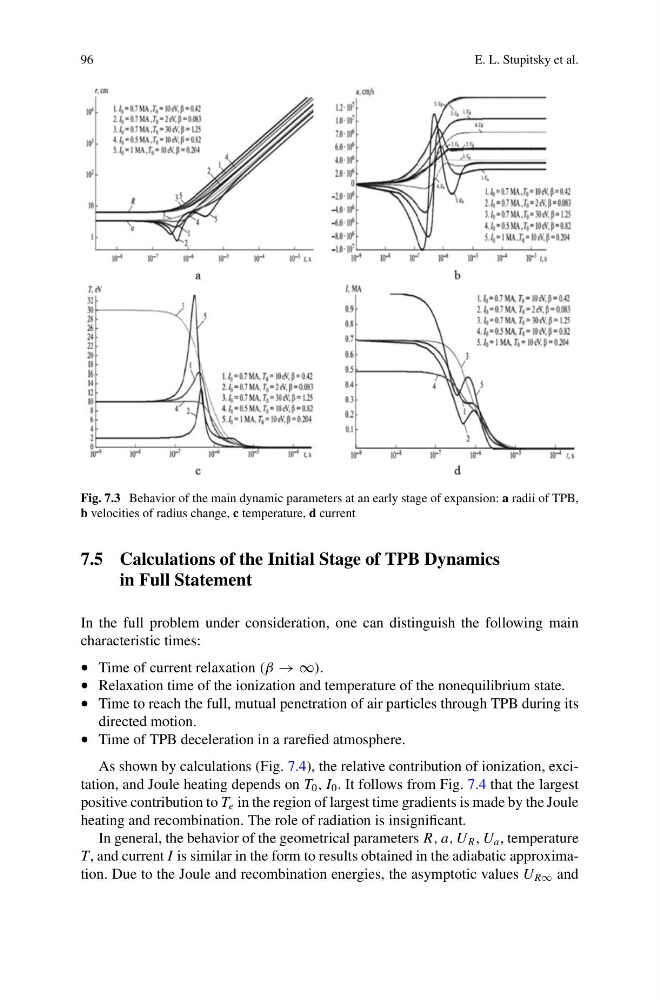
Fig. 7.3 Behavior of the main dynamic parameters at an early stage of expansion: a radii of TPB,
b velocities of radius change, c temperature, d current
7.5 Calculations of the Initial Stage of TPB Dynamics
in Full Statement
In the full problem under consideration, one can distinguish the following main
characteristic times:
• Time of current relaxation (β → ∞).
• Relaxation time of the ionization and temperature of the nonequilibrium state.
• Time to reach the full, mutual penetration of air particles through TPB during its
directed motion.
• Time of TPB deceleration in a rarefied atmosphere.
As shown by calculations (Fig. 7.4), the relative contribution of ionization, excitation, and Joule heating depends on T 0 , I 0 . It follows from Fig. 7.4 that the largest
positive contribution to T e in the region of largest time gradients is made by the Joule
heating and recombination. The role of radiation is insignificant.
In general, the behavior of the geometrical parameters R, a, U R , U a , temperature
T, and current I is similar in the form to results obtained in the adiabatic approximation. Due to the Joule and recombination energies, the asymptotic values U R∞ and
E. L. Stupitsky et al.
Fig. 7.3 Behavior of the main dynamic parameters at an early stage of expansion: a radii of TPB,
b velocities of radius change, c temperature, d current
7.5 Calculations of the Initial Stage of TPB Dynamics
in Full Statement
In the full problem under consideration, one can distinguish the following main
characteristic times:
• Time of current relaxation (β → ∞).
• Relaxation time of the ionization and temperature of the nonequilibrium state.
• Time to reach the full, mutual penetration of air particles through TPB during its
directed motion.
• Time of TPB deceleration in a rarefied atmosphere.
As shown by calculations (Fig. 7.4), the relative contribution of ionization, excitation, and Joule heating depends on T 0 , I 0 . It follows from Fig. 7.4 that the largest
positive contribution to T e in the region of largest time gradients is made by the Joule
heating and recombination. The role of radiation is insignificant.
In general, the behavior of the geometrical parameters R, a, U R , U a , temperature
T, and current I is similar in the form to results obtained in the adiabatic approximation. Due to the Joule and recombination energies, the asymptotic values U R∞ and