

7 Numerical Simulation of Generation, Distribution, and Impact …
95
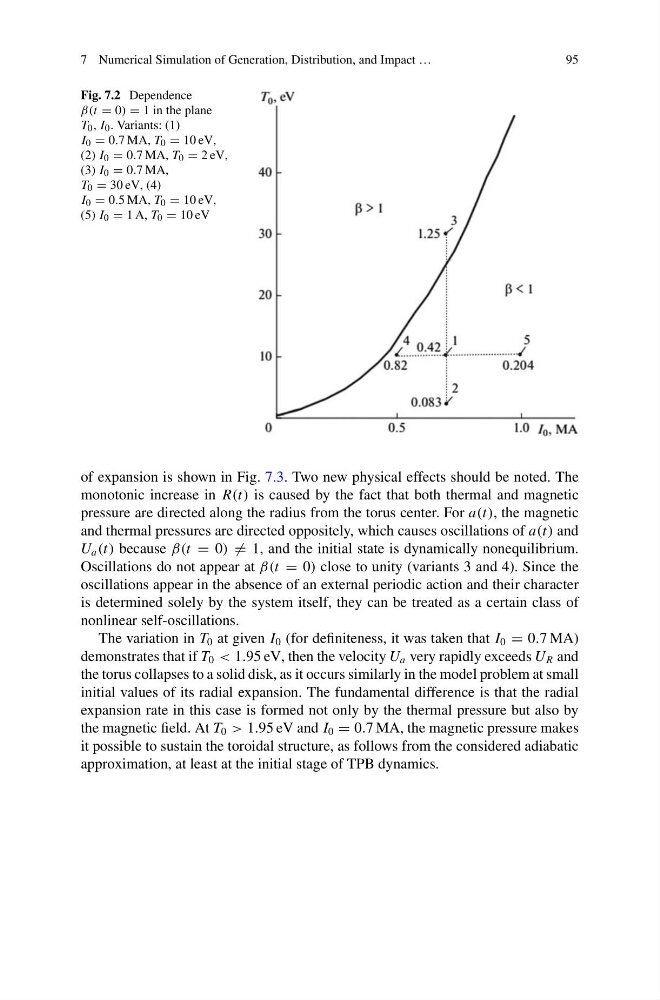
Fig. 7.2 Dependence
β(t = 0) = 1 in the plane
T 0 , I 0 . Variants: (1)
I 0 = 0.7 MA, T 0 = 10 eV,
(2) I 0 = 0.7 MA, T 0 = 2 eV,
(3) I 0 = 0.7 MA,
T 0 = 30 eV, (4)
I 0 = 0.5 MA, T 0 = 10 eV,
(5) I 0 = 1 A, T 0 = 10 eV
of expansion is shown in Fig. 7.3. Two new physical effects should be noted. The
monotonic increase in R(t) is caused by the fact that both thermal and magnetic
pressure are directed along the radius from the torus center. For a(t), the magnetic
and thermal pressures are directed oppositely, which causes oscillations of a(t) and
U a (t) because β(t = 0) = 1, and the initial state is dynamically nonequilibrium.
Oscillations do not appear at β(t = 0) close to unity (variants 3 and 4). Since the
oscillations appear in the absence of an external periodic action and their character
is determined solely by the system itself, they can be treated as a certain class of
nonlinear self-oscillations.
The variation in T 0 at given I 0 (for definiteness, it was taken that I 0 = 0.7 MA)
demonstrates that if T 0 < 1.95 eV, then the velocity U a very rapidly exceeds U R and
the torus collapses to a solid disk, as it occurs similarly in the model problem at small
initial values of its radial expansion. The fundamental difference is that the radial
expansion rate in this case is formed not only by the thermal pressure but also by
the magnetic field. At T 0 > 1.95 eV and I 0 = 0.7 MA, the magnetic pressure makes
it possible to sustain the toroidal structure, as follows from the considered adiabatic
approximation, at least at the initial stage of TPB dynamics.
95
Fig. 7.2 Dependence
β(t = 0) = 1 in the plane
T 0 , I 0 . Variants: (1)
I 0 = 0.7 MA, T 0 = 10 eV,
(2) I 0 = 0.7 MA, T 0 = 2 eV,
(3) I 0 = 0.7 MA,
T 0 = 30 eV, (4)
I 0 = 0.5 MA, T 0 = 10 eV,
(5) I 0 = 1 A, T 0 = 10 eV
of expansion is shown in Fig. 7.3. Two new physical effects should be noted. The
monotonic increase in R(t) is caused by the fact that both thermal and magnetic
pressure are directed along the radius from the torus center. For a(t), the magnetic
and thermal pressures are directed oppositely, which causes oscillations of a(t) and
U a (t) because β(t = 0) = 1, and the initial state is dynamically nonequilibrium.
Oscillations do not appear at β(t = 0) close to unity (variants 3 and 4). Since the
oscillations appear in the absence of an external periodic action and their character
is determined solely by the system itself, they can be treated as a certain class of
nonlinear self-oscillations.
The variation in T 0 at given I 0 (for definiteness, it was taken that I 0 = 0.7 MA)
demonstrates that if T 0 < 1.95 eV, then the velocity U a very rapidly exceeds U R and
the torus collapses to a solid disk, as it occurs similarly in the model problem at small
initial values of its radial expansion. The fundamental difference is that the radial
expansion rate in this case is formed not only by the thermal pressure but also by
the magnetic field. At T 0 > 1.95 eV and I 0 = 0.7 MA, the magnetic pressure makes
it possible to sustain the toroidal structure, as follows from the considered adiabatic
approximation, at least at the initial stage of TPB dynamics.