

92
A. Chanda et al.
Engineering and animal science researchers have to cooperate and activate directive 97-12 and regulation 178-2002 to monitor and control farms for food safety
and security, public health, animal health, and welfare. Sensors based on molecular
imprinting [40] creates template-shaped cavities in polymer matrices with memory of
the template molecules with the same merits as of Lock and the Key theory/paradigm
and are of great applications. Since the 90’s, chemists succeeded in preparation of
imprinted polymers (artificial receptor/plastic antibody) that imitating/mimicing biological natural molecular recognition explained by Lock and the key theory in the
early 40’s. In the last decade, the use of molecularly imprinted polymers (MIPs) in
sensors have played high recognition ability, known as plastic antibodies, to extract
target analytes from complicated sample matrices [16].
Analytes are inorganic elements up to macromolecular biomarkers of air, water
and soil quality parameters of valuable insight into the status of both crops and fish
in a highly localized way in integrated greenhouse farming like aquaponics strategy.
Incorporation of MIP technology as advanced materials in sensor development and
WSN leads to innovations in smart systems flourishing applications of precision
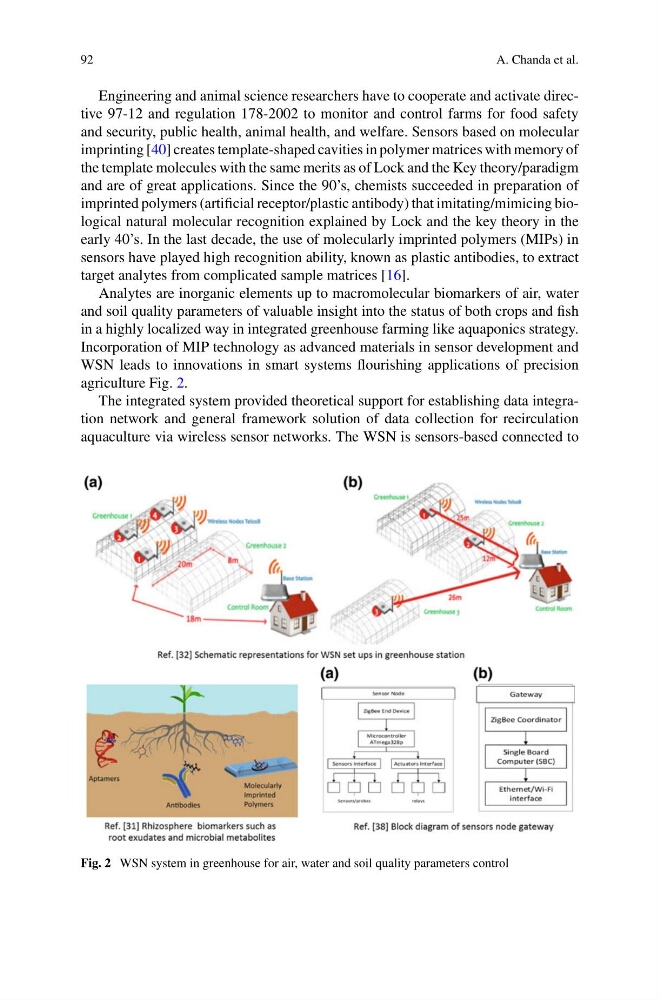
agriculture Fig. 2.
The integrated system provided theoretical support for establishing data integration network and general framework solution of data collection for recirculation
aquaculture via wireless sensor networks. The WSN is sensors-based connected to
Fig. 2 WSN system in greenhouse for air, water and soil quality parameters control
A. Chanda et al.
Engineering and animal science researchers have to cooperate and activate directive 97-12 and regulation 178-2002 to monitor and control farms for food safety
and security, public health, animal health, and welfare. Sensors based on molecular
imprinting [40] creates template-shaped cavities in polymer matrices with memory of
the template molecules with the same merits as of Lock and the Key theory/paradigm
and are of great applications. Since the 90’s, chemists succeeded in preparation of
imprinted polymers (artificial receptor/plastic antibody) that imitating/mimicing biological natural molecular recognition explained by Lock and the key theory in the
early 40’s. In the last decade, the use of molecularly imprinted polymers (MIPs) in
sensors have played high recognition ability, known as plastic antibodies, to extract
target analytes from complicated sample matrices [16].
Analytes are inorganic elements up to macromolecular biomarkers of air, water
and soil quality parameters of valuable insight into the status of both crops and fish
in a highly localized way in integrated greenhouse farming like aquaponics strategy.
Incorporation of MIP technology as advanced materials in sensor development and
WSN leads to innovations in smart systems flourishing applications of precision
agriculture Fig. 2.
The integrated system provided theoretical support for establishing data integration network and general framework solution of data collection for recirculation
aquaculture via wireless sensor networks. The WSN is sensors-based connected to
Fig. 2 WSN system in greenhouse for air, water and soil quality parameters control