

Impact of Climate Change on Plant-Associated Fungi
91
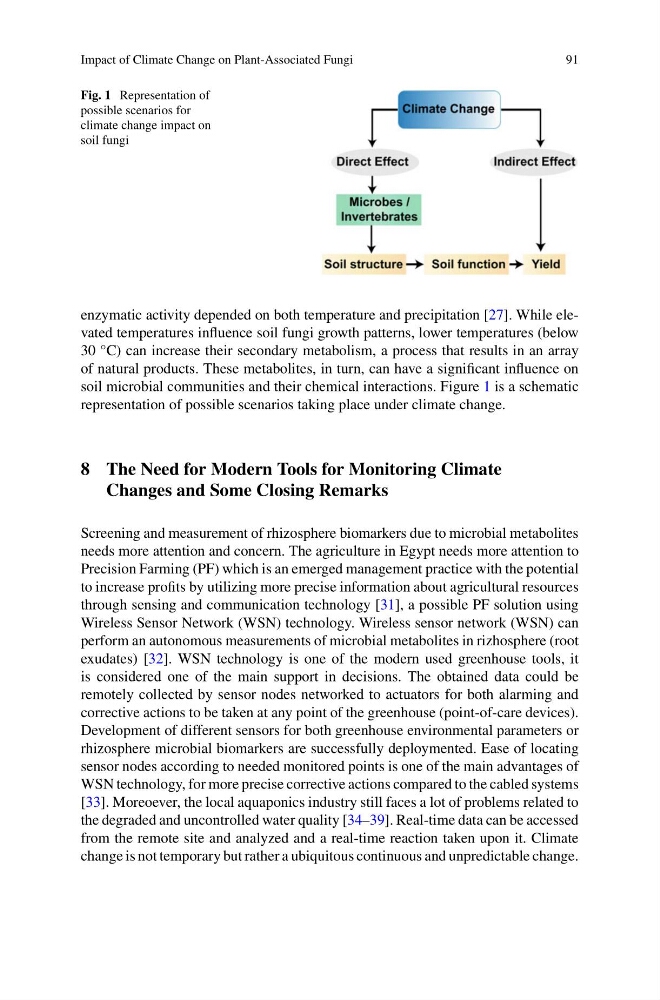
Fig. 1 Representation of
possible scenarios for
climate change impact on
soil fungi
enzymatic activity depended on both temperature and precipitation [27]. While elevated temperatures influence soil fungi growth patterns, lower temperatures (below
30 °C) can increase their secondary metabolism, a process that results in an array
of natural products. These metabolites, in turn, can have a significant influence on
soil microbial communities and their chemical interactions. Figure 1 is a schematic
representation of possible scenarios taking place under climate change.
8 The Need for Modern Tools for Monitoring Climate
Changes and Some Closing Remarks
Screening and measurement of rhizosphere biomarkers due to microbial metabolites
needs more attention and concern. The agriculture in Egypt needs more attention to
Precision Farming (PF) which is an emerged management practice with the potential
to increase profits by utilizing more precise information about agricultural resources
through sensing and communication technology [31], a possible PF solution using
Wireless Sensor Network (WSN) technology. Wireless sensor network (WSN) can
perform an autonomous measurements of microbial metabolites in rizhosphere (root
exudates) [32]. WSN technology is one of the modern used greenhouse tools, it
is considered one of the main support in decisions. The obtained data could be
remotely collected by sensor nodes networked to actuators for both alarming and
corrective actions to be taken at any point of the greenhouse (point-of-care devices).
Development of different sensors for both greenhouse environmental parameters or
rhizosphere microbial biomarkers are successfully deploymented. Ease of locating
sensor nodes according to needed monitored points is one of the main advantages of
WSN technology, for more precise corrective actions compared to the cabled systems
[33]. Moreoever, the local aquaponics industry still faces a lot of problems related to
the degraded and uncontrolled water quality [34–39]. Real-time data can be accessed
from the remote site and analyzed and a real-time reaction taken upon it. Climate
change is not temporary but rather a ubiquitous continuous and unpredictable change.
91
Fig. 1 Representation of
possible scenarios for
climate change impact on
soil fungi
enzymatic activity depended on both temperature and precipitation [27]. While elevated temperatures influence soil fungi growth patterns, lower temperatures (below
30 °C) can increase their secondary metabolism, a process that results in an array
of natural products. These metabolites, in turn, can have a significant influence on
soil microbial communities and their chemical interactions. Figure 1 is a schematic
representation of possible scenarios taking place under climate change.
8 The Need for Modern Tools for Monitoring Climate
Changes and Some Closing Remarks
Screening and measurement of rhizosphere biomarkers due to microbial metabolites
needs more attention and concern. The agriculture in Egypt needs more attention to
Precision Farming (PF) which is an emerged management practice with the potential
to increase profits by utilizing more precise information about agricultural resources
through sensing and communication technology [31], a possible PF solution using
Wireless Sensor Network (WSN) technology. Wireless sensor network (WSN) can
perform an autonomous measurements of microbial metabolites in rizhosphere (root
exudates) [32]. WSN technology is one of the modern used greenhouse tools, it
is considered one of the main support in decisions. The obtained data could be
remotely collected by sensor nodes networked to actuators for both alarming and
corrective actions to be taken at any point of the greenhouse (point-of-care devices).
Development of different sensors for both greenhouse environmental parameters or
rhizosphere microbial biomarkers are successfully deploymented. Ease of locating
sensor nodes according to needed monitored points is one of the main advantages of
WSN technology, for more precise corrective actions compared to the cabled systems
[33]. Moreoever, the local aquaponics industry still faces a lot of problems related to
the degraded and uncontrolled water quality [34–39]. Real-time data can be accessed
from the remote site and analyzed and a real-time reaction taken upon it. Climate
change is not temporary but rather a ubiquitous continuous and unpredictable change.