

590
S. A. Zahran
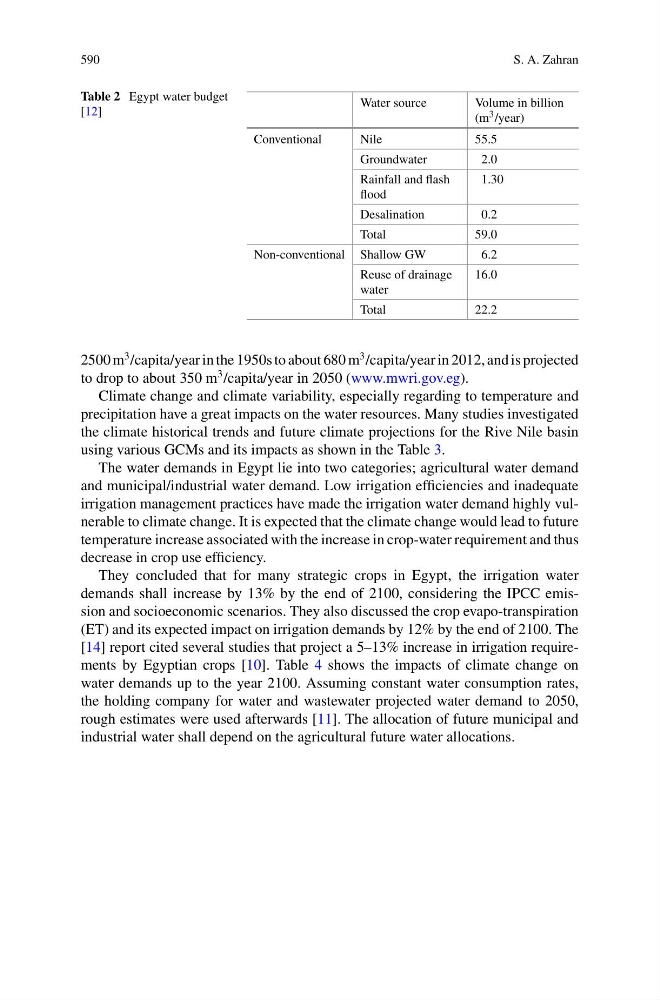
Table 2 Egypt water budget
[12]
Water source
Volume in billion
(m 3 /year)
Conventional
Nile
55.5
Groundwater
2.0
Rainfall and flash
flood
1.30
Desalination
0.2
Total
59.0
Non-conventional Shallow GW
6.2
Reuse of drainage
water
16.0
Total
22.2
2500 m
3 /capita/year in the 1950s to about 680 m
3 /capita/year in 2012, and is projected
to drop to about 350 m
3 /capita/year in 2050 (www.mwri.gov.eg).
Climate change and climate variability, especially regarding to temperature and
precipitation have a great impacts on the water resources. Many studies investigated
the climate historical trends and future climate projections for the Rive Nile basin
using various GCMs and its impacts as shown in the Table 3.
The water demands in Egypt lie into two categories; agricultural water demand
and municipal/industrial water demand. Low irrigation efficiencies and inadequate
irrigation management practices have made the irrigation water demand highly vulnerable to climate change. It is expected that the climate change would lead to future
temperature increase associated with the increase in crop-water requirement and thus
decrease in crop use efficiency.
They concluded that for many strategic crops in Egypt, the irrigation water
demands shall increase by 13% by the end of 2100, considering the IPCC emission and socioeconomic scenarios. They also discussed the crop evapo-transpiration
(ET) and its expected impact on irrigation demands by 12% by the end of 2100. The
[14] report cited several studies that project a 5–13% increase in irrigation requirements by Egyptian crops [10]. Table 4 shows the impacts of climate change on
water demands up to the year 2100. Assuming constant water consumption rates,
the holding company for water and wastewater projected water demand to 2050,
rough estimates were used afterwards [11]. The allocation of future municipal and
industrial water shall depend on the agricultural future water allocations.
S. A. Zahran
Table 2 Egypt water budget
[12]
Water source
Volume in billion
(m 3 /year)
Conventional
Nile
55.5
Groundwater
2.0
Rainfall and flash
flood
1.30
Desalination
0.2
Total
59.0
Non-conventional Shallow GW
6.2
Reuse of drainage
water
16.0
Total
22.2
2500 m
3 /capita/year in the 1950s to about 680 m
3 /capita/year in 2012, and is projected
to drop to about 350 m
3 /capita/year in 2050 (www.mwri.gov.eg).
Climate change and climate variability, especially regarding to temperature and
precipitation have a great impacts on the water resources. Many studies investigated
the climate historical trends and future climate projections for the Rive Nile basin
using various GCMs and its impacts as shown in the Table 3.
The water demands in Egypt lie into two categories; agricultural water demand
and municipal/industrial water demand. Low irrigation efficiencies and inadequate
irrigation management practices have made the irrigation water demand highly vulnerable to climate change. It is expected that the climate change would lead to future
temperature increase associated with the increase in crop-water requirement and thus
decrease in crop use efficiency.
They concluded that for many strategic crops in Egypt, the irrigation water
demands shall increase by 13% by the end of 2100, considering the IPCC emission and socioeconomic scenarios. They also discussed the crop evapo-transpiration
(ET) and its expected impact on irrigation demands by 12% by the end of 2100. The
[14] report cited several studies that project a 5–13% increase in irrigation requirements by Egyptian crops [10]. Table 4 shows the impacts of climate change on
water demands up to the year 2100. Assuming constant water consumption rates,
the holding company for water and wastewater projected water demand to 2050,
rough estimates were used afterwards [11]. The allocation of future municipal and
industrial water shall depend on the agricultural future water allocations.