

An Overview of Paleo-Climate Evidence in Egypt
23
2 Palaeoclimate Through Geological Time
The dramatic instability of the Earth’s climate is a point of debate. Many hypotheses
have been proposed to explain the climate variations through the geologic time such
as changes in solar radiance due to the instability of earth’s Orbital and Milankovitch
cycles, change in the greenhouse gases (carbon dioxide or methane) level in the
atmosphere [2], or change in the Oceanic thermohaline circulation. The climate can
be affected by two different major processes; internal processes such as changes
in the atmosphere, ice, vegetation, and changes in the ocean and land surface; and
external processes like changes in plate tectonics, change in the Earth’s orbit, and
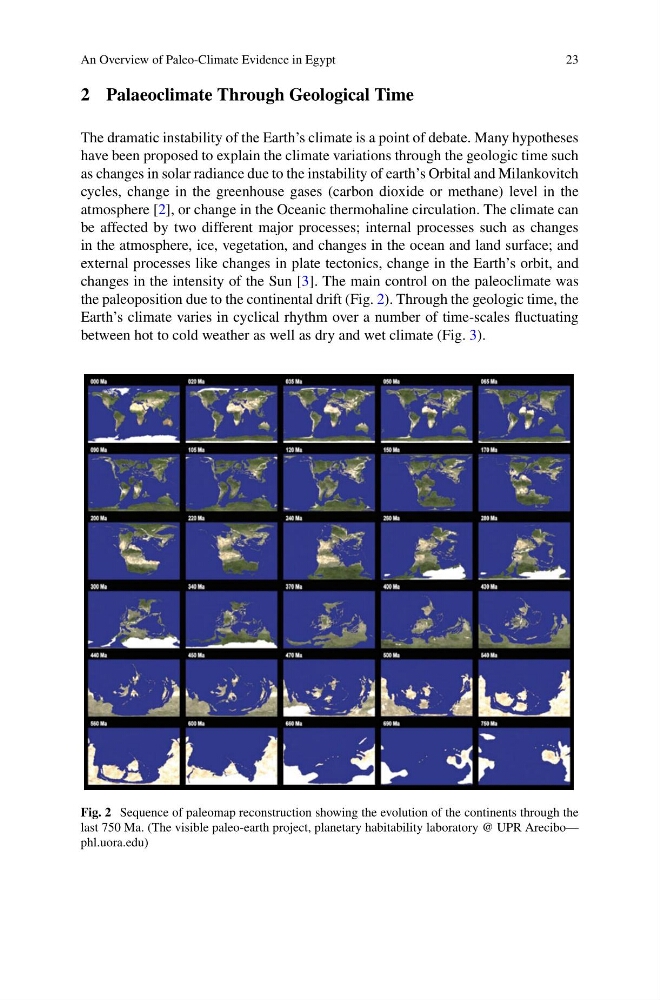
changes in the intensity of the Sun [3]. The main control on the paleoclimate was
the paleoposition due to the continental drift (Fig. 2). Through the geologic time, the
Earth’s climate varies in cyclical rhythm over a number of time-scales fluctuating
between hot to cold weather as well as dry and wet climate (Fig. 3).
Fig. 2 Sequence of paleomap reconstruction showing the evolution of the continents through the
last 750 Ma. (The visible paleo-earth project, planetary habitability laboratory @ UPR Arecibo—
phl.uora.edu)
23
2 Palaeoclimate Through Geological Time
The dramatic instability of the Earth’s climate is a point of debate. Many hypotheses
have been proposed to explain the climate variations through the geologic time such
as changes in solar radiance due to the instability of earth’s Orbital and Milankovitch
cycles, change in the greenhouse gases (carbon dioxide or methane) level in the
atmosphere [2], or change in the Oceanic thermohaline circulation. The climate can
be affected by two different major processes; internal processes such as changes
in the atmosphere, ice, vegetation, and changes in the ocean and land surface; and
external processes like changes in plate tectonics, change in the Earth’s orbit, and
changes in the intensity of the Sun [3]. The main control on the paleoclimate was
the paleoposition due to the continental drift (Fig. 2). Through the geologic time, the
Earth’s climate varies in cyclical rhythm over a number of time-scales fluctuating
between hot to cold weather as well as dry and wet climate (Fig. 3).
Fig. 2 Sequence of paleomap reconstruction showing the evolution of the continents through the
last 750 Ma. (The visible paleo-earth project, planetary habitability laboratory @ UPR Arecibo—
phl.uora.edu)