

24
H. Khozyem
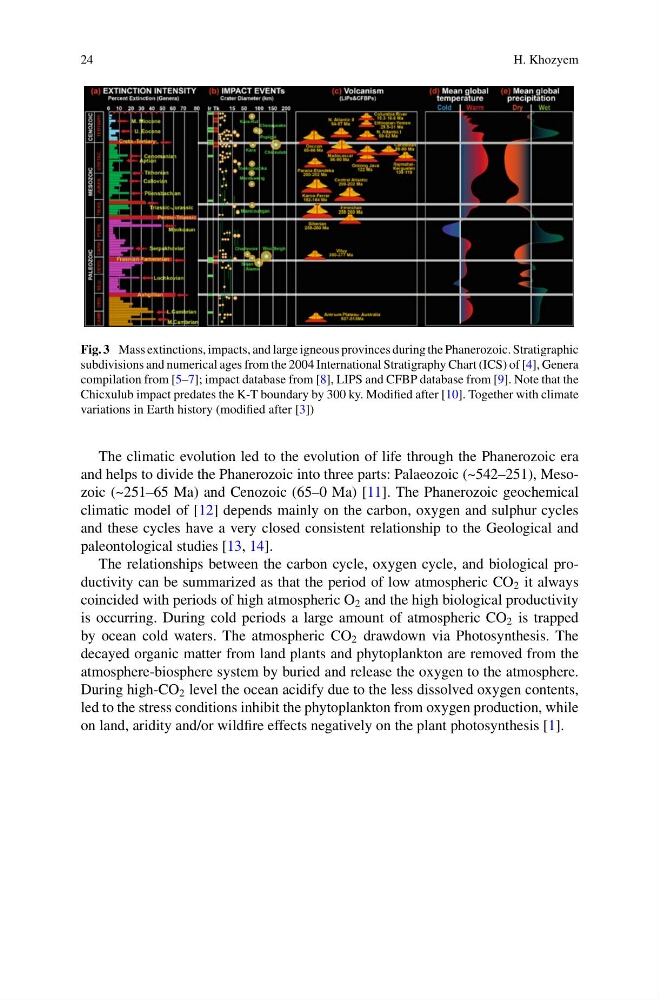
Fig. 3 Mass extinctions, impacts, and large igneous provinces during the Phanerozoic. Stratigraphic
subdivisions and numerical ages from the 2004 International Stratigraphy Chart (ICS) of [4], Genera
compilation from [5–7]; impact database from [8], LIPS and CFBP database from [9]. Note that the
Chicxulub impact predates the K-T boundary by 300 ky. Modified after [10]. Together with climate
variations in Earth history (modified after [3])
The climatic evolution led to the evolution of life through the Phanerozoic era
and helps to divide the Phanerozoic into three parts: Palaeozoic (~542–251), Mesozoic (~251–65 Ma) and Cenozoic (65–0 Ma) [11]. The Phanerozoic geochemical
climatic model of [12] depends mainly on the carbon, oxygen and sulphur cycles
and these cycles have a very closed consistent relationship to the Geological and
paleontological studies [13, 14].
The relationships between the carbon cycle, oxygen cycle, and biological productivity can be summarized as that the period of low atmospheric CO 2 it always
coincided with periods of high atmospheric O 2 and the high biological productivity
is occurring. During cold periods a large amount of atmospheric CO 2 is trapped
by ocean cold waters. The atmospheric CO 2 drawdown via Photosynthesis. The
decayed organic matter from land plants and phytoplankton are removed from the
atmosphere-biosphere system by buried and release the oxygen to the atmosphere.
During high-CO 2 level the ocean acidify due to the less dissolved oxygen contents,
led to the stress conditions inhibit the phytoplankton from oxygen production, while
on land, aridity and/or wildfire effects negatively on the plant photosynthesis [1].
H. Khozyem
Fig. 3 Mass extinctions, impacts, and large igneous provinces during the Phanerozoic. Stratigraphic
subdivisions and numerical ages from the 2004 International Stratigraphy Chart (ICS) of [4], Genera
compilation from [5–7]; impact database from [8], LIPS and CFBP database from [9]. Note that the
Chicxulub impact predates the K-T boundary by 300 ky. Modified after [10]. Together with climate
variations in Earth history (modified after [3])
The climatic evolution led to the evolution of life through the Phanerozoic era
and helps to divide the Phanerozoic into three parts: Palaeozoic (~542–251), Mesozoic (~251–65 Ma) and Cenozoic (65–0 Ma) [11]. The Phanerozoic geochemical
climatic model of [12] depends mainly on the carbon, oxygen and sulphur cycles
and these cycles have a very closed consistent relationship to the Geological and
paleontological studies [13, 14].
The relationships between the carbon cycle, oxygen cycle, and biological productivity can be summarized as that the period of low atmospheric CO 2 it always
coincided with periods of high atmospheric O 2 and the high biological productivity
is occurring. During cold periods a large amount of atmospheric CO 2 is trapped
by ocean cold waters. The atmospheric CO 2 drawdown via Photosynthesis. The
decayed organic matter from land plants and phytoplankton are removed from the
atmosphere-biosphere system by buried and release the oxygen to the atmosphere.
During high-CO 2 level the ocean acidify due to the less dissolved oxygen contents,
led to the stress conditions inhibit the phytoplankton from oxygen production, while
on land, aridity and/or wildfire effects negatively on the plant photosynthesis [1].