

Mapping Egypt Vulnerability to Sea Level Rise Scenarios
187
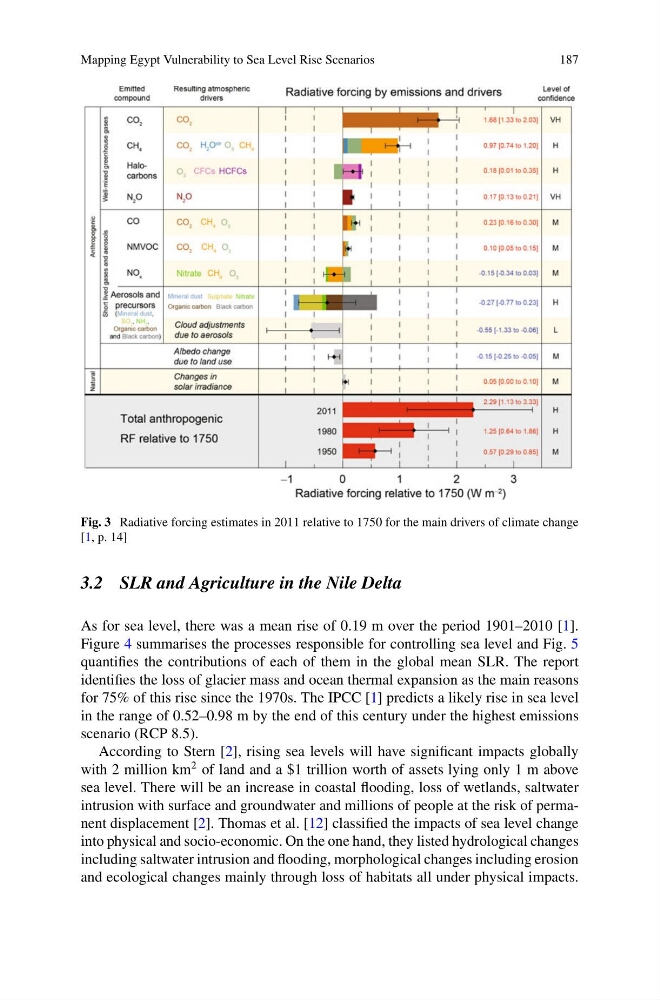
Fig. 3 Radiative forcing estimates in 2011 relative to 1750 for the main drivers of climate change
[1, p. 14]
3.2 SLR and Agriculture in the Nile Delta
As for sea level, there was a mean rise of 0.19 m over the period 1901–2010 [1].
Figure 4 summarises the processes responsible for controlling sea level and Fig. 5
quantifies the contributions of each of them in the global mean SLR. The report
identifies the loss of glacier mass and ocean thermal expansion as the main reasons
for 75% of this rise since the 1970s. The IPCC [1] predicts a likely rise in sea level
in the range of 0.52–0.98 m by the end of this century under the highest emissions
scenario (RCP 8.5).
According to Stern [2], rising sea levels will have significant impacts globally
with 2 million km
2 of land and a $1 trillion worth of assets lying only 1 m above
sea level. There will be an increase in coastal flooding, loss of wetlands, saltwater
intrusion with surface and groundwater and millions of people at the risk of permanent displacement [2]. Thomas et al. [12] classified the impacts of sea level change
into physical and socio-economic. On the one hand, they listed hydrological changes
including saltwater intrusion and flooding, morphological changes including erosion
and ecological changes mainly through loss of habitats all under physical impacts.
187
Fig. 3 Radiative forcing estimates in 2011 relative to 1750 for the main drivers of climate change
[1, p. 14]
3.2 SLR and Agriculture in the Nile Delta
As for sea level, there was a mean rise of 0.19 m over the period 1901–2010 [1].
Figure 4 summarises the processes responsible for controlling sea level and Fig. 5
quantifies the contributions of each of them in the global mean SLR. The report
identifies the loss of glacier mass and ocean thermal expansion as the main reasons
for 75% of this rise since the 1970s. The IPCC [1] predicts a likely rise in sea level
in the range of 0.52–0.98 m by the end of this century under the highest emissions
scenario (RCP 8.5).
According to Stern [2], rising sea levels will have significant impacts globally
with 2 million km
2 of land and a $1 trillion worth of assets lying only 1 m above
sea level. There will be an increase in coastal flooding, loss of wetlands, saltwater
intrusion with surface and groundwater and millions of people at the risk of permanent displacement [2]. Thomas et al. [12] classified the impacts of sea level change
into physical and socio-economic. On the one hand, they listed hydrological changes
including saltwater intrusion and flooding, morphological changes including erosion
and ecological changes mainly through loss of habitats all under physical impacts.