

186
A. Solyman and T. Abdel Monem
North Coast and Nile Delta Regions in Egypt” project funded by the Green Climate
Fund (GCF) and will be implemented by UNDP [10]. In addition, the Shore Protection Agency has allocated around EGP 1.7 billion (approximately US$ 97 million)
for adaptation measures to protect the coastline of the Mediterranean Sea and Red
Sea [10].
3 Climate Change Observations and Potential Impacts
3.1 Greenhouse Gas Emissions and Anthropogenic Climate
Change
There is enough evidence that the global climate is changing and the debate around
the causes and drivers of this phenomenon is settled with only some differences
around regional and local impacts. The most authoritative assessments of climate
change among policymakers are the IPCC reports. According to IPCC [1], there has
been a warming of 0.85 °C in globally averaged land and ocean surface temperature
over the period 1880–2012. The main driver of this warming is the positive total
radiative forcing caused mainly by the greenhouse gases emissions where the greatest
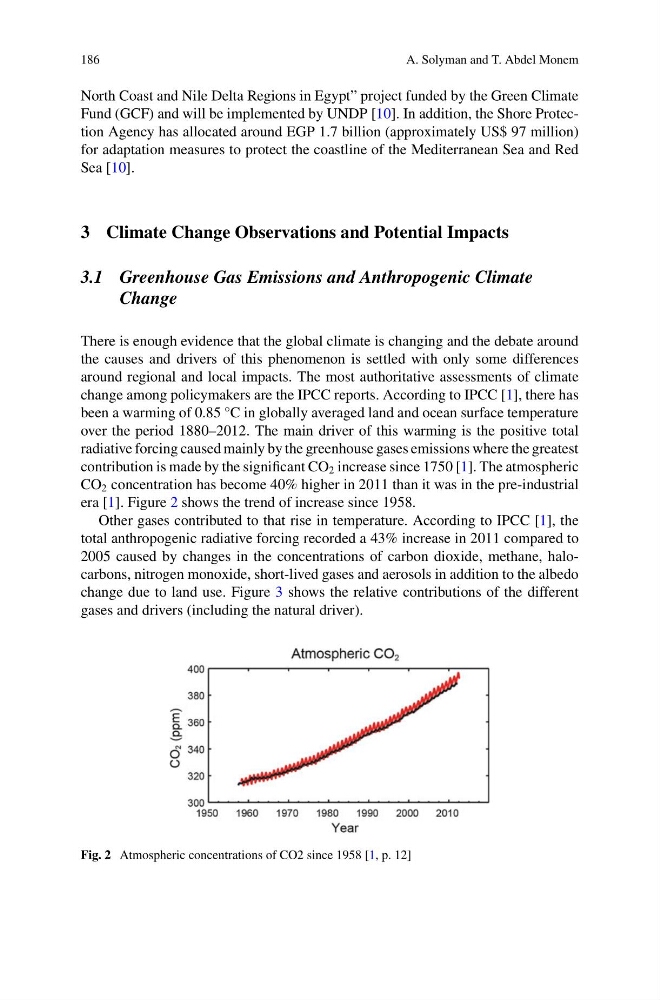
contribution is made by the significant CO 2 increase since 1750 [1]. The atmospheric
CO 2 concentration has become 40% higher in 2011 than it was in the pre-industrial
era [1]. Figure 2 shows the trend of increase since 1958.
Other gases contributed to that rise in temperature. According to IPCC [1], the
total anthropogenic radiative forcing recorded a 43% increase in 2011 compared to
2005 caused by changes in the concentrations of carbon dioxide, methane, halocarbons, nitrogen monoxide, short-lived gases and aerosols in addition to the albedo
change due to land use. Figure 3 shows the relative contributions of the different
gases and drivers (including the natural driver).
Fig. 2 Atmospheric concentrations of CO2 since 1958 [1, p. 12]
A. Solyman and T. Abdel Monem
North Coast and Nile Delta Regions in Egypt” project funded by the Green Climate
Fund (GCF) and will be implemented by UNDP [10]. In addition, the Shore Protection Agency has allocated around EGP 1.7 billion (approximately US$ 97 million)
for adaptation measures to protect the coastline of the Mediterranean Sea and Red
Sea [10].
3 Climate Change Observations and Potential Impacts
3.1 Greenhouse Gas Emissions and Anthropogenic Climate
Change
There is enough evidence that the global climate is changing and the debate around
the causes and drivers of this phenomenon is settled with only some differences
around regional and local impacts. The most authoritative assessments of climate
change among policymakers are the IPCC reports. According to IPCC [1], there has
been a warming of 0.85 °C in globally averaged land and ocean surface temperature
over the period 1880–2012. The main driver of this warming is the positive total
radiative forcing caused mainly by the greenhouse gases emissions where the greatest
contribution is made by the significant CO 2 increase since 1750 [1]. The atmospheric
CO 2 concentration has become 40% higher in 2011 than it was in the pre-industrial
era [1]. Figure 2 shows the trend of increase since 1958.
Other gases contributed to that rise in temperature. According to IPCC [1], the
total anthropogenic radiative forcing recorded a 43% increase in 2011 compared to
2005 caused by changes in the concentrations of carbon dioxide, methane, halocarbons, nitrogen monoxide, short-lived gases and aerosols in addition to the albedo
change due to land use. Figure 3 shows the relative contributions of the different
gases and drivers (including the natural driver).
Fig. 2 Atmospheric concentrations of CO2 since 1958 [1, p. 12]