

Soils as Driver and Victim of Climate Change in Egypt
117
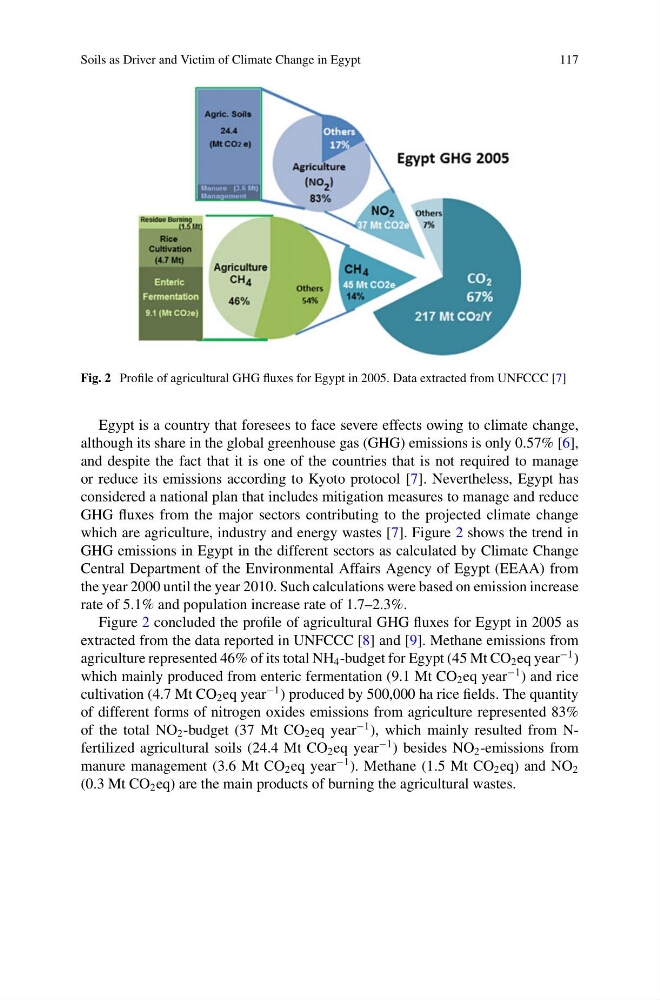
Fig. 2 Profile of agricultural GHG fluxes for Egypt in 2005. Data extracted from UNFCCC [7]
Egypt is a country that foresees to face severe effects owing to climate change,
although its share in the global greenhouse gas (GHG) emissions is only 0.57% [6],
and despite the fact that it is one of the countries that is not required to manage
or reduce its emissions according to Kyoto protocol [7]. Nevertheless, Egypt has
considered a national plan that includes mitigation measures to manage and reduce
GHG fluxes from the major sectors contributing to the projected climate change
which are agriculture, industry and energy wastes [7]. Figure 2 shows the trend in
GHG emissions in Egypt in the different sectors as calculated by Climate Change
Central Department of the Environmental Affairs Agency of Egypt (EEAA) from
the year 2000 until the year 2010. Such calculations were based on emission increase
rate of 5.1% and population increase rate of 1.7–2.3%.
Figure 2 concluded the profile of agricultural GHG fluxes for Egypt in 2005 as
extracted from the data reported in UNFCCC [8] and [9]. Methane emissions from
agriculture represented 46% of its total NH 4 -budget for Egypt (45 Mt CO 2 eq year
−1 )
which mainly produced from enteric fermentation (9.1 Mt CO 2 eq year
−1 ) and rice
cultivation (4.7 Mt CO 2 eq year
−1 ) produced by 500,000 ha rice fields. The quantity
of different forms of nitrogen oxides emissions from agriculture represented 83%
of the total NO 2 -budget (37 Mt CO 2 eq year
−1 ), which mainly resulted from Nfertilized agricultural soils (24.4 Mt CO 2 eq year
−1 ) besides NO 2 -emissions from
manure management (3.6 Mt CO 2 eq year
−1 ). Methane (1.5 Mt CO 2 eq) and NO 2
(0.3 Mt CO 2 eq) are the main products of burning the agricultural wastes.
117
Fig. 2 Profile of agricultural GHG fluxes for Egypt in 2005. Data extracted from UNFCCC [7]
Egypt is a country that foresees to face severe effects owing to climate change,
although its share in the global greenhouse gas (GHG) emissions is only 0.57% [6],
and despite the fact that it is one of the countries that is not required to manage
or reduce its emissions according to Kyoto protocol [7]. Nevertheless, Egypt has
considered a national plan that includes mitigation measures to manage and reduce
GHG fluxes from the major sectors contributing to the projected climate change
which are agriculture, industry and energy wastes [7]. Figure 2 shows the trend in
GHG emissions in Egypt in the different sectors as calculated by Climate Change
Central Department of the Environmental Affairs Agency of Egypt (EEAA) from
the year 2000 until the year 2010. Such calculations were based on emission increase
rate of 5.1% and population increase rate of 1.7–2.3%.
Figure 2 concluded the profile of agricultural GHG fluxes for Egypt in 2005 as
extracted from the data reported in UNFCCC [8] and [9]. Methane emissions from
agriculture represented 46% of its total NH 4 -budget for Egypt (45 Mt CO 2 eq year
−1 )
which mainly produced from enteric fermentation (9.1 Mt CO 2 eq year
−1 ) and rice
cultivation (4.7 Mt CO 2 eq year
−1 ) produced by 500,000 ha rice fields. The quantity
of different forms of nitrogen oxides emissions from agriculture represented 83%
of the total NO 2 -budget (37 Mt CO 2 eq year
−1 ), which mainly resulted from Nfertilized agricultural soils (24.4 Mt CO 2 eq year
−1 ) besides NO 2 -emissions from
manure management (3.6 Mt CO 2 eq year
−1 ). Methane (1.5 Mt CO 2 eq) and NO 2
(0.3 Mt CO 2 eq) are the main products of burning the agricultural wastes.