

116
R. R. Shahin
60% above emissions in 1990 [2]. For the decade from 2005 to 2014, about 44%
of CO 2 emissions remain in the troposphere and 26% in the ocean (https://www.
co2.earth/global-co2-emissions). The land is the natural sink of 30% of the world
CO 2 emissions [3]. Methane (CH 4 ), nitrous oxide (N 2 O) and carbon dioxide (CO 2 )
are the main GHG emissions resulted from the agricultural production. Greenhouse
gas emissions are generally reported as an equivalent of carbon dioxide (CO 2 -eq).
On a global scale, agricultural activities accounted to be 6.1–5.1 Gt CO 2 -eq/year
of emissions in 2005 (10–12% of the entire anthropogenic GHG emissions) and a
nearly 17% increase in CH 4 and N 2 O emissions from 1990 to 2005 [4].
2 Agricultural GHG Invention of Egypt
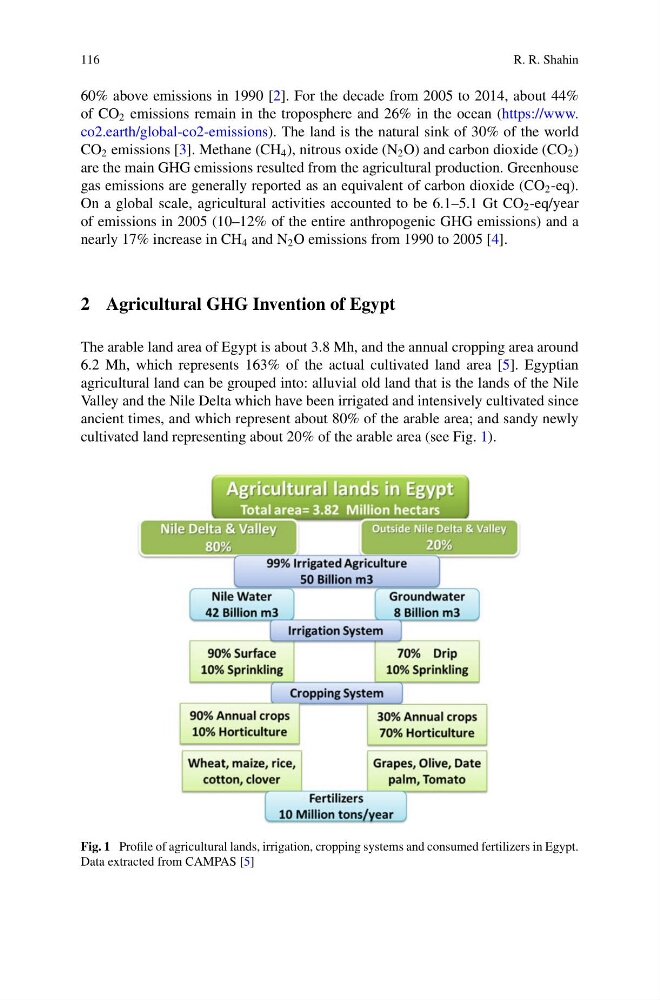
The arable land area of Egypt is about 3.8 Mh, and the annual cropping area around
6.2 Mh, which represents 163% of the actual cultivated land area [5]. Egyptian
agricultural land can be grouped into: alluvial old land that is the lands of the Nile
Valley and the Nile Delta which have been irrigated and intensively cultivated since
ancient times, and which represent about 80% of the arable area; and sandy newly
cultivated land representing about 20% of the arable area (see Fig. 1).
Fig. 1 Profile of agricultural lands, irrigation, cropping systems and consumed fertilizers in Egypt.
Data extracted from CAMPAS [5]
R. R. Shahin
60% above emissions in 1990 [2]. For the decade from 2005 to 2014, about 44%
of CO 2 emissions remain in the troposphere and 26% in the ocean (https://www.
co2.earth/global-co2-emissions). The land is the natural sink of 30% of the world
CO 2 emissions [3]. Methane (CH 4 ), nitrous oxide (N 2 O) and carbon dioxide (CO 2 )
are the main GHG emissions resulted from the agricultural production. Greenhouse
gas emissions are generally reported as an equivalent of carbon dioxide (CO 2 -eq).
On a global scale, agricultural activities accounted to be 6.1–5.1 Gt CO 2 -eq/year
of emissions in 2005 (10–12% of the entire anthropogenic GHG emissions) and a
nearly 17% increase in CH 4 and N 2 O emissions from 1990 to 2005 [4].
2 Agricultural GHG Invention of Egypt
The arable land area of Egypt is about 3.8 Mh, and the annual cropping area around
6.2 Mh, which represents 163% of the actual cultivated land area [5]. Egyptian
agricultural land can be grouped into: alluvial old land that is the lands of the Nile
Valley and the Nile Delta which have been irrigated and intensively cultivated since
ancient times, and which represent about 80% of the arable area; and sandy newly
cultivated land representing about 20% of the arable area (see Fig. 1).
Fig. 1 Profile of agricultural lands, irrigation, cropping systems and consumed fertilizers in Egypt.
Data extracted from CAMPAS [5]