

118
R. R. Shahin
3 Drivers of Soil GHG Emissions
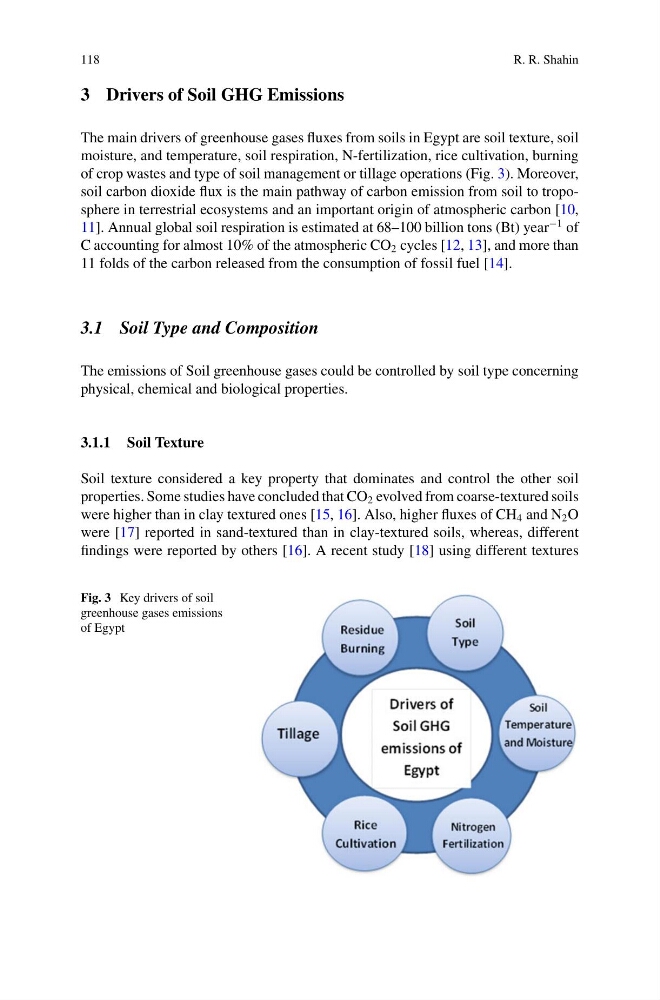
The main drivers of greenhouse gases fluxes from soils in Egypt are soil texture, soil
moisture, and temperature, soil respiration, N-fertilization, rice cultivation, burning
of crop wastes and type of soil management or tillage operations (Fig. 3). Moreover,
soil carbon dioxide flux is the main pathway of carbon emission from soil to troposphere in terrestrial ecosystems and an important origin of atmospheric carbon [10,
11]. Annual global soil respiration is estimated at 68–100 billion tons (Bt) year
−1 of
C accounting for almost 10% of the atmospheric CO 2 cycles [12, 13], and more than
11 folds of the carbon released from the consumption of fossil fuel [14].
3.1 Soil Type and Composition
The emissions of Soil greenhouse gases could be controlled by soil type concerning
physical, chemical and biological properties.
3.1.1 Soil Texture
Soil texture considered a key property that dominates and control the other soil
properties. Some studies have concluded that CO 2 evolved from coarse-textured soils
were higher than in clay textured ones [15, 16]. Also, higher fluxes of CH 4 and N 2 O
were [17] reported in sand-textured than in clay-textured soils, whereas, different
findings were reported by others [16]. A recent study [18] using different textures
Fig. 3 Key drivers of soil
greenhouse gases emissions
of Egypt
R. R. Shahin
3 Drivers of Soil GHG Emissions
The main drivers of greenhouse gases fluxes from soils in Egypt are soil texture, soil
moisture, and temperature, soil respiration, N-fertilization, rice cultivation, burning
of crop wastes and type of soil management or tillage operations (Fig. 3). Moreover,
soil carbon dioxide flux is the main pathway of carbon emission from soil to troposphere in terrestrial ecosystems and an important origin of atmospheric carbon [10,
11]. Annual global soil respiration is estimated at 68–100 billion tons (Bt) year
−1 of
C accounting for almost 10% of the atmospheric CO 2 cycles [12, 13], and more than
11 folds of the carbon released from the consumption of fossil fuel [14].
3.1 Soil Type and Composition
The emissions of Soil greenhouse gases could be controlled by soil type concerning
physical, chemical and biological properties.
3.1.1 Soil Texture
Soil texture considered a key property that dominates and control the other soil
properties. Some studies have concluded that CO 2 evolved from coarse-textured soils
were higher than in clay textured ones [15, 16]. Also, higher fluxes of CH 4 and N 2 O
were [17] reported in sand-textured than in clay-textured soils, whereas, different
findings were reported by others [16]. A recent study [18] using different textures
Fig. 3 Key drivers of soil
greenhouse gases emissions
of Egypt