

As can be seen, NSAIDs, like other pharmaceutical products, have the ability to
cause toxicity in the environment, even at very low concentrations in the order of
ng L
À1 to μg L
À1 [16], so that the presence of NSAIDs in the environment has
become a topic of great concern due to their potential ecotoxicity, as there is
evidence that they can negatively affect aquatic and terrestrial organisms at different
trophic levels and may cause damage to function of the ecosystem and the services
that depend on it [5, 17, 18]. Regarding this, there are several studies that have
reported risk assessments for this group of pharmaceuticals, and some of them are
found below:
In Hernando et al. [19]’s study, a general description of the environmental
occurrence and the ecological risk assessment of pharmaceutical waste is presented
from the literature data. The risk quotient method (RQ) was applied to estimate the
environmental risk of pharmaceutical products that are most frequently detected in
wastewater, surface water, and sediment effluents.
Comparing the concentrations present in the effluents of the wastewater treatment
plants and in surface waters against toxicity data, in this study, in both cases the
nonsteroidal anti-inflammatory ibuprofen, naproxen, diclofenac, and ketoprofen
present a high ecological risk for representative species of the food chain that are
typically used in acute toxicity tests (bacteria, algae, and invertebrates) in these
circumstances.
Yamamoto et al. [20] selected eight pharmaceutical products based on their
internal consumption in Japan, the proportion of excretion of the original compound,
and the frequency of detection in the aquatic environment or in the wastewater
treatment plants. Toxicity tests were performed using Japanese medaka (Oryzias
latipes), Daphnia (Daphnia magna), and green algae (Pseudokirchneriella
subcapitata). The predicted no-effect concentration (PNEC) was calculated using
values of lethal or effective concentration 50 (LC 50 or EC 50 ), and the concentration
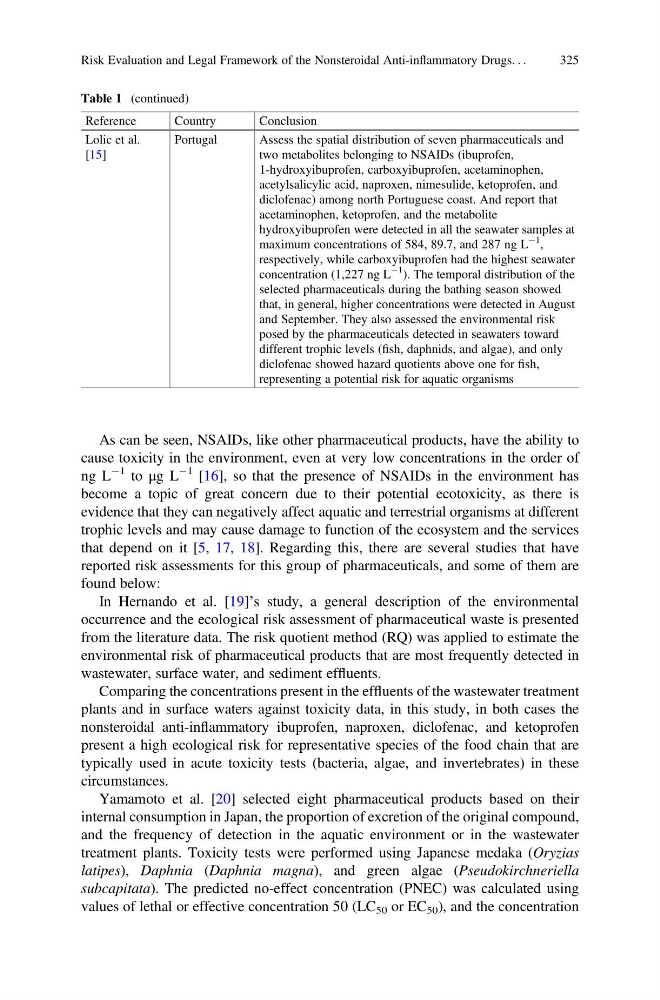
Table 1 (continued)
Reference
Country
Conclusion
Lolic et al.
[15]
Portugal
Assess the spatial distribution of seven pharmaceuticals and
two metabolites belonging to NSAIDs (ibuprofen,
1-hydroxyibuprofen, carboxyibuprofen, acetaminophen,
acetylsalicylic acid, naproxen, nimesulide, ketoprofen, and
diclofenac) among north Portuguese coast. And report that
acetaminophen, ketoprofen, and the metabolite
hydroxyibuprofen were detected in all the seawater samples at
maximum concentrations of 584, 89.7, and 287 ng L
À1
,
respectively, while carboxyibuprofen had the highest seawater
concentration (1,227 ng L
À1
). The temporal distribution of the
selected pharmaceuticals during the bathing season showed
that, in general, higher concentrations were detected in August
and September. They also assessed the environmental risk
posed by the pharmaceuticals detected in seawaters toward
different trophic levels (fish, daphnids, and algae), and only
diclofenac showed hazard quotients above one for fish,
representing a potential risk for aquatic organisms
Risk Evaluation and Legal Framework of the Nonsteroidal Anti-inflammatory Drugs. . .
325
cause toxicity in the environment, even at very low concentrations in the order of
ng L
À1 to μg L
À1 [16], so that the presence of NSAIDs in the environment has
become a topic of great concern due to their potential ecotoxicity, as there is
evidence that they can negatively affect aquatic and terrestrial organisms at different
trophic levels and may cause damage to function of the ecosystem and the services
that depend on it [5, 17, 18]. Regarding this, there are several studies that have
reported risk assessments for this group of pharmaceuticals, and some of them are
found below:
In Hernando et al. [19]’s study, a general description of the environmental
occurrence and the ecological risk assessment of pharmaceutical waste is presented
from the literature data. The risk quotient method (RQ) was applied to estimate the
environmental risk of pharmaceutical products that are most frequently detected in
wastewater, surface water, and sediment effluents.
Comparing the concentrations present in the effluents of the wastewater treatment
plants and in surface waters against toxicity data, in this study, in both cases the
nonsteroidal anti-inflammatory ibuprofen, naproxen, diclofenac, and ketoprofen
present a high ecological risk for representative species of the food chain that are
typically used in acute toxicity tests (bacteria, algae, and invertebrates) in these
circumstances.
Yamamoto et al. [20] selected eight pharmaceutical products based on their
internal consumption in Japan, the proportion of excretion of the original compound,
and the frequency of detection in the aquatic environment or in the wastewater
treatment plants. Toxicity tests were performed using Japanese medaka (Oryzias
latipes), Daphnia (Daphnia magna), and green algae (Pseudokirchneriella
subcapitata). The predicted no-effect concentration (PNEC) was calculated using
values of lethal or effective concentration 50 (LC 50 or EC 50 ), and the concentration
Table 1 (continued)
Reference
Country
Conclusion
Lolic et al.
[15]
Portugal
Assess the spatial distribution of seven pharmaceuticals and
two metabolites belonging to NSAIDs (ibuprofen,
1-hydroxyibuprofen, carboxyibuprofen, acetaminophen,
acetylsalicylic acid, naproxen, nimesulide, ketoprofen, and
diclofenac) among north Portuguese coast. And report that
acetaminophen, ketoprofen, and the metabolite
hydroxyibuprofen were detected in all the seawater samples at
maximum concentrations of 584, 89.7, and 287 ng L
À1
,
respectively, while carboxyibuprofen had the highest seawater
concentration (1,227 ng L
À1
). The temporal distribution of the
selected pharmaceuticals during the bathing season showed
that, in general, higher concentrations were detected in August
and September. They also assessed the environmental risk
posed by the pharmaceuticals detected in seawaters toward
different trophic levels (fish, daphnids, and algae), and only
diclofenac showed hazard quotients above one for fish,
representing a potential risk for aquatic organisms
Risk Evaluation and Legal Framework of the Nonsteroidal Anti-inflammatory Drugs. . .
325