

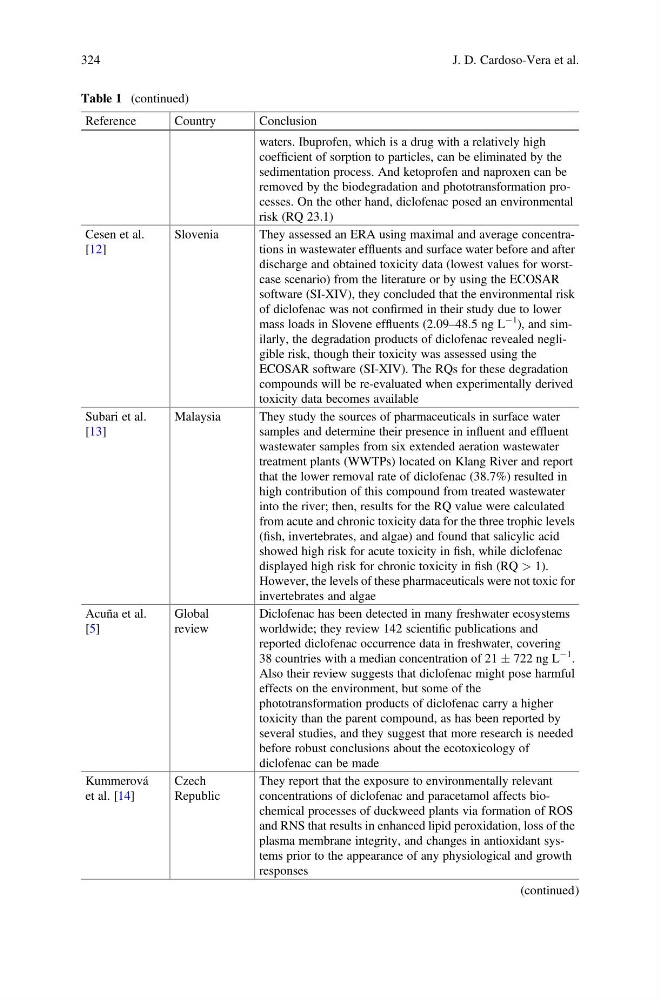
Table 1 (continued)
Reference
Country
Conclusion
waters. Ibuprofen, which is a drug with a relatively high
coefficient of sorption to particles, can be eliminated by the
sedimentation process. And ketoprofen and naproxen can be
removed by the biodegradation and phototransformation processes. On the other hand, diclofenac posed an environmental
risk (RQ 23.1)
Cesen et al.
[12]
Slovenia
They assessed an ERA using maximal and average concentrations in wastewater effluents and surface water before and after
discharge and obtained toxicity data (lowest values for worstcase scenario) from the literature or by using the ECOSAR
software (SI-XIV), they concluded that the environmental risk
of diclofenac was not confirmed in their study due to lower
mass loads in Slovene effluents (2.09–48.5 ng L
À1
), and similarly, the degradation products of diclofenac revealed negligible risk, though their toxicity was assessed using the
ECOSAR software (SI-XIV). The RQs for these degradation
compounds will be re-evaluated when experimentally derived
toxicity data becomes available
Subari et al.
[13]
Malaysia
They study the sources of pharmaceuticals in surface water
samples and determine their presence in influent and effluent
wastewater samples from six extended aeration wastewater
treatment plants (WWTPs) located on Klang River and report
that the lower removal rate of diclofenac (38.7%) resulted in
high contribution of this compound from treated wastewater
into the river; then, results for the RQ value were calculated
from acute and chronic toxicity data for the three trophic levels
(fish, invertebrates, and algae) and found that salicylic acid
showed high risk for acute toxicity in fish, while diclofenac
displayed high risk for chronic toxicity in fish (RQ > 1).
However, the levels of these pharmaceuticals were not toxic for
invertebrates and algae
Acuña et al.
[5]
Global
review
Diclofenac has been detected in many freshwater ecosystems
worldwide; they review 142 scientific publications and
reported diclofenac occurrence data in freshwater, covering
38 countries with a median concentration of 21 Æ 722 ng L
À1
.
Also their review suggests that diclofenac might pose harmful
effects on the environment, but some of the
phototransformation products of diclofenac carry a higher
toxicity than the parent compound, as has been reported by
several studies, and they suggest that more research is needed
before robust conclusions about the ecotoxicology of
diclofenac can be made
Kummerová
et al. [14]
Czech
Republic
They report that the exposure to environmentally relevant
concentrations of diclofenac and paracetamol affects biochemical processes of duckweed plants via formation of ROS
and RNS that results in enhanced lipid peroxidation, loss of the
plasma membrane integrity, and changes in antioxidant systems prior to the appearance of any physiological and growth
responses
(continued)
324
J. D. Cardoso-Vera et al.
Reference
Country
Conclusion
waters. Ibuprofen, which is a drug with a relatively high
coefficient of sorption to particles, can be eliminated by the
sedimentation process. And ketoprofen and naproxen can be
removed by the biodegradation and phototransformation processes. On the other hand, diclofenac posed an environmental
risk (RQ 23.1)
Cesen et al.
[12]
Slovenia
They assessed an ERA using maximal and average concentrations in wastewater effluents and surface water before and after
discharge and obtained toxicity data (lowest values for worstcase scenario) from the literature or by using the ECOSAR
software (SI-XIV), they concluded that the environmental risk
of diclofenac was not confirmed in their study due to lower
mass loads in Slovene effluents (2.09–48.5 ng L
À1
), and similarly, the degradation products of diclofenac revealed negligible risk, though their toxicity was assessed using the
ECOSAR software (SI-XIV). The RQs for these degradation
compounds will be re-evaluated when experimentally derived
toxicity data becomes available
Subari et al.
[13]
Malaysia
They study the sources of pharmaceuticals in surface water
samples and determine their presence in influent and effluent
wastewater samples from six extended aeration wastewater
treatment plants (WWTPs) located on Klang River and report
that the lower removal rate of diclofenac (38.7%) resulted in
high contribution of this compound from treated wastewater
into the river; then, results for the RQ value were calculated
from acute and chronic toxicity data for the three trophic levels
(fish, invertebrates, and algae) and found that salicylic acid
showed high risk for acute toxicity in fish, while diclofenac
displayed high risk for chronic toxicity in fish (RQ > 1).
However, the levels of these pharmaceuticals were not toxic for
invertebrates and algae
Acuña et al.
[5]
Global
review
Diclofenac has been detected in many freshwater ecosystems
worldwide; they review 142 scientific publications and
reported diclofenac occurrence data in freshwater, covering
38 countries with a median concentration of 21 Æ 722 ng L
À1
.
Also their review suggests that diclofenac might pose harmful
effects on the environment, but some of the
phototransformation products of diclofenac carry a higher
toxicity than the parent compound, as has been reported by
several studies, and they suggest that more research is needed
before robust conclusions about the ecotoxicology of
diclofenac can be made
Kummerová
et al. [14]
Czech
Republic
They report that the exposure to environmentally relevant
concentrations of diclofenac and paracetamol affects biochemical processes of duckweed plants via formation of ROS
and RNS that results in enhanced lipid peroxidation, loss of the
plasma membrane integrity, and changes in antioxidant systems prior to the appearance of any physiological and growth
responses
(continued)
324
J. D. Cardoso-Vera et al.