

Membrane
NMW (datons)
Polyethersulfone
10,000
Polyamide
8,000
Titanium oxide
1 k, 3 k, 5 k,8 k
Note: NMW, nominal molecular weight
Filtration membrane with a molecular weight cut off of 8,000 Da exhibited
25 ~ 95% removal efficiencies of ibuprofen with a molecular weight of 206 with
and without presence of effluent organic matter from membrane bioreactor. The
membranes with different nominal molecular weight cut-offs a tight-Ultra. UF
membrane could successfully remove ibuprofen at lower J0/k ratio range ( 1) in
organic free water.
The sludge retention time (SRT), sludge concentration (SC), and hydraulic
retention time (HRT), in the treatment the waste water to scale of the pilot-plants
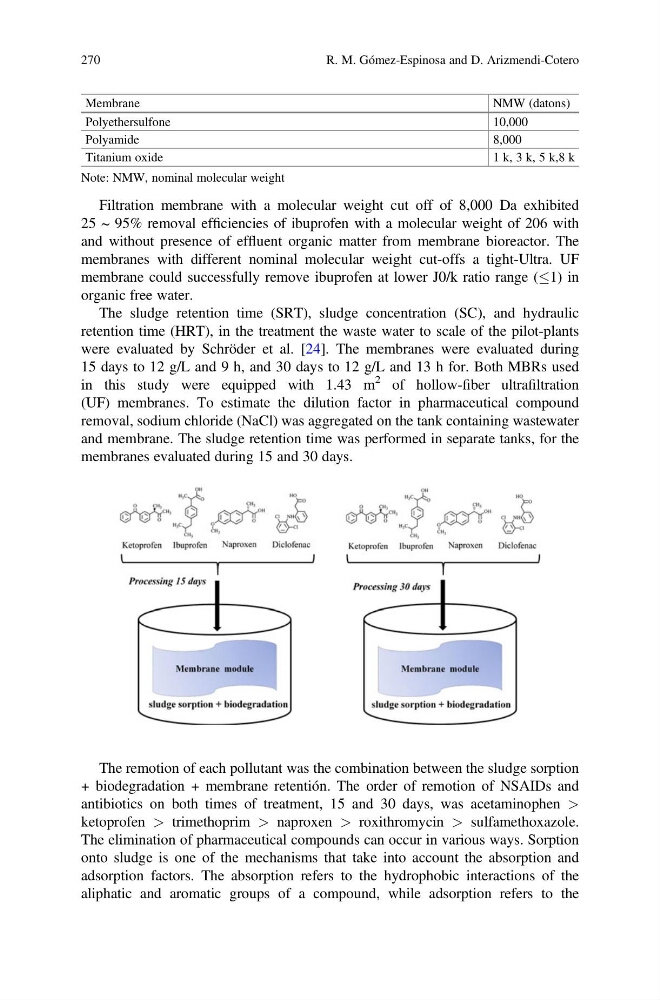
were evaluated by Schröder et al. [24]. The membranes were evaluated during
15 days to 12 g/L and 9 h, and 30 days to 12 g/L and 13 h for. Both MBRs used
in this study were equipped with 1.43 m
2 of hollow-fiber ultrafiltration
(UF) membranes. To estimate the dilution factor in pharmaceutical compound
removal, sodium chloride (NaCl) was aggregated on the tank containing wastewater
and membrane. The sludge retention time was performed in separate tanks, for the
membranes evaluated during 15 and 30 days.
The remotion of each pollutant was the combination between the sludge sorption
+ biodegradation + membrane retentión. The order of remotion of NSAIDs and
antibiotics on both times of treatment, 15 and 30 days, was acetaminophen >
ketoprofen > trimethoprim > naproxen > roxithromycin > sulfamethoxazole.
The elimination of pharmaceutical compounds can occur in various ways. Sorption
onto sludge is one of the mechanisms that take into account the absorption and
adsorption factors. The absorption refers to the hydrophobic interactions of the
aliphatic and aromatic groups of a compound, while adsorption refers to the
270
R. M. Gómez-Espinosa and D. Arizmendi-Cotero
NMW (datons)
Polyethersulfone
10,000
Polyamide
8,000
Titanium oxide
1 k, 3 k, 5 k,8 k
Note: NMW, nominal molecular weight
Filtration membrane with a molecular weight cut off of 8,000 Da exhibited
25 ~ 95% removal efficiencies of ibuprofen with a molecular weight of 206 with
and without presence of effluent organic matter from membrane bioreactor. The
membranes with different nominal molecular weight cut-offs a tight-Ultra. UF
membrane could successfully remove ibuprofen at lower J0/k ratio range ( 1) in
organic free water.
The sludge retention time (SRT), sludge concentration (SC), and hydraulic
retention time (HRT), in the treatment the waste water to scale of the pilot-plants
were evaluated by Schröder et al. [24]. The membranes were evaluated during
15 days to 12 g/L and 9 h, and 30 days to 12 g/L and 13 h for. Both MBRs used
in this study were equipped with 1.43 m
2 of hollow-fiber ultrafiltration
(UF) membranes. To estimate the dilution factor in pharmaceutical compound
removal, sodium chloride (NaCl) was aggregated on the tank containing wastewater
and membrane. The sludge retention time was performed in separate tanks, for the
membranes evaluated during 15 and 30 days.
The remotion of each pollutant was the combination between the sludge sorption
+ biodegradation + membrane retentión. The order of remotion of NSAIDs and
antibiotics on both times of treatment, 15 and 30 days, was acetaminophen >
ketoprofen > trimethoprim > naproxen > roxithromycin > sulfamethoxazole.
The elimination of pharmaceutical compounds can occur in various ways. Sorption
onto sludge is one of the mechanisms that take into account the absorption and
adsorption factors. The absorption refers to the hydrophobic interactions of the
aliphatic and aromatic groups of a compound, while adsorption refers to the
270
R. M. Gómez-Espinosa and D. Arizmendi-Cotero