

electrostatic interactions of positively charged groups of dissolved chemicals with
the negatively charged surfaces of the microorganisms.
The elimination of pharmaceutical compounds can occur in two ways. By
absorption because of the hydrophobic interactions of the aliphatic and aromatic
groups of a compound, and by adsorption through the electrostatic interactions of
positively charged groups of dissolved chemicals with the negatively charged
surfaces of the microorganisms.
Another mechanism responsible for the removal of pharmaceutical compounds in
MBRs is the physical retention by the membranes. The retention of the pharmaceutical depends on the molecular weight cutoff (MWCO) of MBR membranes. Sorption onto the membranes is also limited by the available membrane surface area.
Pharmaceutical compounds which are nonpolar will sorb onto the biomass and will
therefore be removed indirectly during the retention of the solids by the membranes.
Polar pharmaceuticals, with a low tendency to adsorb to the lipophilic sludge
surface, will be eliminated neither by adsorption nor by biodegradation because
the interaction with the wastewater biocoenosis essential for the biodegradation
process will be too short [4, 11]. A better performance in the treatment of wastewater
contaminated by drugs could be achieved by the application of additional treatments,
e.g., activated carbon adsorption, ozone oxidation, advanced oxidation processes
(AOP), nanofiltration (NF), or reverse osmosis (RO).
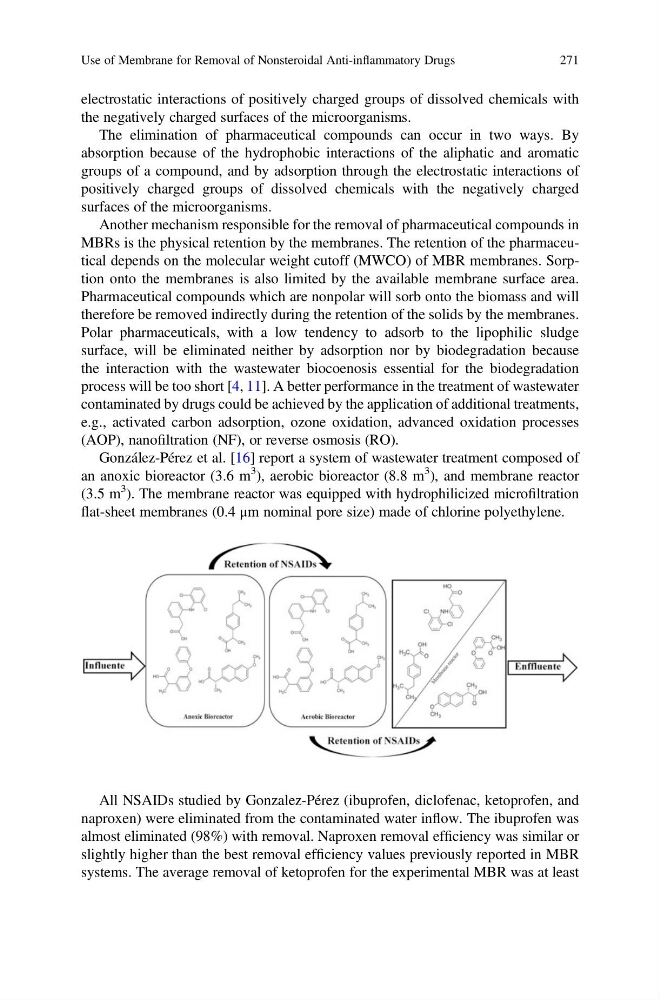
González-Pérez et al. [16] report a system of wastewater treatment composed of
an anoxic bioreactor (3.6 m
3 ), aerobic bioreactor (8.8 m
3 ), and membrane reactor
(3.5 m
3 ). The membrane reactor was equipped with hydrophilicized microfiltration
flat-sheet membranes (0.4 μm nominal pore size) made of chlorine polyethylene.
All NSAIDs studied by Gonzalez-Pérez (ibuprofen, diclofenac, ketoprofen, and
naproxen) were eliminated from the contaminated water inflow. The ibuprofen was
almost eliminated (98%) with removal. Naproxen removal efficiency was similar or
slightly higher than the best removal efficiency values previously reported in MBR
systems. The average removal of ketoprofen for the experimental MBR was at least
Use of Membrane for Removal of Nonsteroidal Anti-inflammatory Drugs
271
the negatively charged surfaces of the microorganisms.
The elimination of pharmaceutical compounds can occur in two ways. By
absorption because of the hydrophobic interactions of the aliphatic and aromatic
groups of a compound, and by adsorption through the electrostatic interactions of
positively charged groups of dissolved chemicals with the negatively charged
surfaces of the microorganisms.
Another mechanism responsible for the removal of pharmaceutical compounds in
MBRs is the physical retention by the membranes. The retention of the pharmaceutical depends on the molecular weight cutoff (MWCO) of MBR membranes. Sorption onto the membranes is also limited by the available membrane surface area.
Pharmaceutical compounds which are nonpolar will sorb onto the biomass and will
therefore be removed indirectly during the retention of the solids by the membranes.
Polar pharmaceuticals, with a low tendency to adsorb to the lipophilic sludge
surface, will be eliminated neither by adsorption nor by biodegradation because
the interaction with the wastewater biocoenosis essential for the biodegradation
process will be too short [4, 11]. A better performance in the treatment of wastewater
contaminated by drugs could be achieved by the application of additional treatments,
e.g., activated carbon adsorption, ozone oxidation, advanced oxidation processes
(AOP), nanofiltration (NF), or reverse osmosis (RO).
González-Pérez et al. [16] report a system of wastewater treatment composed of
an anoxic bioreactor (3.6 m
3 ), aerobic bioreactor (8.8 m
3 ), and membrane reactor
(3.5 m
3 ). The membrane reactor was equipped with hydrophilicized microfiltration
flat-sheet membranes (0.4 μm nominal pore size) made of chlorine polyethylene.
All NSAIDs studied by Gonzalez-Pérez (ibuprofen, diclofenac, ketoprofen, and
naproxen) were eliminated from the contaminated water inflow. The ibuprofen was
almost eliminated (98%) with removal. Naproxen removal efficiency was similar or
slightly higher than the best removal efficiency values previously reported in MBR
systems. The average removal of ketoprofen for the experimental MBR was at least
Use of Membrane for Removal of Nonsteroidal Anti-inflammatory Drugs
271