

The removal of the two NSAIDs, naproxen metabolite (DMN) and Cr (VI) using
ODTMA-micelle-clay complex, was studied and compared with that of activated
charcoal. The adsorption results revealed that ODTMA-micelle-clay complex was
more efficient in removing these pollutants than activated carbon as judged by the
calculated Qmax and k for both adsorbents.
5 Emulsion Liquid Membrane
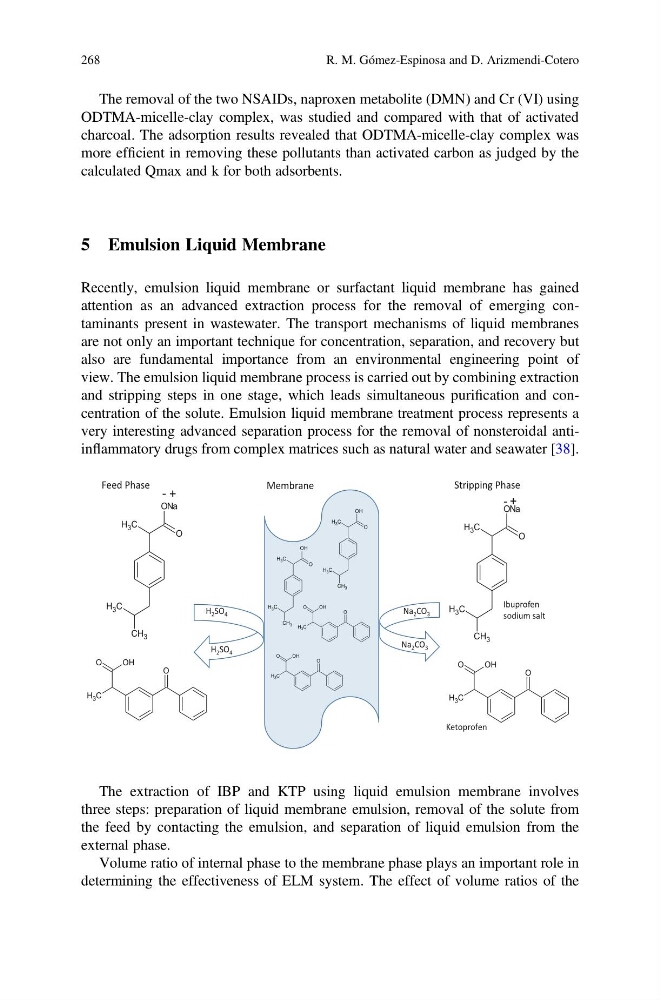
Recently, emulsion liquid membrane or surfactant liquid membrane has gained
attention as an advanced extraction process for the removal of emerging contaminants present in wastewater. The transport mechanisms of liquid membranes
are not only an important technique for concentration, separation, and recovery but
also are fundamental importance from an environmental engineering point of
view. The emulsion liquid membrane process is carried out by combining extraction
and stripping steps in one stage, which leads simultaneous purification and concentration of the solute. Emulsion liquid membrane treatment process represents a
very interesting advanced separation process for the removal of nonsteroidal antiinflammatory drugs from complex matrices such as natural water and seawater [38].
ONa
C
H 3
CH 3
C
H 3
O
- +
Ketoprofen
Ibuprofen
sodium salt
OH
C
H 3
CH 3
C
H 3
O
O
C
H3
OH
O
H 2 SO 4
H 2 SO 4
OH
C
H 3
CH 3
C
H 3
O
O
C
H3
OH
O
Na 2 CO 3
Na 2 CO 3
- +
O
C
H 3
OH
O
ONa
C
H 3
CH 3
C
H 3
O
O
C
H 3
OH
O
Stripping Phase
Feed Phase
Membrane
The extraction of IBP and KTP using liquid emulsion membrane involves
three steps: preparation of liquid membrane emulsion, removal of the solute from
the feed by contacting the emulsion, and separation of liquid emulsion from the
external phase.
Volume ratio of internal phase to the membrane phase plays an important role in
determining the effectiveness of ELM system. The effect of volume ratios of the
268
R. M. Gómez-Espinosa and D. Arizmendi-Cotero
ODTMA-micelle-clay complex, was studied and compared with that of activated
charcoal. The adsorption results revealed that ODTMA-micelle-clay complex was
more efficient in removing these pollutants than activated carbon as judged by the
calculated Qmax and k for both adsorbents.
5 Emulsion Liquid Membrane
Recently, emulsion liquid membrane or surfactant liquid membrane has gained
attention as an advanced extraction process for the removal of emerging contaminants present in wastewater. The transport mechanisms of liquid membranes
are not only an important technique for concentration, separation, and recovery but
also are fundamental importance from an environmental engineering point of
view. The emulsion liquid membrane process is carried out by combining extraction
and stripping steps in one stage, which leads simultaneous purification and concentration of the solute. Emulsion liquid membrane treatment process represents a
very interesting advanced separation process for the removal of nonsteroidal antiinflammatory drugs from complex matrices such as natural water and seawater [38].
ONa
C
H 3
CH 3
C
H 3
O
- +
Ketoprofen
Ibuprofen
sodium salt
OH
C
H 3
CH 3
C
H 3
O
O
C
H3
OH
O
H 2 SO 4
H 2 SO 4
OH
C
H 3
CH 3
C
H 3
O
O
C
H3
OH
O
Na 2 CO 3
Na 2 CO 3
- +
O
C
H 3
OH
O
ONa
C
H 3
CH 3
C
H 3
O
O
C
H 3
OH
O
Stripping Phase
Feed Phase
Membrane
The extraction of IBP and KTP using liquid emulsion membrane involves
three steps: preparation of liquid membrane emulsion, removal of the solute from
the feed by contacting the emulsion, and separation of liquid emulsion from the
external phase.
Volume ratio of internal phase to the membrane phase plays an important role in
determining the effectiveness of ELM system. The effect of volume ratios of the
268
R. M. Gómez-Espinosa and D. Arizmendi-Cotero