

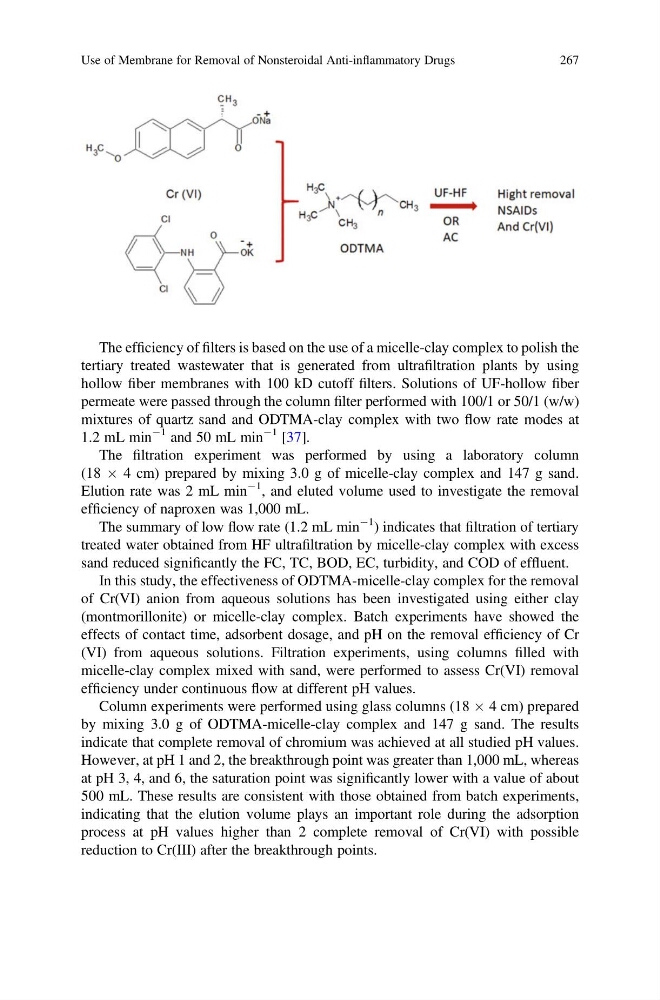
The efficiency of filters is based on the use of a micelle-clay complex to polish the
tertiary treated wastewater that is generated from ultrafiltration plants by using
hollow fiber membranes with 100 kD cutoff filters. Solutions of UF-hollow fiber
permeate were passed through the column filter performed with 100/1 or 50/1 (w/w)
mixtures of quartz sand and ODTMA-clay complex with two flow rate modes at
1.2 mL min
À1 and 50 mL min
À1 [37].
The filtration experiment was performed by using a laboratory column
(18 Â 4 cm) prepared by mixing 3.0 g of micelle-clay complex and 147 g sand.
Elution rate was 2 mL min
À1 , and eluted volume used to investigate the removal
efficiency of naproxen was 1,000 mL.
The summary of low flow rate (1.2 mL min
À1 ) indicates that filtration of tertiary
treated water obtained from HF ultrafiltration by micelle-clay complex with excess
sand reduced significantly the FC, TC, BOD, EC, turbidity, and COD of effluent.
In this study, the effectiveness of ODTMA-micelle-clay complex for the removal
of Cr(VI) anion from aqueous solutions has been investigated using either clay
(montmorillonite) or micelle-clay complex. Batch experiments have showed the
effects of contact time, adsorbent dosage, and pH on the removal efficiency of Cr
(VI) from aqueous solutions. Filtration experiments, using columns filled with
micelle-clay complex mixed with sand, were performed to assess Cr(VI) removal
efficiency under continuous flow at different pH values.
Column experiments were performed using glass columns (18 Â 4 cm) prepared
by mixing 3.0 g of ODTMA-micelle-clay complex and 147 g sand. The results
indicate that complete removal of chromium was achieved at all studied pH values.
However, at pH 1 and 2, the breakthrough point was greater than 1,000 mL, whereas
at pH 3, 4, and 6, the saturation point was significantly lower with a value of about
500 mL. These results are consistent with those obtained from batch experiments,
indicating that the elution volume plays an important role during the adsorption
process at pH values higher than 2 complete removal of Cr(VI) with possible
reduction to Cr(III) after the breakthrough points.
Use of Membrane for Removal of Nonsteroidal Anti-inflammatory Drugs
267
tertiary treated wastewater that is generated from ultrafiltration plants by using
hollow fiber membranes with 100 kD cutoff filters. Solutions of UF-hollow fiber
permeate were passed through the column filter performed with 100/1 or 50/1 (w/w)
mixtures of quartz sand and ODTMA-clay complex with two flow rate modes at
1.2 mL min
À1 and 50 mL min
À1 [37].
The filtration experiment was performed by using a laboratory column
(18 Â 4 cm) prepared by mixing 3.0 g of micelle-clay complex and 147 g sand.
Elution rate was 2 mL min
À1 , and eluted volume used to investigate the removal
efficiency of naproxen was 1,000 mL.
The summary of low flow rate (1.2 mL min
À1 ) indicates that filtration of tertiary
treated water obtained from HF ultrafiltration by micelle-clay complex with excess
sand reduced significantly the FC, TC, BOD, EC, turbidity, and COD of effluent.
In this study, the effectiveness of ODTMA-micelle-clay complex for the removal
of Cr(VI) anion from aqueous solutions has been investigated using either clay
(montmorillonite) or micelle-clay complex. Batch experiments have showed the
effects of contact time, adsorbent dosage, and pH on the removal efficiency of Cr
(VI) from aqueous solutions. Filtration experiments, using columns filled with
micelle-clay complex mixed with sand, were performed to assess Cr(VI) removal
efficiency under continuous flow at different pH values.
Column experiments were performed using glass columns (18 Â 4 cm) prepared
by mixing 3.0 g of ODTMA-micelle-clay complex and 147 g sand. The results
indicate that complete removal of chromium was achieved at all studied pH values.
However, at pH 1 and 2, the breakthrough point was greater than 1,000 mL, whereas
at pH 3, 4, and 6, the saturation point was significantly lower with a value of about
500 mL. These results are consistent with those obtained from batch experiments,
indicating that the elution volume plays an important role during the adsorption
process at pH values higher than 2 complete removal of Cr(VI) with possible
reduction to Cr(III) after the breakthrough points.
Use of Membrane for Removal of Nonsteroidal Anti-inflammatory Drugs
267