

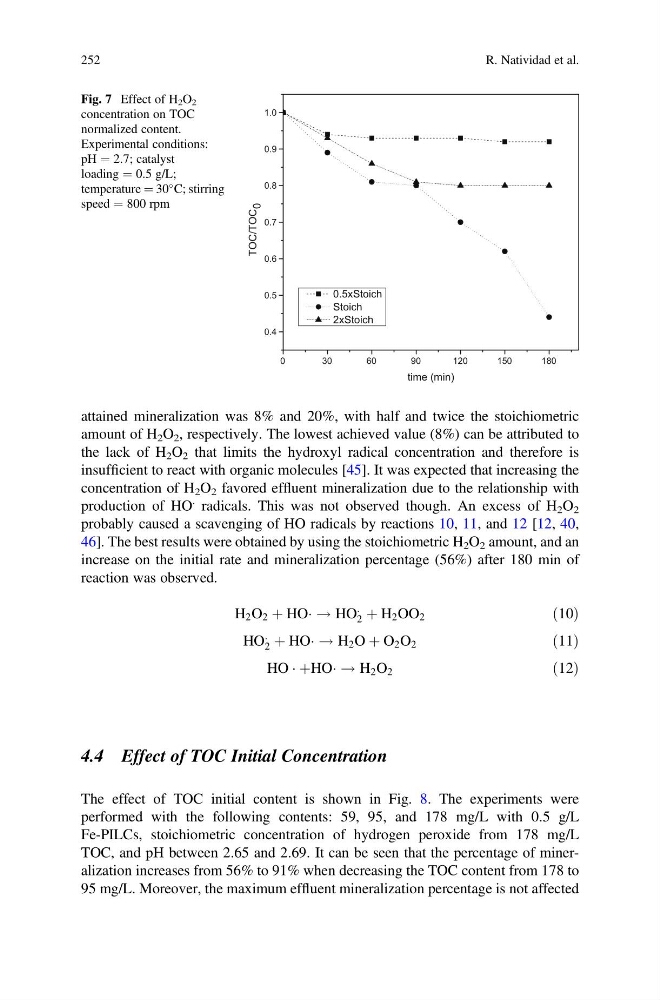
attained mineralization was 8% and 20%, with half and twice the stoichiometric
amount of H 2 O 2 , respectively. The lowest achieved value (8%) can be attributed to
the lack of H 2 O 2 that limits the hydroxyl radical concentration and therefore is
insufficient to react with organic molecules [45]. It was expected that increasing the
concentration of H 2 O 2 favored effluent mineralization due to the relationship with
production of HO
. radicals. This was not observed though. An excess of H 2 O 2
probably caused a scavenging of HO radicals by reactions 10, 11, and 12 [12, 40,
46]. The best results were obtained by using the stoichiometric H 2 O 2 amount, and an
increase on the initial rate and mineralization percentage (56%) after 180 min of
reaction was observed.
H 2 O 2 þ HOÁ ! HO
:
2 þ H 2 OO 2
ð10Þ
HO
:
2 þ HOÁ ! H 2 O þ O 2 O 2
ð11Þ
HO Á þHOÁ ! H 2 O 2
ð12Þ
4.4 Effect of TOC Initial Concentration
The effect of TOC initial content is shown in Fig. 8. The experiments were
performed with the following contents: 59, 95, and 178 mg/L with 0.5 g/L
Fe-PILCs, stoichiometric concentration of hydrogen peroxide from 178 mg/L
TOC, and pH between 2.65 and 2.69. It can be seen that the percentage of mineralization increases from 56% to 91% when decreasing the TOC content from 178 to
95 mg/L. Moreover, the maximum effluent mineralization percentage is not affected
0
30
60
90
120
150
180
0.4
0.5
0.6
0.7
0.8
0.9
1.0
C
O
T
/
C
O
T
0
time (min)
0.5xStoich
Stoich
2xStoich
Fig. 7 Effect of H 2 O 2
concentration on TOC
normalized content.
Experimental conditions:
pH ¼ 2.7; catalyst
loading ¼ 0.5 g/L;
temperature ¼ 30
C; stirring
speed ¼ 800 rpm
252
R. Natividad et al.
amount of H 2 O 2 , respectively. The lowest achieved value (8%) can be attributed to
the lack of H 2 O 2 that limits the hydroxyl radical concentration and therefore is
insufficient to react with organic molecules [45]. It was expected that increasing the
concentration of H 2 O 2 favored effluent mineralization due to the relationship with
production of HO
. radicals. This was not observed though. An excess of H 2 O 2
probably caused a scavenging of HO radicals by reactions 10, 11, and 12 [12, 40,
46]. The best results were obtained by using the stoichiometric H 2 O 2 amount, and an
increase on the initial rate and mineralization percentage (56%) after 180 min of
reaction was observed.
H 2 O 2 þ HOÁ ! HO
:
2 þ H 2 OO 2
ð10Þ
HO
:
2 þ HOÁ ! H 2 O þ O 2 O 2
ð11Þ
HO Á þHOÁ ! H 2 O 2
ð12Þ
4.4 Effect of TOC Initial Concentration
The effect of TOC initial content is shown in Fig. 8. The experiments were
performed with the following contents: 59, 95, and 178 mg/L with 0.5 g/L
Fe-PILCs, stoichiometric concentration of hydrogen peroxide from 178 mg/L
TOC, and pH between 2.65 and 2.69. It can be seen that the percentage of mineralization increases from 56% to 91% when decreasing the TOC content from 178 to
95 mg/L. Moreover, the maximum effluent mineralization percentage is not affected
0
30
60
90
120
150
180
0.4
0.5
0.6
0.7
0.8
0.9
1.0
C
O
T
/
C
O
T
0
time (min)
0.5xStoich
Stoich
2xStoich
Fig. 7 Effect of H 2 O 2
concentration on TOC
normalized content.
Experimental conditions:
pH ¼ 2.7; catalyst
loading ¼ 0.5 g/L;
temperature ¼ 30
C; stirring
speed ¼ 800 rpm
252
R. Natividad et al.