

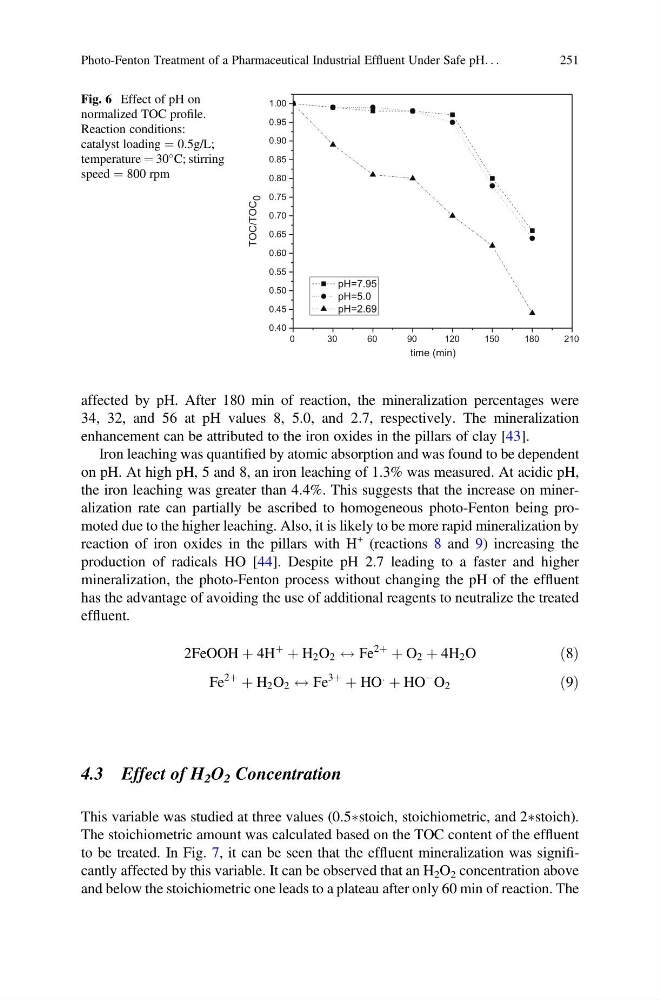
affected by pH. After 180 min of reaction, the mineralization percentages were
34, 32, and 56 at pH values 8, 5.0, and 2.7, respectively. The mineralization
enhancement can be attributed to the iron oxides in the pillars of clay [43].
Iron leaching was quantified by atomic absorption and was found to be dependent
on pH. At high pH, 5 and 8, an iron leaching of 1.3% was measured. At acidic pH,
the iron leaching was greater than 4.4%. This suggests that the increase on mineralization rate can partially be ascribed to homogeneous photo-Fenton being promoted due to the higher leaching. Also, it is likely to be more rapid mineralization by
reaction of iron oxides in the pillars with H
+ (reactions 8 and 9) increasing the
production of radicals HO [44]. Despite pH 2.7 leading to a faster and higher
mineralization, the photo-Fenton process without changing the pH of the effluent
has the advantage of avoiding the use of additional reagents to neutralize the treated
effluent.
2FeOOH þ 4H
þ
þ H 2 O 2 $ Fe
2þ
þ O 2 þ 4H 2 O
ð8Þ
Fe
2þ
þ H 2 O 2 $ Fe
3þ
þ HO
:
þ HO
À O 2
ð9Þ
4.3 Effect of H 2 O 2 Concentration
This variable was studied at three values (0.5Ãstoich, stoichiometric, and 2Ãstoich).
The stoichiometric amount was calculated based on the TOC content of the effluent
to be treated. In Fig. 7, it can be seen that the effluent mineralization was significantly affected by this variable. It can be observed that an H 2 O 2 concentration above
and below the stoichiometric one leads to a plateau after only 60 min of reaction. The
0
30
60
90
120
150
180
210
0.40
0.45
0.50
0.55
0.60
0.65
0.70
0.75
0.80
0.85
0.90
0.95
1.00
pH=7.95
pH=5.0
pH=2.69
C
O
T
/
C
O
T
0
time (min)
Fig. 6 Effect of pH on
normalized TOC profile.
Reaction conditions:
catalyst loading ¼ 0.5g/L;
temperature ¼ 30
C; stirring
speed ¼ 800 rpm
Photo-Fenton Treatment of a Pharmaceutical Industrial Effluent Under Safe pH. . .
251
34, 32, and 56 at pH values 8, 5.0, and 2.7, respectively. The mineralization
enhancement can be attributed to the iron oxides in the pillars of clay [43].
Iron leaching was quantified by atomic absorption and was found to be dependent
on pH. At high pH, 5 and 8, an iron leaching of 1.3% was measured. At acidic pH,
the iron leaching was greater than 4.4%. This suggests that the increase on mineralization rate can partially be ascribed to homogeneous photo-Fenton being promoted due to the higher leaching. Also, it is likely to be more rapid mineralization by
reaction of iron oxides in the pillars with H
+ (reactions 8 and 9) increasing the
production of radicals HO [44]. Despite pH 2.7 leading to a faster and higher
mineralization, the photo-Fenton process without changing the pH of the effluent
has the advantage of avoiding the use of additional reagents to neutralize the treated
effluent.
2FeOOH þ 4H
þ
þ H 2 O 2 $ Fe
2þ
þ O 2 þ 4H 2 O
ð8Þ
Fe
2þ
þ H 2 O 2 $ Fe
3þ
þ HO
:
þ HO
À O 2
ð9Þ
4.3 Effect of H 2 O 2 Concentration
This variable was studied at three values (0.5Ãstoich, stoichiometric, and 2Ãstoich).
The stoichiometric amount was calculated based on the TOC content of the effluent
to be treated. In Fig. 7, it can be seen that the effluent mineralization was significantly affected by this variable. It can be observed that an H 2 O 2 concentration above
and below the stoichiometric one leads to a plateau after only 60 min of reaction. The
0
30
60
90
120
150
180
210
0.40
0.45
0.50
0.55
0.60
0.65
0.70
0.75
0.80
0.85
0.90
0.95
1.00
pH=7.95
pH=5.0
pH=2.69
C
O
T
/
C
O
T
0
time (min)
Fig. 6 Effect of pH on
normalized TOC profile.
Reaction conditions:
catalyst loading ¼ 0.5g/L;
temperature ¼ 30
C; stirring
speed ¼ 800 rpm
Photo-Fenton Treatment of a Pharmaceutical Industrial Effluent Under Safe pH. . .
251